|
Before the Investment Committee
The Hidden Enterprise Value Risk Emerging Now
This week's developments underscore a common theme across industries and transactions: understanding which drivers of performance are truly structural. Whether examining healthcare cost inflation, acquisition outcomes, or resilience to energy volatility, long-term value increasingly depends on identifying the factors that matter most beneath the surface.
|
|
Our latest survey with Healthcare150 suggests rising healthcare costs are being driven by a combination of labor, input, supply chain, regulatory, and technology pressures rather than any single factor. The findings reinforce the growing importance of multifaceted operational strategies in addressing complex industry challenges.
The failure of Quaker Oats' acquisition of Snapple offers a parallel lesson in diligence. By treating Snapple's independent distribution network as an inefficiency rather than a competitive advantage, Quaker undermined a core driver of the company's success. The case serves as a reminder that value creation often depends as much on preserving key assets as integrating them.
Meanwhile, renewed focus on energy markets highlights the importance of pricing power. As costs fluctuate, a company's ability to pass through increases to customers can significantly influence margin durability and enterprise value, making stress-testing pricing resilience an increasingly important diligence exercise.
Exact Insight surfaces these patterns early—directly from operator conversations—before they show up in CIMs or IC memos.
Access the Full Briefing
|
|
|
Insights From the Network
Healthcare Cost Pressures Remain Broad-Based
In partnership with Healthcare150, we recently surveyed 211 healthcare leaders, investors, operators, and advisors to understand the single biggest driver of cost increases across the industry. The results point to an important conclusion: there is no single culprit.
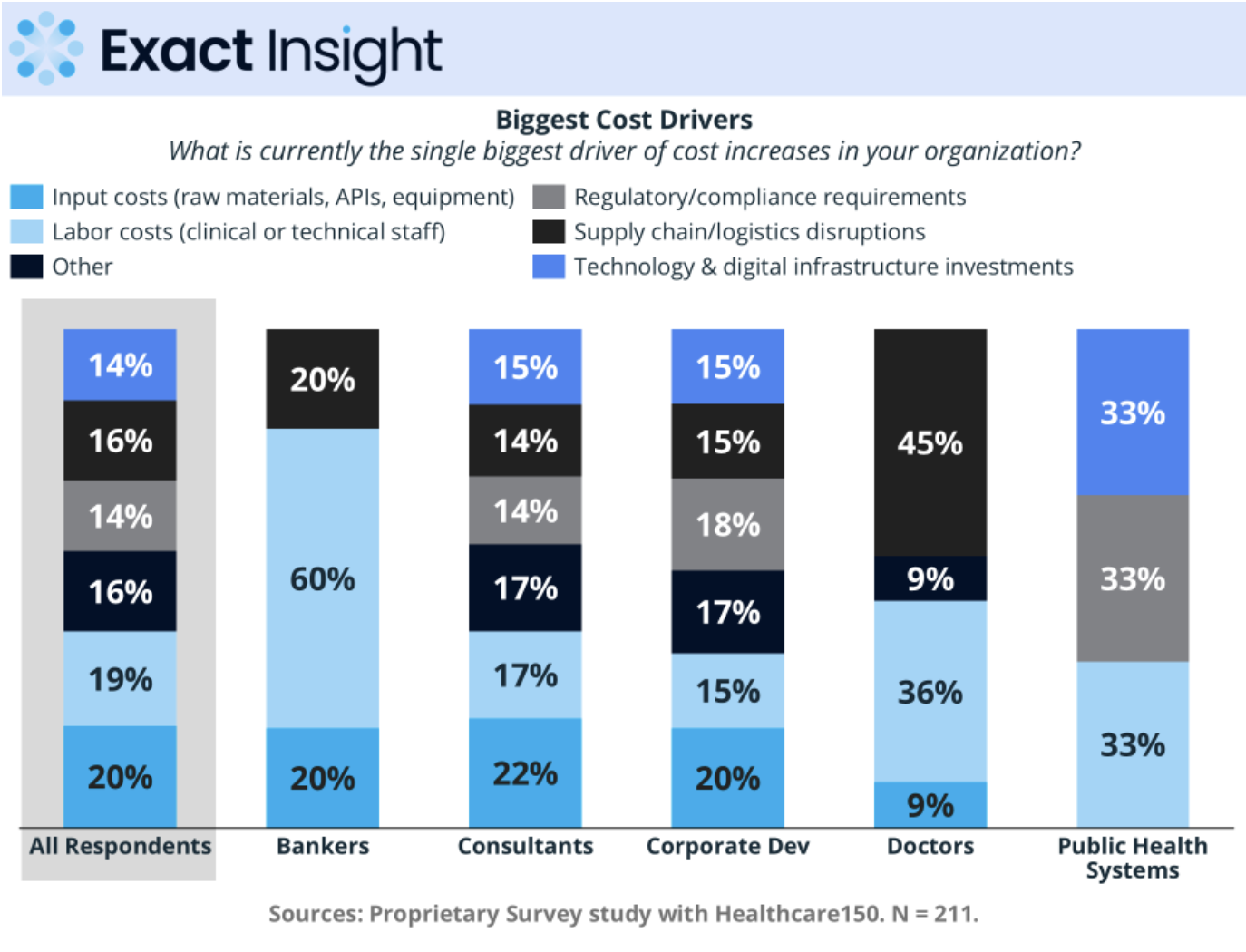
While input costs (20%) and labor costs (19%) emerged as the leading pressures overall, responses were remarkably distributed across categories, with supply chain disruptions (16%), regulatory requirements (14%), technology investments (14%), and other factors (16%) all playing meaningful roles. The data suggests that healthcare cost inflation is being driven by a combination of structural and operational forces rather than one dominant issue.
The picture becomes even more nuanced by stakeholder group. Doctors identified supply chain disruptions (45%) and labor costs (36%) as their primary challenges, reflecting ongoing frontline operational strain. Bankers, meanwhile, overwhelmingly pointed to labor costs (60%), highlighting continued concerns around workforce economics and margin pressure. Consultants and corporate development leaders—who represented the majority of respondents—reported a far more balanced distribution of cost drivers, reinforcing the view that cost pressures are systemic and multifaceted.
For investors and operators alike, the takeaway is clear: addressing healthcare costs will require multiple levers, not a single silver bullet.
Read the Full Article
|
|
|
Deal Autopsy: Lessons from the Field
Quaker Oats–Snapple: When Distribution Is the Business
In January 1994, Quaker Oats acquired Snapple for approximately $1.7 billion. The acquisition was widely viewed as a natural extension of Quaker's success with Gatorade, which had become one of the most successful beverage brands in the United States. But this acquisition was one of the 15 biggest M&A failures of all time.
The strategic rationale appeared compelling. Quaker possessed world-class consumer marketing capabilities, strong retail relationships, and a proven track record of building beverage brands. Snapple brought a fast-growing portfolio of teas, juices, and flavored drinks that had developed a loyal following and strong brand recognition throughout the early 1990s.
Management believed Quaker could replicate its Gatorade playbook: leverage its scale, improve distribution efficiency, and accelerate growth. Instead, the acquisition became one of the most expensive value-destruction events in consumer products history.
The core problem was that Quaker misunderstood what made Snapple successful. Unlike Gatorade, which relied heavily on grocery and mass-market channels, Snapple's growth had been built through thousands of independent distributors serving convenience stores, gas stations, delis, and small retailers. These local distributors were not merely a logistics network—they were a critical component of the brand's market presence and customer relationships.
Following the acquisition, Quaker attempted to integrate Snapple into its existing distribution system and corporate operating model. The transition disrupted key distributor relationships, weakened shelf presence in core channels, and diluted the quirky, entrepreneurial brand identity that had differentiated Snapple from larger competitors.
At the same time, competition intensified. Coca-Cola and Pepsi aggressively entered the fast-growing ready-to-drink beverage category, putting additional pressure on a brand already struggling through a difficult integration.
Sales declined rapidly. By 1997, less than three years after the acquisition, Quaker sold Snapple for roughly $300 million—representing a loss of approximately $1.4 billion on the transaction.
Key diligence gaps
- Failure to identify that Snapple's independent distribution network was a strategic asset rather than an inefficiency to be optimized
- Overreliance on prior success with Gatorade and the assumption that the same operating model would apply
- Insufficient commercial diligence on channel dynamics and customer purchasing behavior
- Underestimation of the integration risk associated with changing distribution and brand management simultaneously
- Lack of a preservation strategy for the entrepreneurial culture that drove Snapple's market success
Key lesson learned: Not every synergy should be captured. Acquirers often assume that integrating a target into existing systems automatically creates value. In reality, some businesses derive their advantage from operating differently. Effective diligence requires identifying which elements can be integrated and which must be preserved. In Snapple's case, the distribution model was not a cost to be eliminated—it was the source of the company's competitive advantage.
Read More
|
|
|
Pre-Deal Intelligence
Energy Cost Exposure: The Hidden Enterprise Value Sensitivity
Recent geopolitical tensions have renewed focus on a frequently overlooked diligence question: how much of an energy cost shock can a company actually pass through to customers?
For producers operating in competitive, demand-elastic markets, the answer can have a disproportionate impact on enterprise value. While management teams often emphasize historical margin resilience, sponsors should focus on the structural pricing power embedded within the business model. When energy costs rise sharply, companies with limited pass-through capability typically absorb the increase through EBITDA compression, while stronger operators preserve profitability through pricing actions.
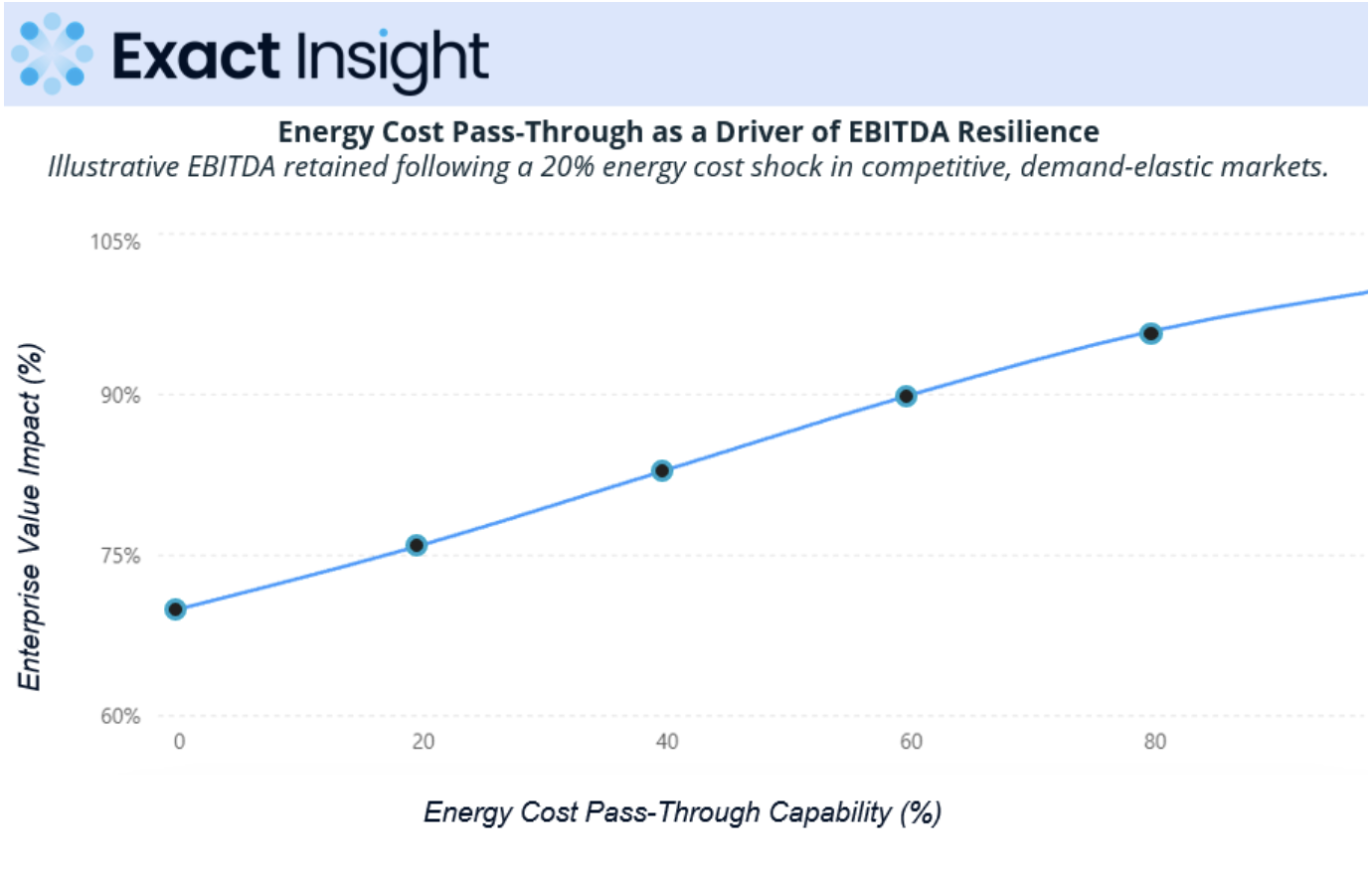
The implication for diligence is significant. Two businesses with identical margins today may exhibit dramatically different value trajectories under the same energy shock scenario. A company capable of passing through 70–80% of incremental energy costs may experience only modest EBITDA erosion, whereas a competitor with 20–30% pass-through capability can suffer substantial margin deterioration and valuation pressure.
As a result, energy-cost sensitivity analysis should increasingly be treated as a core value-creation and risk-assessment exercise. Sponsors should evaluate customer concentration, contractual pricing mechanisms, competitive intensity, product substitutability, and historical pricing behavior to determine true pass-through potential.
In periods of energy volatility, pricing power is often the difference between a temporary earnings headwind and a material enterprise value event.
|
|
|
Interesting Articles
Worth Your Time
|
|
|