|
Before the Investment Committee
The Market Expects Cuts. Diligence Still Wins.
This week's insights highlight a common challenge in investing: distinguishing expectation from reality. Whether forecasting interest rates, evaluating acquisition opportunities, or assessing market potential, successful investing depends on testing assumptions rather than accepting them at face value.
|
|
Our latest survey with PE150 reveals that most private market professionals expect lower U.S. interest rates by year-end, reflecting growing optimism around financing conditions and deal activity. The failed Microsoft–Nokia acquisition serves as a reminder that even compelling strategic logic cannot overcome unfavorable industry dynamics. Meanwhile, our examination of Total Addressable Market (TAM) challenges one of the most persistent diligence myths: a larger market does not necessarily translate into a better investment if a company lacks the ability to capture it profitably.
Across all three topics, the lesson is consistent: markets, narratives, and headline metrics provide context—but disciplined diligence requires looking beyond them to understand the underlying drivers of long-term value creation.
Exact Insight surfaces these patterns early—directly from operator conversations—before they show up in CIMs or IC memos.
Access the Full Briefing
|
|
|
Insights From the Network
Rate Expectations Reveal a Market Positioning for Easing
As part of our ongoing collaboration with PE150, we recently conducted a proprietary microsurvey of 221 private market professionals to understand where investors expect the U.S. Federal Funds Rate to finish the year. While opinions remain divided, one message is clear: most respondents anticipate further monetary easing rather than higher rates.
Across all respondents, 56% expect the Federal Funds Rate to end below 5%, including 16% who anticipate rates below 3%. Only 22% believe rates will remain at 6% or higher, suggesting that investors broadly expect the Federal Reserve to continue its easing cycle over the coming months.
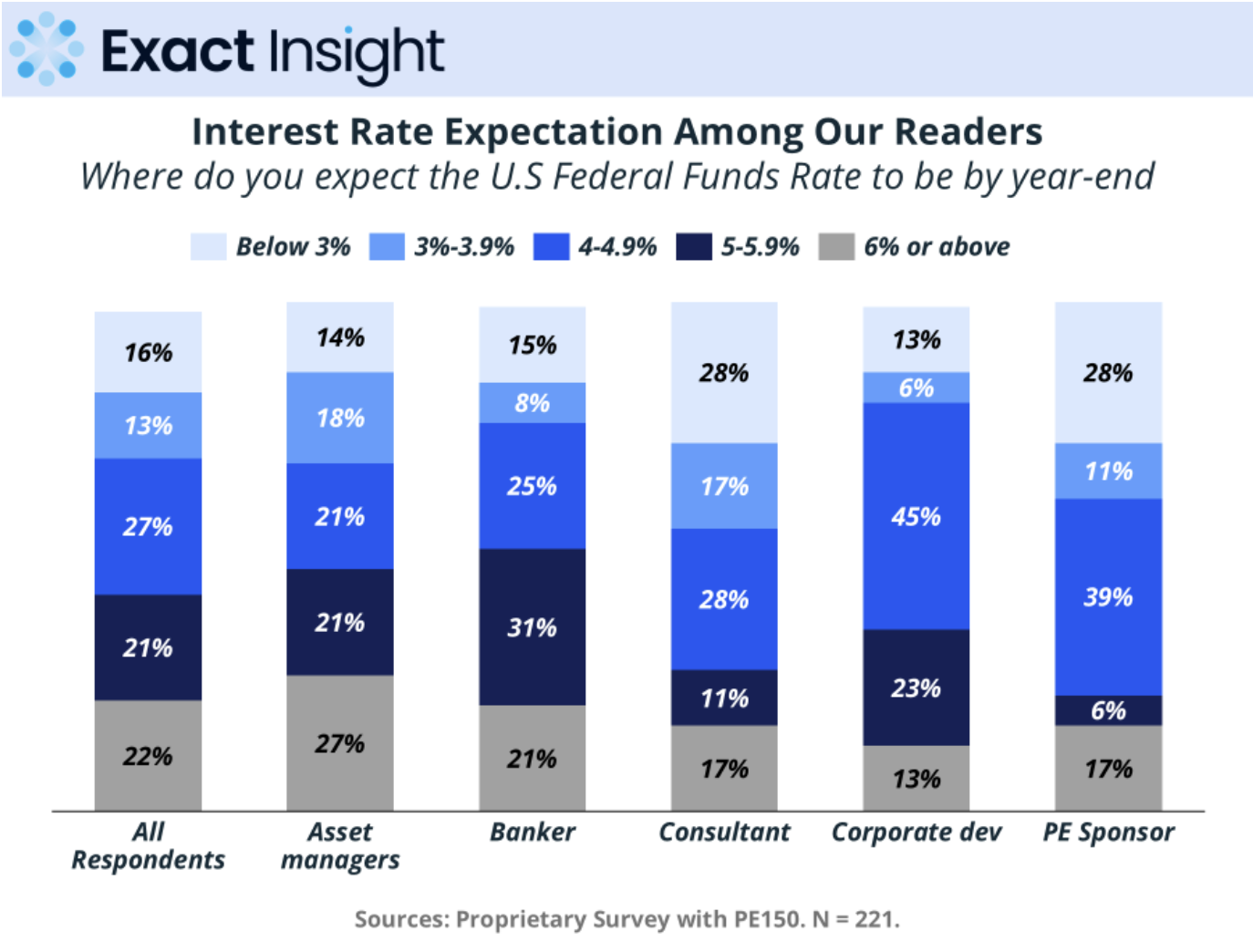
Expectations vary meaningfully by role. Corporate development professionals expressed the most dovish outlook, with 58% expecting rates between 4% and 4.9% or lower, while PE sponsors were similarly optimistic, as 67% forecast rates below 5%, including 28% expecting rates below 3%. Lower financing costs would improve acquisition economics, support refinancing activity, and potentially stimulate dealmaking.
Bankers, however, were the most cautious. 31% expect rates to remain between 5% and 5.9%, the highest share among all groups, reflecting greater skepticism that inflation will moderate quickly enough to justify aggressive cuts.
For investors, interest rate expectations extend beyond macro forecasts—they directly influence valuation models, financing assumptions, and capital deployment strategies. Whether these expectations ultimately prove correct or not, the survey highlights that much of the private market is already positioning portfolios for a lower-rate environment.
Read the Full Article
|
|
|
Deal Autopsy: Lessons from the Field
Microsoft–Nokia: When You Buy Yesterday's Market
In September 2013, Microsoft announced the acquisition of Nokia's Devices & Services business for approximately $7.2 billion, aiming to establish itself as a fully integrated competitor to Apple and Google in the rapidly evolving smartphone market.
The strategic rationale was compelling. Microsoft owned the Windows Phone operating system, while Nokia remained one of the world's most recognized handset manufacturers. By combining hardware and software under one company, Microsoft hoped to replicate Apple's successful ecosystem and regain relevance in mobile computing.
The problem was timing.
By the time the transaction closed, the smartphone market had largely consolidated around iOS and Android. Developers were prioritizing those ecosystems, consumers had already committed to competing platforms, and application availability had become a decisive competitive advantage. Even with strong engineering and global distribution, Microsoft struggled to attract both developers and users, leaving Windows Phone unable to achieve the scale required to compete.
Less than two years after closing the acquisition, Microsoft wrote down $7.6 billion, effectively acknowledging that the investment thesis had failed.
Key diligence gaps
- Overestimating the ability to reverse structural market trends.
- Underestimating the power of ecosystem and network effects.
- Assuming capital and execution could overcome declining market relevance.
- Insufficient assessment of long-term competitive positioning.
Key lesson learned: Great execution cannot overcome a structurally unfavorable market. Effective commercial diligence should evaluate not only a company's current performance, but also whether industry dynamics leave room for sustainable competitive advantage. Sometimes the greatest risk isn't buying a bad company—it's buying into a market that has already chosen its winners.
Read More
|
|
|
Pre-Deal Intelligence
Why a Bigger TAM Doesn't Always Mean a Better Investment
One of the most common assumptions in commercial diligence is that the larger the Total Addressable Market (TAM), the more attractive the investment. While a large market can create opportunity, it does not guarantee that a company can successfully capture it—or generate attractive returns.
TAM measures the theoretical revenue opportunity if every potential customer purchased a company's product or service. But in practice, businesses rarely compete for the entire market. Geographic limitations, customer segments, competitive intensity, regulatory barriers, pricing constraints, and product-market fit all reduce the portion of the market that is realistically accessible.
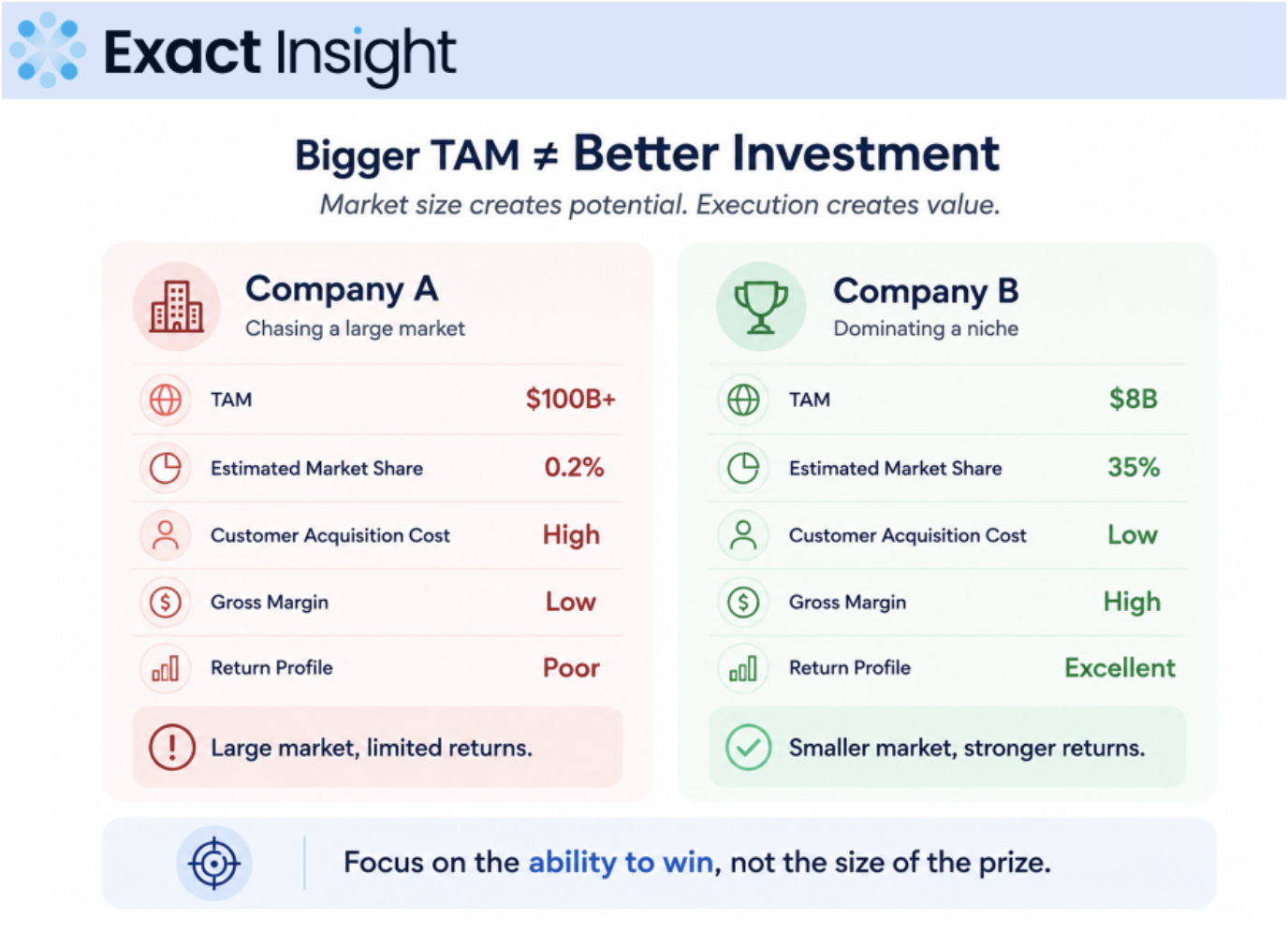
For investors, the more important question is not "How big is the market?" but "How much of the market can this business actually win?" A company operating in a smaller niche with strong competitive advantages, high switching costs, and pricing power can often generate superior returns compared to one pursuing a massive but highly fragmented or saturated market.
The most valuable diligence therefore focuses beyond headline TAM figures. Investors should assess the Serviceable Addressable Market (SAM), the Serviceable Obtainable Market (SOM), customer acquisition economics, competitive positioning, and evidence that management has consistently expanded market share.
A large TAM creates potential. Sustainable value comes from a company's ability to capture that opportunity profitably. In commercial diligence, execution almost always matters more than market size.
Read More
|
|
|
Interesting Articles
Worth Your Time
|
|
|