|
OPERATOR SIGNAL
|
|
BEFORE THE INVESTMENT COMMITTEE
|
Selective Capital. Smarter Expansion. Stronger Diligence.
This week's insights examine a defining characteristic of today's private equity environment: not every opportunity deserves capital, and not every growth strategy deserves underwriting. Successful investors distinguish between opportunities that appear attractive and those whose underlying assumptions have been rigorously validated.
|
|
Hi there,
Our latest proprietary survey conducted in partnership with PE150 shows that financing markets are gradually reopening, but optimism remains highly selective. While private equity sponsors increasingly expect improved credit availability, the broader market continues to recognize that capital is flowing disproportionately toward businesses with resilient fundamentals and compelling investment theses. We complement these findings with a practical framework for evaluating international expansion readiness, highlighting the commercial, competitive, regulatory, cultural, and operational factors investors should validate before underwriting cross-border growth. Finally, our review of Uber's expansion into China demonstrates how even globally dominant companies can struggle when local competitive advantages, regulatory dynamics, and customer behavior are underestimated.
Across all three topics, the message is consistent: the quality of an investment depends less on the attractiveness of the opportunity than on the rigor with which its assumptions are challenged.
The strongest investments are rarely those with the most ambitious growth stories, but those whose path to value creation has been tested, validated, and proven achievable.
Exact Insight surfaces these patterns early.directly from operator conversations.before they show up in CIMs or IC memos.
Access the full briefing or request expert calls in this sector to go deeper.
|
|
|
|
INSIGHTS FROM THE NETWORK
Financing Markets Are Reopening, But Selectively
Credit availability depends heavily on which businesses are asking. In a proprietary survey conducted in partnership with PE150 (N = 68), we found that while overall sentiment has become more constructive, financing conditions remain tightly coupled to underlying business quality and capital structure discipline.
Across all respondents, 39% expect financing conditions to improve, including 24% forecasting significant improvement. However, optimism is far from universal, with 39% expecting conditions to either worsen or remain challenging and another 24% believing financing markets will remain largely unchanged, underscoring that uncertainty around lender behavior, leverage tolerance, and capital costs continues to shape underwriting decisions.
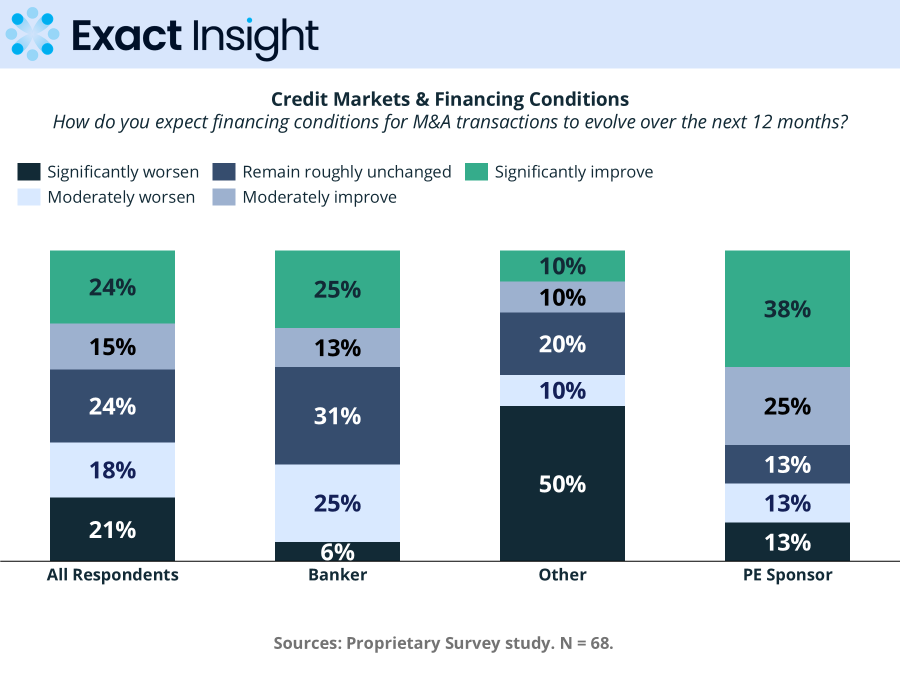
The strongest optimism comes from private equity sponsors, where 63% expect financing conditions to improve, including 38% anticipating significant improvement. Bankers, by contrast, remain considerably more balanced. While 38% foresee improving markets, an equal share expect either deterioration or no meaningful change, reflecting continued discipline among lenders despite improving liquidity.
The message is clear: credit markets are reopening, but access to capital remains highly selective. High-quality businesses with resilient cash flows, defensive end markets, and credible value creation plans are increasingly benefiting from stronger lender competition. Lower-quality assets, however, continue to face tighter leverage, higher financing costs, and more conservative underwriting. For private equity investors, financing is once again becoming a source of competitive advantage rather than a commodity.
|
|
|
|
PRE-DEAL INTELLIGENCE
Can This Business Travel? (Part 2)
One of the most common value creation assumptions in private equity is that a successful domestic business can simply be replicated across international markets. Yet some of the industry's most disappointing investments have stemmed from assuming that a winning business model is universally transferable. In reality, geographic expansion introduces an entirely new set of commercial, operational, regulatory, and cultural risks that can fundamentally alter the investment thesis.
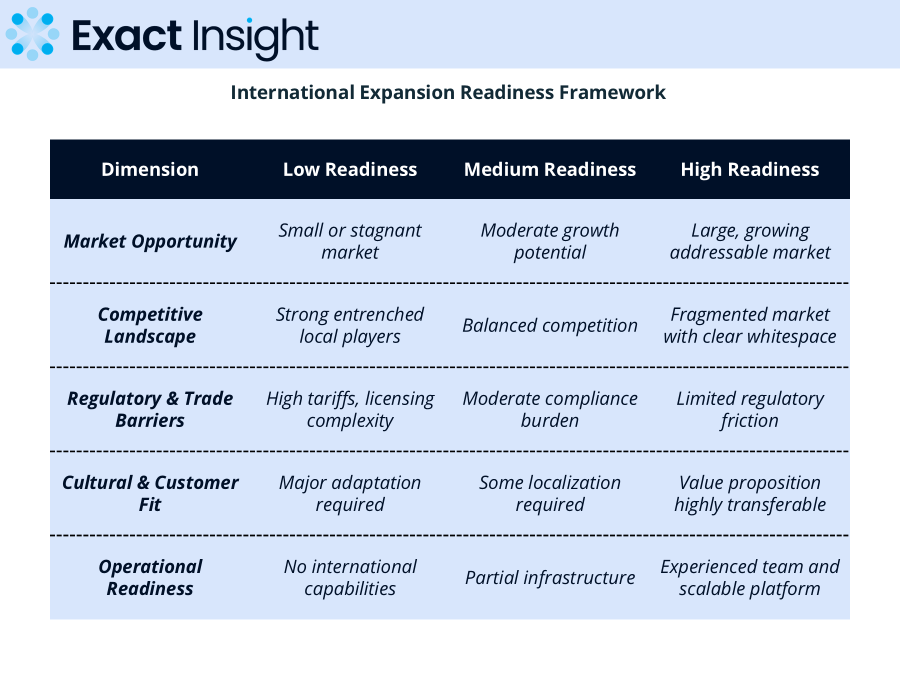
Before underwriting international growth, investors should pressure-test five critical dimensions. Market attractiveness asks whether the target country offers sufficient demand, purchasing power, and long-term growth to justify expansion. Competitive intensity evaluates whether entrenched local champions, customer loyalty, or alternative business models reduce the newcomer's ability to gain share. Regulatory and trade barriers determine how licensing requirements, tariffs, labor laws, or data regulations may increase execution risk. Cultural and customer fit examines whether consumer preferences, purchasing behavior, and pricing expectations align with the existing value proposition. Finally, operational readiness assesses whether management possesses the capabilities, local talent, supply chain, and organizational bandwidth required to execute internationally.
Many companies fail abroad not because they have poor products, but because their competitive advantages were built around conditions unique to their home market. Commercial diligence should therefore evaluate whether the company's value proposition is genuinely transferable or largely location-specific. International expansion should never be treated as an automatic source of upside. It is an investment hypothesis that deserves the same level of validation as revenue growth, margin expansion, or customer retention.
|
|
|
|
LESSONS FROM THE FIELD
Uber in China: Global Scale Couldn't Beat Local Advantage
Uber entered China in 2014 expecting that its globally successful ride-hailing model could be replicated in the world's largest mobility market. Instead, it encountered a competitor that understood the local ecosystem far better. DiDi Chuxing had already established dominant network effects, deep relationships with regulators, strong integrations with local digital platforms such as WeChat and Alipay, and a nuanced understanding of Chinese consumer behavior.
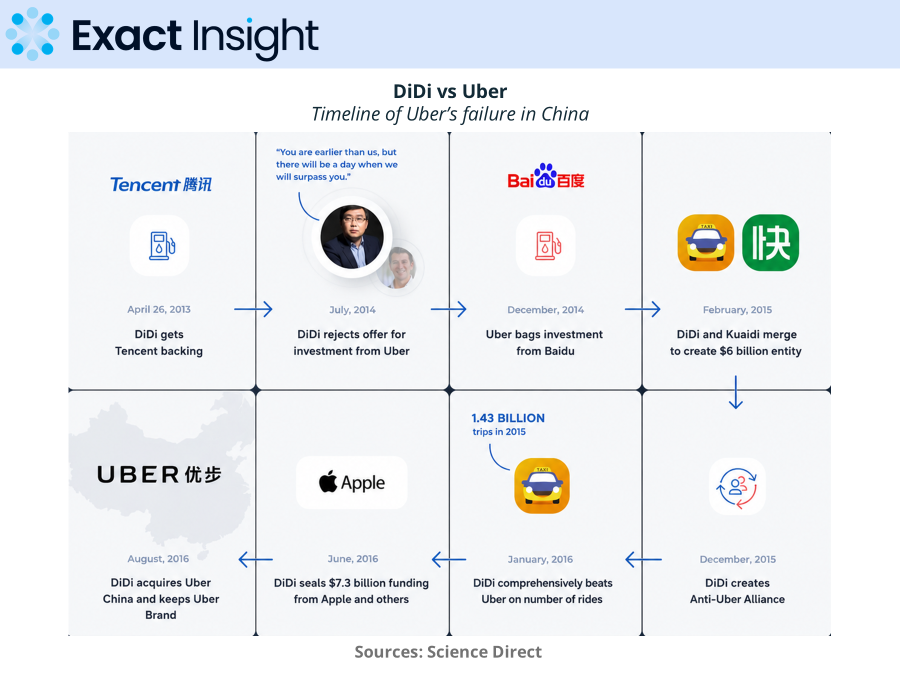
Uber spent billions of dollars subsidizing drivers and riders in an attempt to gain market share, but scale alone was insufficient to overcome these structural local advantages. After an expensive two-year battle, Uber sold its China operations to DiDi in 2016 in exchange for an equity stake, effectively exiting one of its most strategically important international markets.
| |
Key diligence lesson: International expansion requires more than a successful business model. Investors must determine whether competitive advantages are transferable across markets or whether they depend on local relationships, regulatory familiarity, customer behavior, and ecosystem positioning. When local incumbents possess structural advantages that cannot easily be replicated, even world-class companies can find themselves competing on unfavorable terms. That distinction can fundamentally reshape an investment thesis.
|
Sources:
Science Direct
Business Insider
|
|
|
|
INTERESTING ARTICLES
Worth Your Time
M&A Trends Report. Deloitte
What Are the Most Common Mistakes When Expanding Internationally? AEX US
5 AI-Powered Due Diligence Strategies Every PE Firm Should Know. Analytics Insight
AI Credentials Increase in M&A Popularity as Companies Look to Strengthen Defensibility. Consultancy.uk
|
|
Operator Signal . by Exact Insight
Exact Insight . 170 Mason Street . Greenwich, Connecticut 06830 . United States
You're receiving this because you subscribed to Operator Signal.
|
|