|
OPERATOR SIGNAL
|
|
BEFORE THE INVESTMENT COMMITTEE
|
Growth Today. Risk Tomorrow. Diligence Before Both.
This week's insights examine a challenge that sits at the heart of private equity underwriting: strong performance today does not necessarily mean durable performance tomorrow. From recession expectations to growth assumptions and structural market decline, investors must distinguish between businesses that can compound through changing conditions and those whose apparent strength may be masking risks beneath the surface.
|
|
Hi there,
Our latest proprietary survey conducted in partnership with PE150 shows that recession risk remains firmly on the radar, but investors are far from positioning for crisis. Most respondents assign meaningful probability to a U.S. recession over the next 18 months, while PE sponsors emerge as notably more optimistic than other market participants. We complement these findings with a practical framework for evaluating growth in structurally fading markets, asking investors to separate company-level outperformance from the trajectory of the underlying industry and determine how long share gains, pricing, and consolidation can realistically offset market decline. Finally, our review of Yellow Pages Group New Zealand shows what can happen when investors acquire an exceptionally profitable business without adequately accounting for technological substitution and the deterioration of its core market.
Across all three topics, the message is consistent: underwriting today's numbers is not enough.investors must understand what will sustain them tomorrow.
The strongest diligence does not simply ask how much a business can grow. It asks how long that growth can last, what must be true for it to continue, and what happens when those assumptions begin to fade.
Exact Insight surfaces these patterns early.directly from operator conversations.before they show up in CIMs or IC memos.
Access the full briefing or request expert calls in this sector to go deeper.
|
|
|
|
INSIGHTS FROM THE NETWORK
Recession Risk Is Back on the Radar.But Not at Crisis Levels
Private market professionals are increasingly pricing recession risk into their outlook.but few appear to be preparing for a severe downturn. In our latest survey conducted in partnership with PE150 (N = 184), 66% of respondents assign a greater than 25% probability to a U.S. recession over the next 18 months. The largest group, 38%, puts the odds between 26% and 50%, while 28% see the probability above 50%. The picture is one of elevated caution rather than outright pessimism.
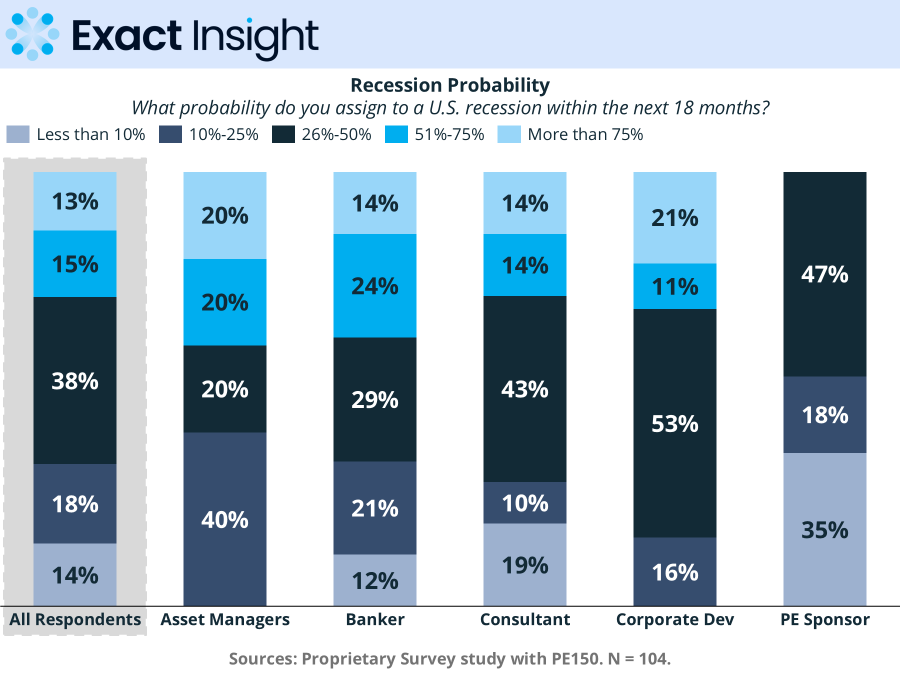
The differences across market participants are particularly revealing. Corporate development professionals are the most cautious, with 64% placing recession odds above 25%. Consultants are similarly defensive, with 43% assigning a 26%.50% probability.
PE sponsors stand out at the other end of the spectrum. Thirty-five percent see recession odds below 10%, while none place the probability above 50%. That relative confidence could reflect greater conviction in portfolio resilience.or a recognition that weaker economic conditions can create attractive entry points for well-capitalized sponsors.
The takeaway: recession risk is firmly embedded in underwriting, but the market is not positioned for crisis. For dealmakers, that likely means continued discipline around leverage, valuations, downside cases, and deployment.without abandoning the hunt for opportunities.
|
|
|
|
PRE-DEAL INTELLIGENCE
Is This Business Growing.or Just Dying More Slowly.
One of the easiest assumptions to make in commercial diligence is that a business with a history of growth can continue growing under new ownership. But for companies operating in markets exposed to technological substitution, changing customer behavior, or product obsolescence, historical growth can disguise a more fundamental risk: the market itself may be fading.
Before underwriting growth, investors should separate company-level performance from market-level trajectory. A company can gain share, raise prices, or consolidate weaker competitors while its underlying addressable market continues to shrink. That can produce attractive revenue growth for several years.but it does not necessarily make the business a durable compounder. Diligence should therefore test the expected rate of market decline, adoption curves for substitutes, customer replacement cycles, cohort behavior, and how much future growth depends on taking share from competitors that are themselves disappearing.
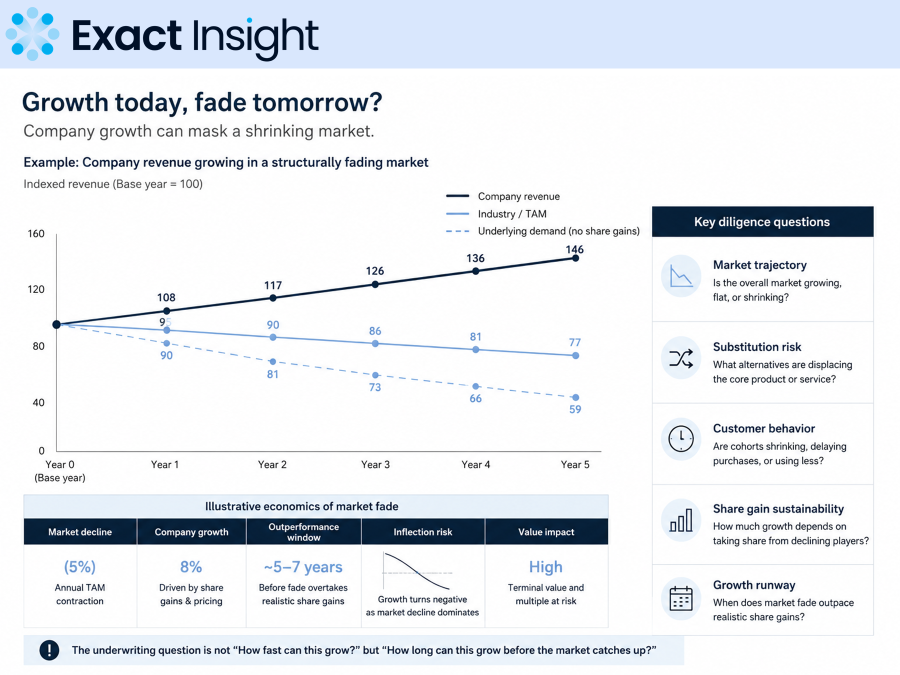
The critical question is when company growth stops outrunning market fade. If the addressable market is contracting 5% annually, a business growing 8% through share gains may look healthy today.but maintaining that trajectory requires increasingly aggressive penetration just to offset the shrinking opportunity set. Investors should model the point at which share gains become mathematically or commercially unrealistic and stress-test whether pricing, adjacent products, or new customer segments can genuinely extend the growth runway.
For businesses facing structural decline, the underwriting question is not simply "How fast can this grow." It is "How long can this business keep growing before the market catches up with it." That distinction can determine whether investors are buying a durable growth platform.or paying a growth multiple for a business with an expiration date.
|
|
|
|
LESSONS FROM THE FIELD
When a Cash Cow Has an Expiration Date
In 2007, Unitas Capital and Ontario Teachers' Pension Plan acquired New Zealand's Yellow Pages Group for NZ$2.24 billion, paying roughly 13.14x EBITDA for what appeared to be an extraordinarily attractive cash-generating business. The deal was financed with approximately NZ$1.5 billion of debt.
The problem was not that Yellow Pages suddenly became a bad business. It was that its underlying market was disappearing.
As consumers shifted searches online and advertisers followed them, print-directory economics deteriorated. Yellow Pages still generated substantial earnings, but those earnings were now declining precisely when the leveraged investment required continued growth. By 2010, EBITDA was forecast to fall from roughly NZ$157 million to NZ$133 million, while debt had climbed above NZ$1.7 billion.
By 2011, lenders took control. NZ$1.05 billion of debt was written off, the business was valued at just NZ$750 million, and the sponsors' equity was wiped out.less than four years after the acquisition.
| |
The diligence lesson is powerful: current profitability is not the same as durability. For businesses exposed to technological substitution, investors must underwrite not only company growth, but the rate at which the underlying market is fading.
|
A great business today can still be a terrible investment if tomorrow's market is disappearing.
Read More
Interest.co.nz. What does Telstra's Sensis sale mean for banks holding debt and shares in NZ's Yellow Pages.
|
|
|
|
INTERESTING ARTICLES
Worth Your Time
Q2 2026 Pulse of Private Equity. KPMG
How AI Is Reshaping Private Equity Value Creation. Private Markets Profile
Technology Diligence Is Broken. What Private Equity Firms Miss Before the Deal and Pay for Later. National CIO Review
|
|
Operator Signal · by Exact Insight
Exact Insight · [CALLE Y NUMERO] · [CIUDAD, ESTADO, CODIGO POSTAL] · [PAIS]
You're receiving this because you subscribed to Operator Signal.
|
|