|
OPERATOR SIGNAL
|
|
BEFORE THE INVESTMENT COMMITTEE
|
What Happens to Revenue When the Founder Leaves?
This week's insights explore a question that sits at the center of both investing and value creation: where does durable enterprise value actually come from? Whether identifying the next major healthcare technology platform, evaluating a founder-led business, or learning from an acquisition that failed to preserve what made the target successful, investors must distinguish between value that belongs to the company and value that depends on conditions.or people.that may not survive a transaction.
|
|
Hi there,
Our latest proprietary survey conducted in partnership with Healthcare150 shows that healthcare investors increasingly believe the next $10B digital health company will be built around intelligence rather than access, with 54% selecting Clinical Decision Support as the most likely category to produce the next major platform. We complement these findings with a practical framework for evaluating founder dependency, asking investors to determine how much revenue, customer loyalty, institutional knowledge, and decision-making authority truly exists independently of the founder. Finally, our review of Quaker Oats' $1.7 billion acquisition of Snapple demonstrates what can happen when an acquirer underestimates the informal relationships, distribution networks, and operating capabilities underpinning a target's historical success.
Across all three topics, the message is consistent: strong businesses create value that can endure beyond the individuals, systems, and market conditions that produced today's results.
The strongest diligence does not simply identify what makes a company successful today. It determines whether those advantages are institutionalized, transferable, and durable enough to remain after ownership changes.
Exact Insight surfaces these patterns early.directly from operator conversations.before they show up in CIMs or IC memos.
Access the full briefing or request expert calls in this sector to go deeper.
|
|
|
|
INSIGHTS FROM THE NETWORK
Healthcare's Next $10B Winner May Be Built on Intelligence
The next category-defining digital health company may not be focused on expanding access to care. Instead, healthcare investors are looking toward technologies that make the care itself smarter.
In our latest proprietary survey conducted in partnership with Healthcare150, 54% of 162 healthcare investors identified Clinical Decision Support (CDS) as the digital health category most likely to produce the next $10B company. That compares with 30% for Virtual Care Platforms and just 16% for Remote Patient Monitoring.
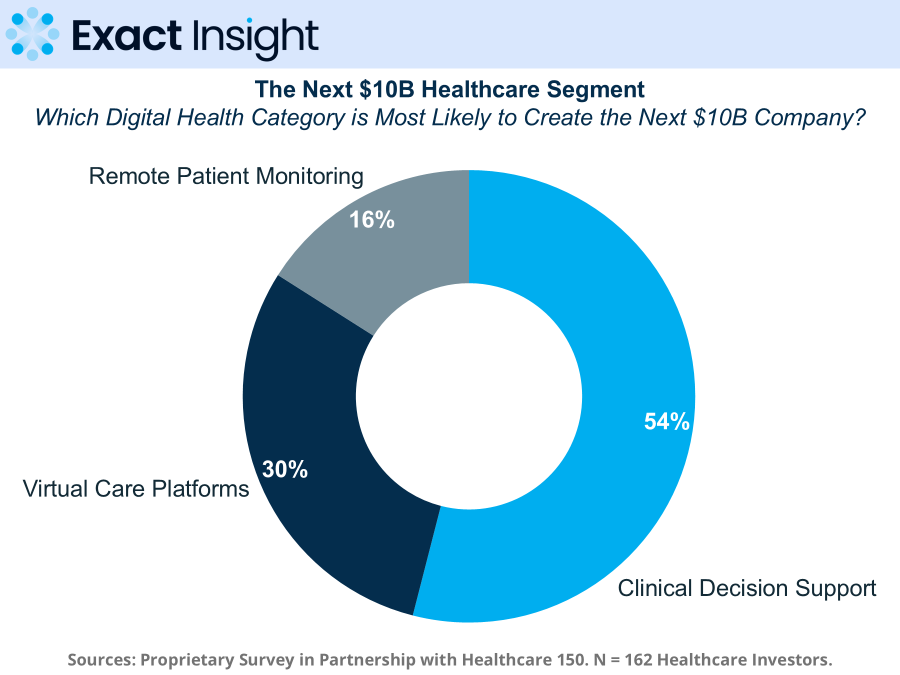
The results point to a broader shift in digital health's investment thesis. The previous cycle focused heavily on expanding access through telehealth, virtual delivery, and connected devices. Today, the opportunity is increasingly moving toward the intelligence layer: technologies that help clinicians synthesize information, automate workflows, identify risks, and make better decisions with fewer resources.
The relatively low showing for remote monitoring is particularly revealing. Investors may increasingly see data collection as a feature of broader healthcare platforms rather than the primary source of value. The competitive advantage is shifting from collecting more clinical data to interpreting it effectively.
For investors, the message is clear: healthcare's next major technology platform may not win by creating another access point. It may win by becoming indispensable to the clinical workflow itself.
|
|
|
|
PRE-DEAL INTELLIGENCE
How Much Revenue Disappears When the Founder Leaves?
In many middle-market transactions, the founder is not simply the CEO. They may be the company's most important salesperson, relationship manager, recruiter, product expert, and decision-maker. That creates a diligence question that financial statements rarely answer: how much of the company's value actually exists independently of the founder?
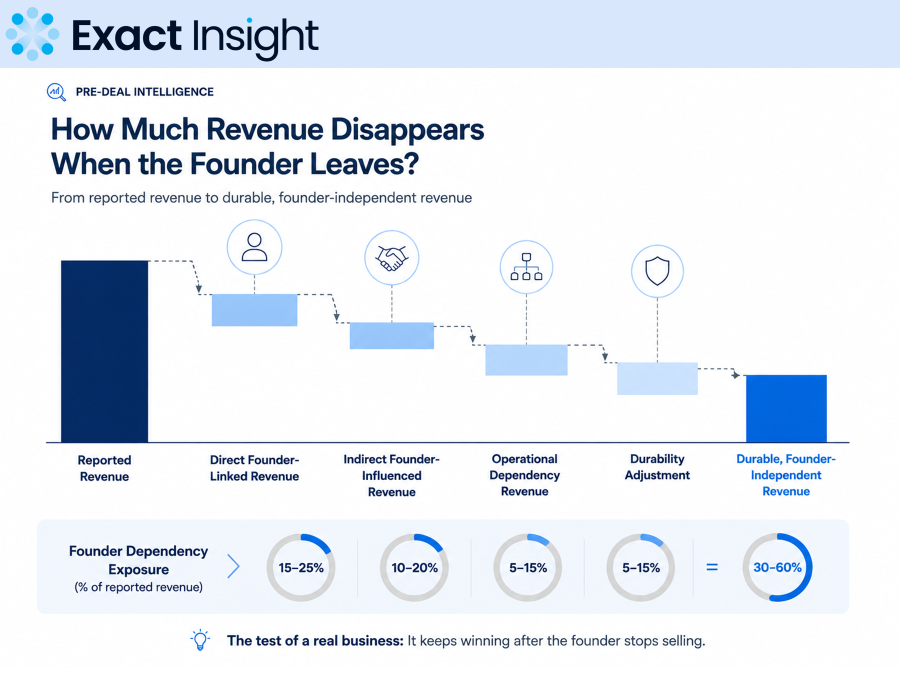
Strong revenue retention and customer relationships can create a false sense of durability when those relationships ultimately belong to one individual. Investors should identify which customers were originated by the founder, who owns each senior relationship, whether contracts are with the company or effectively relationship-driven, and who customers call when something goes wrong. The same analysis should extend internally: pricing decisions, supplier relationships, product knowledge, recruiting, and strategic decisions may all depend disproportionately on one person.
The objective is not to assume the founder disappears on Day 1. It is to determine whether the business can institutionalize what currently resides with the founder. Diligence should therefore quantify founder-linked revenue, identify second-level relationship owners, and test whether management systems can preserve those economics through a transition.
A business is only as transferable as the relationships, knowledge, and decision-making capabilities that remain after its founder leaves.
|
|
|
|
LESSONS FROM THE FIELD
Lessons from the Field: Quaker Bought Snapple. But Did It Buy What Made Snapple Work?
In 1994, Quaker Oats acquired Snapple for $1.7 billion, convinced it could apply the same playbook that had transformed Gatorade into a billion-dollar brand. Less than three years later, Quaker sold Snapple for just $300 million.
The problem went deeper than an unsuccessful marketing strategy. Snapple's success depended on an unusually decentralized ecosystem of independent distributors, local relationships, unconventional marketing, and organizational know-how that had developed alongside the brand. Quaker saw opportunities to rationalize that system and capture synergies. Instead, it alienated distributors and struggled to replicate the informal network that had helped make Snapple successful.
The numbers deteriorated quickly. Snapple's annual case sales ultimately fell from a peak of roughly 70 million to 45 million under Quaker, while the expected distribution synergies largely failed to materialize.
| |
For investors, the pre-deal lesson extends well beyond founder-led consumer businesses. When acquiring a company built around a founder or small leadership team, investors must determine where the economic value actually resides. Is it embedded in contracts, processes, systems, and institutional relationships.or does it live inside people and networks that may not transfer with ownership?
|
Buying the company does not automatically mean you have bought the capabilities that made it successful.
Source: Harvard Business School
|
|
|
|
INTERESTING ARTICLES
Worth Your Time
https://economy.ac/market/2026/08/202608290821
https://www.morningstar.com/business/insights/blog/largest-alternative-asset-managers
https://tradetecheye.com/news/alts-custodian-launches-portfolio-modeling-platform-for-private-markets-integration
https://www.ft.com/content/65d1e0f3-f056-49dc-907a-b76a7f2794c8
|
|
Operator Signal . by Exact Insight
Exact Insight . 170 Mason Street, Greenwich, Connecticut 06830, United States
You're receiving this because you subscribed to Operator Signal.
|
|