|
OPERATOR SIGNAL
|
|
BEFORE THE INVESTMENT COMMITTEE
|
Multiples Split. Quality Decides. Playbooks Prove It.
This week, Operator Signal looks at why valuation expectations across private markets are splitting rather than moving together, the diligence question sponsors should ask before assuming an acquirer's operating model can protect the premium it just paid, and Kraft Heinz's 2015 merger as a reminder of what happens when the playbook cuts into the same capabilities that justified the price. The theme is not whether multiples are up or down. It is who actually gets to keep the value once the deal closes.
|
|
Hi there,
Across all three topics, the message is consistent: a premium multiple is a claim on future quality, not proof of it. Investors are increasingly right to expect capital to reward strong assets and punish weak ones, but that same discipline has to apply after the deal closes, not just at the entry price. In this market, the diligence question worth asking is not only "is this a quality asset," but "will the buyer's own operating model let that quality survive integration."
Before the investment committee, know whether the playbook protects the premium or erodes it.
Exact Insight surfaces these patterns early, directly from operator conversations, before they show up in CIMs or IC memos.
Access the full briefing or request expert calls in this sector to go deeper.
|
|
|
|
INSIGHTS FROM THE NETWORK
Valuation expectations are splitting, and quality is now the dividing line.
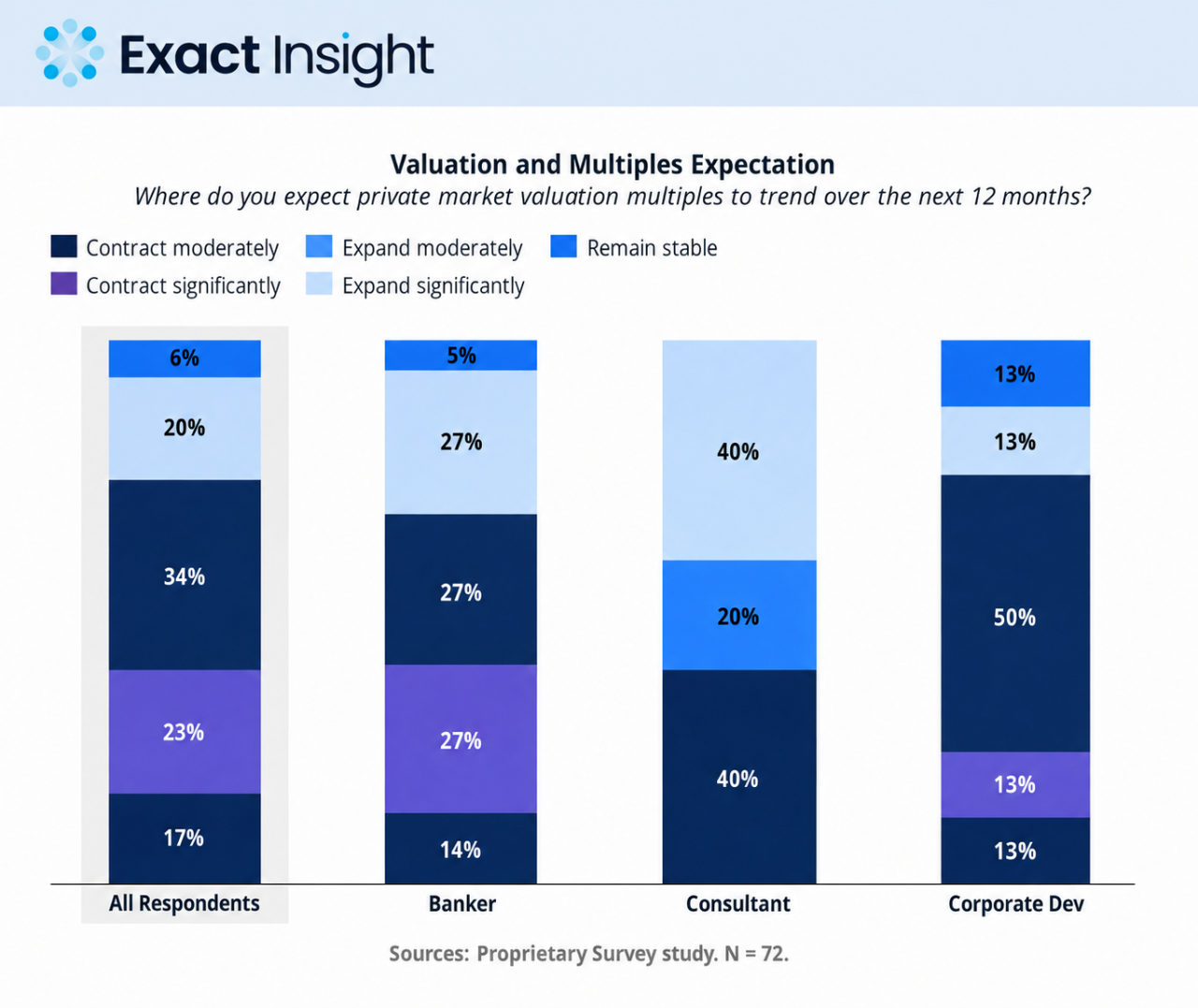
In a recent survey we conducted in partnership with PE150, 54% of 72 private markets professionals expect valuation multiples to expand from here (20% significantly, 34% moderately), 40% expect contraction (23% significantly, 17% moderately), and 6% expect multiples to hold roughly stable. The headline split gets sharper by respondent type. Bankers are the most bullish and the most polarized at once: 54% expect expansion (27% of them significantly), while 27% separately expect significant contraction, barely anyone in that group expects only a moderate move either way. Consultants sit at the other extreme: 60% expect contraction (40% moderately, 20% significantly), 40% expect moderate expansion, and none expect stability or significant expansion. Corporate development respondents are the most evenly spread, with 50% expecting moderate expansion and the rest split in small groups across every other outcome.
The report frames the divide as a function of "asset quality, sector exposure, and buyer conviction rather than a uniform change in valuations." Rather than multiples moving as a single market-wide number, capital is concentrating around businesses with durable growth, strong cash conversion, and defensible market positions, while weaker assets are increasingly repriced downward. AI exposure is becoming another layer of differentiation, and the report notes that lower-middle-market deals may keep attracting capital even as competition intensifies for trophy assets.
For investors, the practical read is that "capital is likely to reward quality more aggressively and penalize weakness more." A rising median multiple can mask a market that is actually pulling apart at the extremes.
|
|
|
|
PRE-DEAL INTELLIGENCE
Can the buyer's playbook protect the quality premium it just paid for?
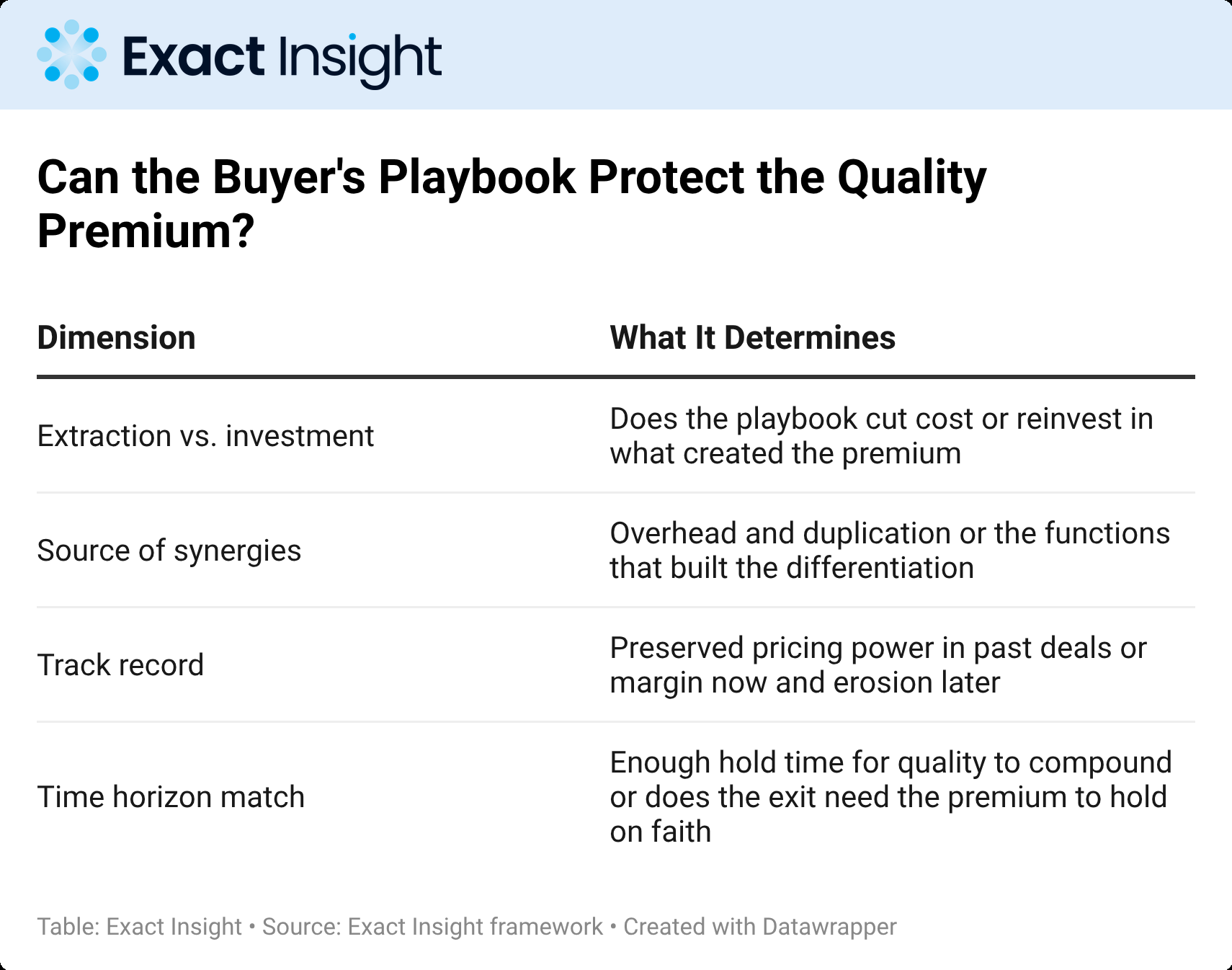
If capital is now paying up specifically for quality, the diligence question has to extend past the target and onto the buyer's own operating model. A useful framework has four dimensions.
The first is extraction versus investment orientation. Is the buyer's standard playbook built around stripping cost, or around reinvesting in the functions, R&D, brand, service quality, that justified the premium in the first place?
The second is the source of the planned synergies. Synergies drawn from overhead and duplication protect the asset. Synergies drawn from the same marketing, product, or customer-facing functions that created the differentiation put it directly at risk.
The third is the buyer's track record with comparable assets. Has this playbook preserved pricing power and brand equity in past deals of a similar type, or is there a pattern of margin expansion in year one followed by share or brand erosion by year three?
The fourth is time horizon match. Quality takes time to compound. Sponsors should check whether the hold period actually gives that investment room to pay off, or whether the return model needs the premium multiple to hold on exit before the underlying quality has had a chance to prove itself.
|
|
|
|
LESSONS FROM THE FIELD
Kraft Heinz's merger paid for a quality premium its own playbook then eroded.
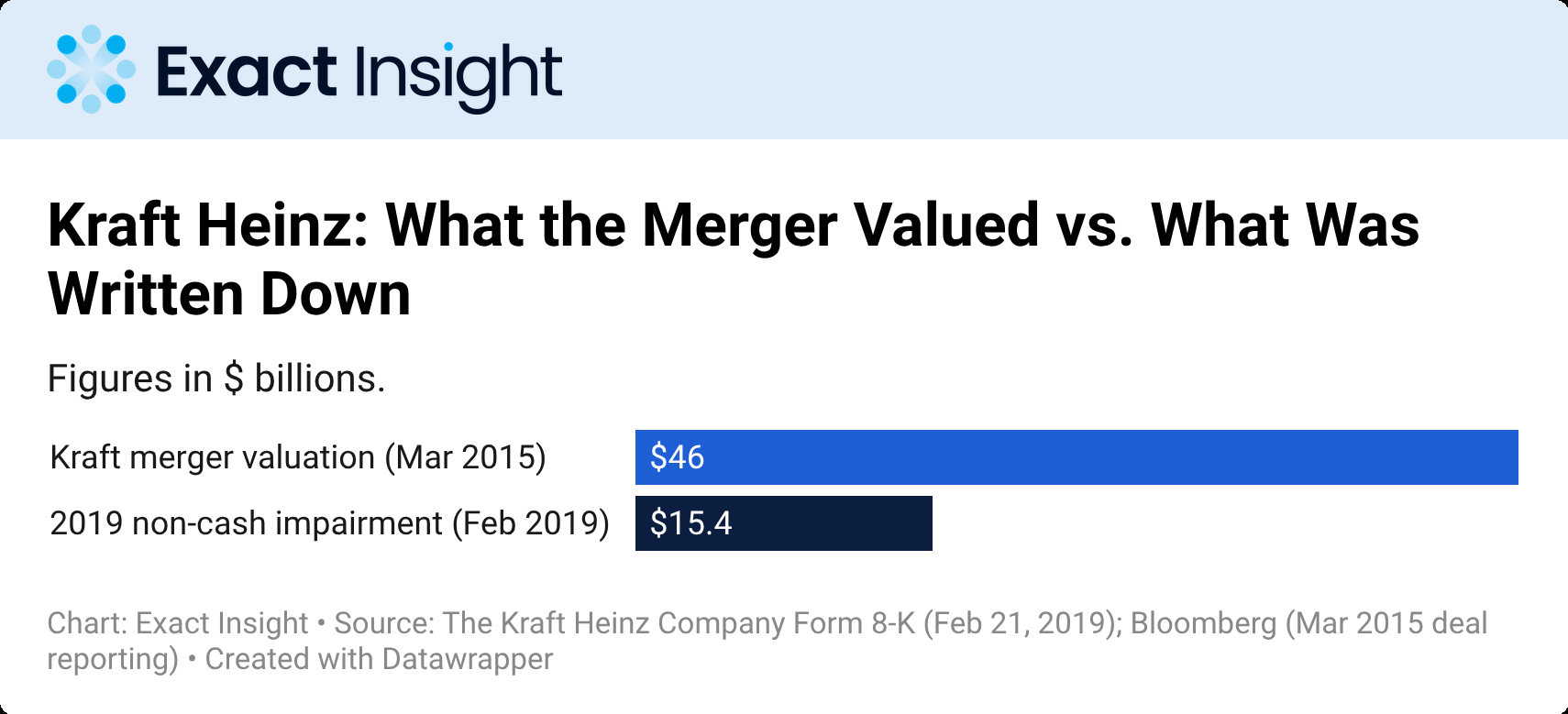
In March 2015, Kraft Foods Group merged with H.J. Heinz in a deal engineered by 3G Capital and Warren Buffett's Berkshire Hathaway. Kraft was valued at approximately $46 billion in the transaction, and the combined company was projected to carry a market value above $80 billion, bringing together eight brands each worth more than $1 billion. The investment case rested heavily on that brand equity: pricing power built over decades, defended by household-name trademarks like Kraft and Oscar Mayer.
3G Capital's operating model, an aggressive zero-based budgeting approach that had already driven returns at Anheuser-Busch InBev and Burger King, was applied to Kraft Heinz's cost base immediately after close. Overhead and marketing spend were cut hard and fast in pursuit of margin.
By February 21, 2019, the cost had become visible. Kraft Heinz disclosed a $15.4 billion non-cash impairment charge, $7.1 billion tied to goodwill and $8.3 billion tied specifically to the Kraft and Oscar Mayer trademarks, alongside a 36% dividend cut and disclosure of an SEC subpoena tied to its procurement accounting practices. The stock dropped sharply on the news.
The lesson is not that brand-driven consolidation is a bad thesis. The lesson is that the same playbook engineered to compress a purchase price can just as easily compress the quality premium a buyer already paid for, if the cuts land on the marketing, R&D, and brand-building functions that created that premium in the first place. Before the multiple assumes the quality will hold, the buyer's own operating model needs to prove it will not be the thing that erodes it.
|
|
|
|
INTERESTING ARTICLES
Worth Your Time
Private Equity Buyers Pay Up for Small Add-Ons as Middle-Market Multiples Climb to 6.9x
Private company valuations rebound as earnings offset lower multiples
Private Equity's Reality Check: The GP Outlook for 2026
|
|
Operator Signal . by Exact Insight
Exact Insight . 170 Mason Street, Greenwich, Connecticut 06830, United States
You're receiving this because you subscribed to Operator Signal.
|
|