|
OPERATOR SIGNAL |
|
BEFORE THE INVESTMENT COMMITTEE |
Prune. Prove. Protect.
This week, Operator Signal examines a Healthcare150 survey on portfolio choices, a diligence test for the costs left behind when a business exits, and Newell's reminder that a smaller portfolio does not automatically produce a smaller cost base.
|
|
Hi there,
Across all three topics, the message is consistent: deciding what to stop doing is only half the work. The investment case needs evidence that costs, commitments, and customer dependencies can actually be unwound.
Underwrite what remains, not just what leaves.
Exact Insight helps investors test the commercial facts before the deal closes. Learn more: https://www.exactinsight.ai/
Exact Insight surfaces these patterns early, directly from operator conversations, before they show up in CIMs or IC memos.
Access the full briefing or request expert calls in this sector to go deeper.
|
|
|
|
INSIGHTS FROM THE NETWORK
Portfolio Focus Leads, Without a Consensus Playbook
In the survey we conducted in partner with Healthcare150, portfolio optimization was the leading margin-protection priority at 24.7%. Pricing adjustments and renegotiations followed at 22.4%, then automation, AI, and digital transformation at 20.0%. The May 7, 2026 article's chart reports 85 respondents.
The lead is a plurality, not a mandate: no clear strategy and M&A or partnerships each received 16.5%. These are stated priorities, not measured margin improvements, and the article does not provide enough sampling detail to establish how representative they are.
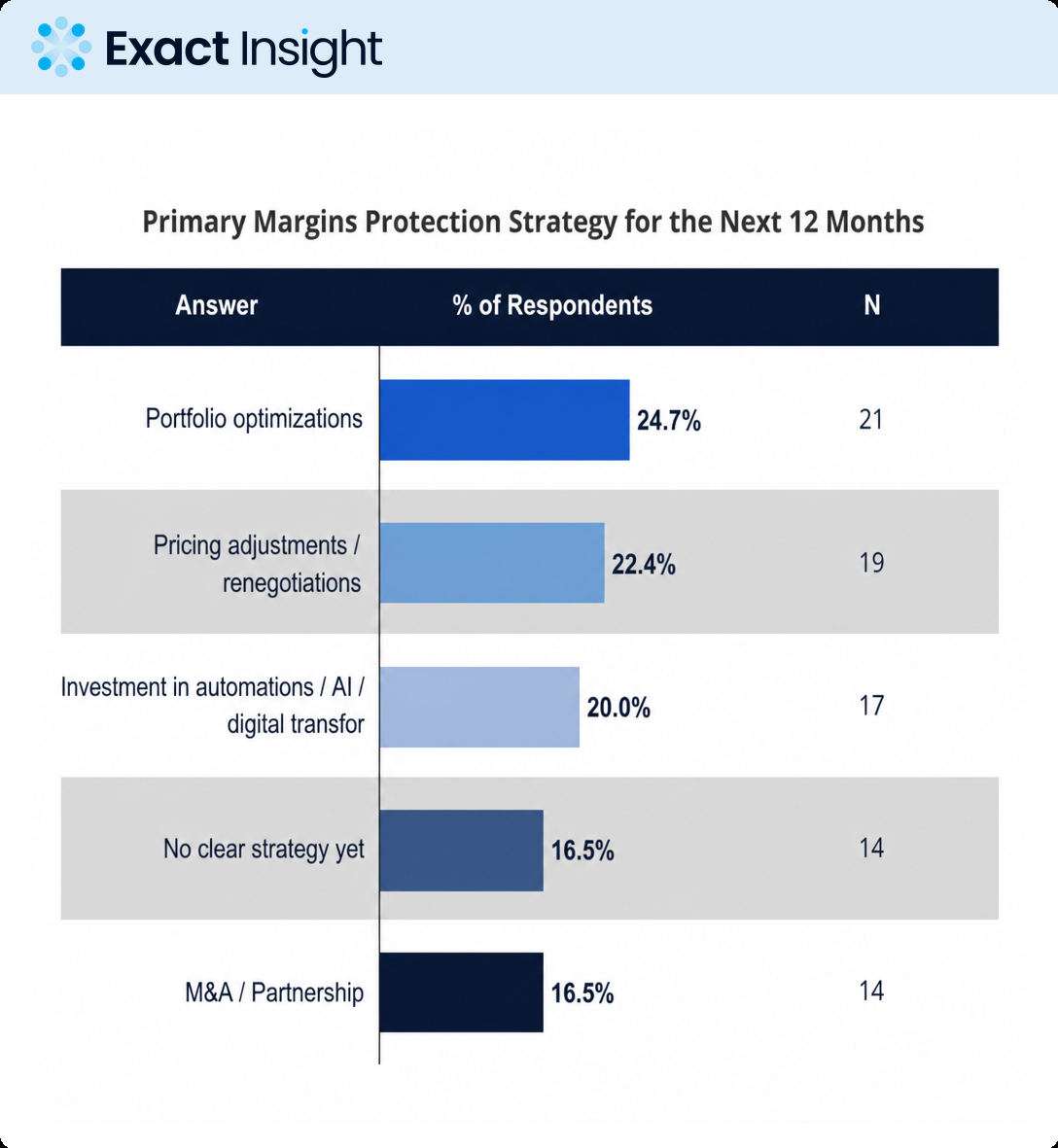
Where portfolio optimization includes an exit, investors should ask which service line or business would leave, which shared costs would remain, and what the retained operation would earn afterward. A cleaner portfolio story still needs a credible post-exit operating model.
|
|
|
|
PRE-DEAL INTELLIGENCE
If This Business Exits, Which Costs Actually Disappear?
Ask management to rebuild the retained business after one proposed disposal or service-line closure. Start with invoices, contracts, and named roles, not divisional cost allocations. An expense assigned to the departing business may still be payable by the company that remains.
Test four points. Cost ownership: classify each material shared expense as transferring, removable, or retained, with a contract or accountable owner behind the answer. Release timing: match savings to termination rights, lease expiries, and employee actions, including cash exit costs. Commercial dependencies: trace referrals, bundled contracts, and cross-selling that the remaining business could lose. Separation funding: identify replacement systems, transition services, and the cash needed before savings arrive.
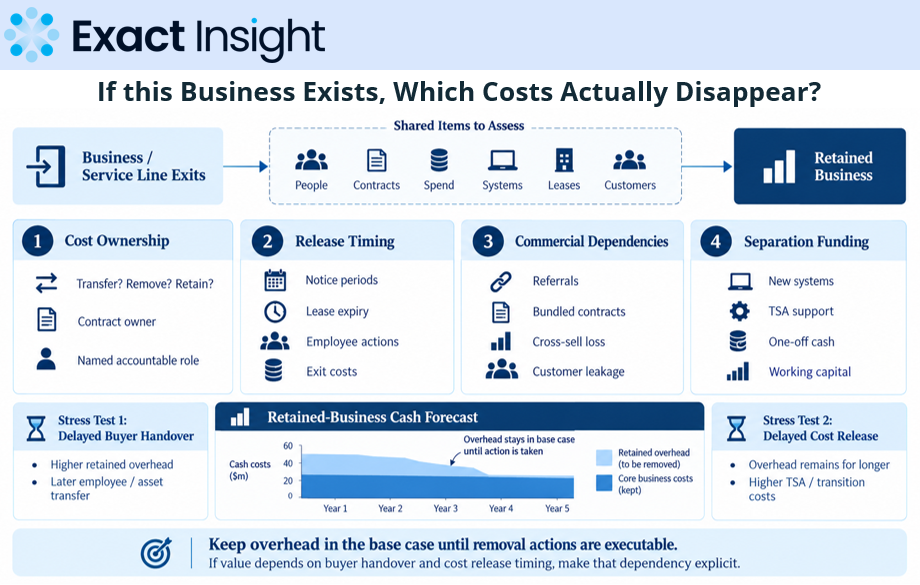
Translate that work into a dated retained-business cash forecast. Keep allocated overhead in the base case until there is an executable removal action. Stress a delayed buyer handover and a delayed cost release separately. If the investment only works when both happen on schedule, make that dependency explicit rather than treating allocated overhead as removable cash cost.
|
|
|
|
LESSONS FROM THE FIELD
Newell: Selling Businesses Does Not Sell Every Cost
Newell Rubbermaid announced its Jarden acquisition in December 2015 at a stated $15.4 billion price. By May 2018, Newell planned to divest businesses representing approximately 35% of company net sales. Its transformation plan explicitly called for removing stranded corporate costs and recovering previously committed synergies lost through divestitures. Those were planned actions, not proof that the savings had been delivered.
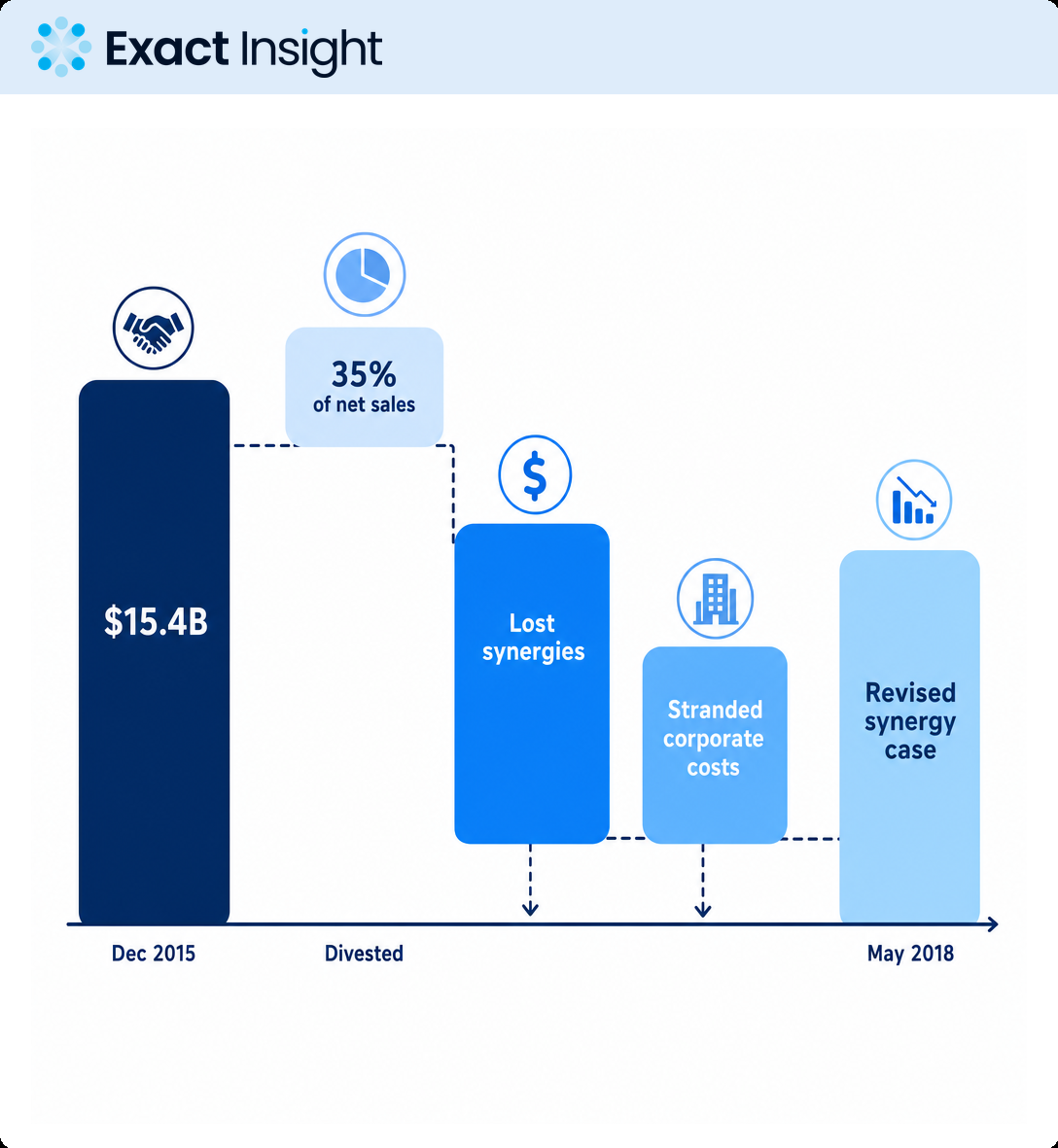
The diligence lesson is direct: test what a disposal does to the original synergy case. Newell's disclosure identifies a double exposure: corporate overhead can remain while divestitures remove previously expected synergies. Require management to reconcile the revised portfolio with the acquisition underwriting, identifying which benefits survive and which require a new cost-removal action. That disclosure does not establish that stranded costs caused Newell's broader financial difficulties.
| |
For investors, the lesson extends well beyond Newell. Strong brands, recurring revenue, and high customer satisfaction do not automatically translate into pricing power. The critical diligence question is not whether customers value the product, but whether they will continue purchasing when prices increase. Customer interviews, historical pricing analyses, churn data, contract structures, and competitive benchmarking should all be used to validate pricing assumptions before underwriting EBITDA expansion driven by higher prices.
|
|
|
|
|
INTERESTING ARTICLES
Worth Your Time
Roland Berger: Carve-Outs and the Real Cost of Independence (April 2026)
BakerHostetler: Practical Guidance for Carve-Outs (April 2026)
AURELIUS: Carve-Out Execution Priorities for 2026 (survey fielded Q4 2025)
|
|
Operator Signal · by Exact Insight
Exact Insight · 170 Mason Street, Greenwich, Connecticut 06830, United States
You're receiving this because you subscribed to Operator Signal.
Unsubscribe
|
|