|
Operator Signal · Before the IC Memo
Why the Best Deals May Be (some times) the Least Digitized Companies
Competitive advantage is increasingly determined not by headline narratives, but by the quality of execution beneath them — across financing, M&A, and AI-driven value creation.
|
|
Opening Words
Operator Signal. Before the Investment Committee.
This week's developments point to a market where competitive advantage is increasingly determined not by headline narratives, but by the quality of execution beneath them. Across financing markets, transformational M&A, and AI-driven value creation, firms are navigating an environment where strategic opportunity remains abundant, but the margin for operational error continues to narrow.
Our latest microsurvey with PE150 suggests the financing landscape remains far more balanced than prevailing private credit narratives imply. While sponsors increasingly favor private lenders for speed, certainty, and flexibility, traditional banks continue to maintain meaningful advantages in pricing, scale, and structured processes. The result is not a winner-take-all market, but an increasingly complex competitive dynamic where firms capable of leveraging both financing ecosystems may hold the strongest position.
The failure of HP's acquisition of Autonomy offers a parallel lesson in what happens when strategic ambition outpaces diligence and operational readiness. The logic behind HP's push into enterprise software was directionally correct, but weak governance, insufficient domain expertise, and the absence of a credible integration plan ultimately overwhelmed the thesis. In transformational environments, execution discipline remains the deciding factor between value creation and value destruction.
At the same time, AI is beginning to reshape how investors evaluate operational upside during diligence. Increasingly, the most attractive targets are not the businesses already optimized through automation, but those with the largest unrealized transformation potential. Companies with fragmented workflows, weak digital infrastructure, and embedded inefficiencies may offer the greatest opportunity for sponsor-led EBITDA expansion when paired with a structured AI value creation strategy.
The takeaway: markets are increasingly rewarding firms that can operationalize complexity rather than simply identify opportunity. Whether navigating financing competition, underwriting transformational acquisitions, or unlocking AI-driven value creation, the advantage increasingly belongs to organizations that combine strategic vision with disciplined execution.
Exact Insight surfaces these patterns early — directly from operator conversations — before they show up in CIMs or IC memos.
Access the Full Briefing →
|
|
|
Insights From the Network
Banks vs. Private Credit: A Two-Player Market
Private credit may dominate conference headlines, but the financing market still looks more like a knife fight than a knockout.
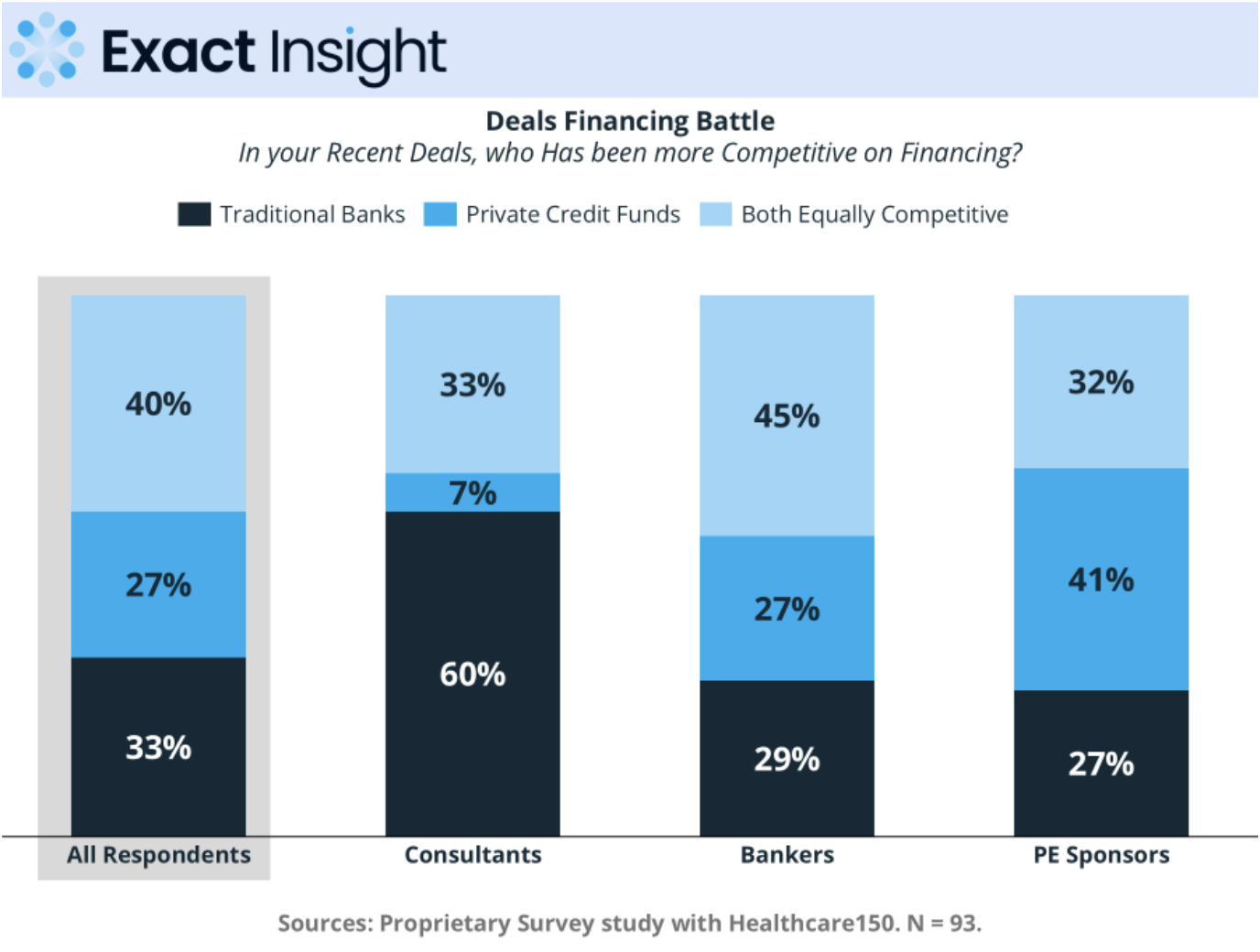
In our recent microsurvey conducted in partnership with PE150, 93 deal professionals weighed in on who has been more competitive on financing in recent deals. The results suggest the market remains far more balanced than the narrative implies.
Overall, 40% of respondents said traditional banks and private credit funds are equally competitive. Another 33% still favor banks, while 27% give the edge to private credit.
The divide becomes sharper when broken down by role.
PE sponsors are leaning decisively toward private credit, with 41% calling private lenders more competitive versus just 27% favoring banks. That reflects what sponsors increasingly value in this market: certainty, speed, and flexibility.
Consultants see it differently. 60% still believe banks hold the advantage, while only 7% favor private credit. Larger syndicated processes and more structured financings still play directly into bank strengths.
The takeaway: this remains a two-player market. Banks continue to win on pricing and scale. Private credit keeps gaining share on execution and flexibility. The firms creating the most leverage today are increasingly the ones able to arbitrage both.
Read the Full Article →
|
|
|
Reader Survey
IT Leaders & AI: 2026 State of Practice
We're surveying IT leaders on how AI is actually being adopted inside organizations in 2026 — what's working, what's stalled, and where teams are investing next. Take our 3-minute reader survey and help shape the upcoming IT Leaders & AI: 2026 State of Practice report.
Take the Survey →
|
|
|
Deal Autopsy: Lessons from the Field
HP–Autonomy: When Strategic Transformation Overrides Diligence
The August 2011 acquisition of Autonomy by Hewlett-Packard was announced with extraordinary ambition — an $11.1 billion transaction designed to transform HP from a slowing hardware manufacturer into a higher-margin enterprise software company.
HP brought a global enterprise customer base and massive distribution scale. Autonomy brought a fast-growing software platform focused on data analytics, industry-leading margins, and a reputation as one of Europe's most successful technology companies. The strategic thesis was genuinely compelling: combine HP's enterprise infrastructure with Autonomy's software capabilities to reposition HP for the next era of enterprise computing.
The deal closed in October 2011. Just thirteen months later, HP announced an $8.8B writedown tied primarily to the acquisition. The company accused Autonomy executives of inflating revenues and profitability ahead of the sale, triggering years of litigation and regulatory investigations.
The structural warning signs were visible before closing. Analysts and short sellers had questioned Autonomy's accounting practices for years, particularly its treatment of hardware sales and reseller transactions. Multiple investors also questioned why HP was paying a 64% premium for a company whose growth had already begun slowing materially.
Post-close, execution deteriorated almost immediately. HP lacked the internal software expertise necessary to properly diligence or integrate the business, while Autonomy executives viewed HP as bureaucratic and operationally incapable of managing innovative software assets. The original strategic rationale — transforming HP into a software-led enterprise company — was never realized.
Key Diligence Gaps
- Failure to rigorously validate Autonomy's accounting practices and revenue quality despite longstanding public concerns
- Overreliance on external advisors without sufficient internal software expertise
- Weak board oversight and accelerated approval timelines for a transformational acquisition
- No credible integration plan before the deal closed
Strategic transformation is not a substitute for disciplined diligence. The underlying logic of HP's expansion into enterprise software was arguably correct, and was eventually validated by the broader shift toward recurring software businesses over the following decade. What failed was not the idea but everything surrounding it: the diligence, the governance, the integration, and the execution.
Read More →
|
|
|
Pre-Deal Intelligence
AI Potential as a Hidden Value Creation Lever
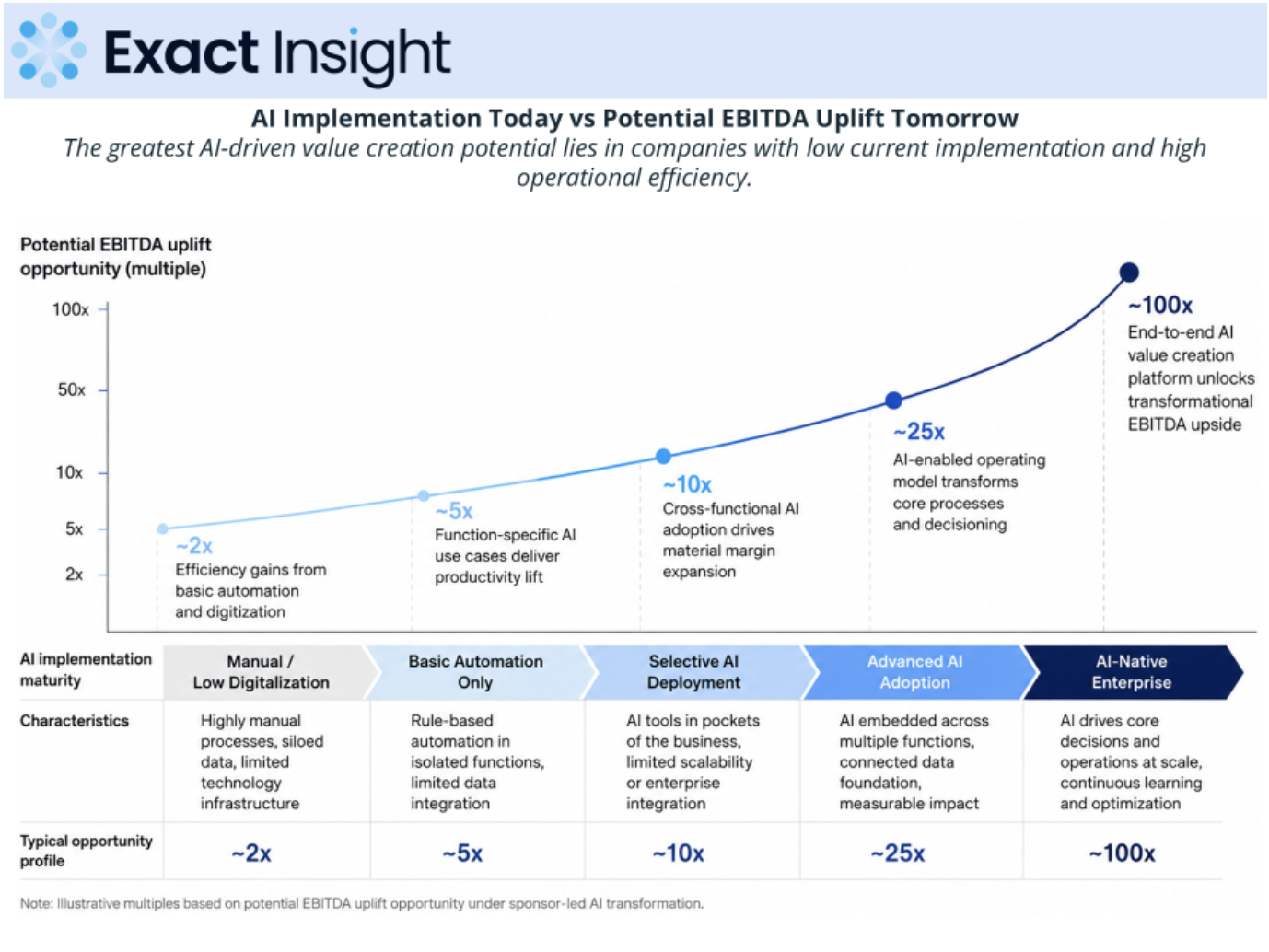
AI diligence is shifting from a technology assessment to a core value creation exercise. Increasingly, the most attractive targets are not necessarily the companies with the highest current AI adoption, but those with the largest unrealized AI potential relative to their operational baseline.
For sponsors, this creates an important distinction during diligence. Highly optimized businesses with advanced automation may deliver operational resilience, but often provide limited incremental upside post-acquisition. In contrast, companies with fragmented processes, labor-intensive workflows, weak data architecture, and low digital penetration can represent outsized transformation opportunities when paired with a structured AI value creation plan.
The key question is no longer "How much AI does the company use today?" but rather "How much EBITDA expansion could AI unlock under sponsor ownership?"
In practice, the largest opportunities tend to emerge in businesses where operational inefficiencies remain structurally embedded. Workflow automation can reduce overhead and accelerate execution, while AI-enabled decision systems can improve pricing, procurement, customer acquisition, and service delivery at scale. When fully integrated into the operating model, AI can fundamentally reshape margin profiles and organizational productivity.
As a result, companies with limited current AI implementation may paradoxically offer the highest investment upside. Under the right sponsor-led transformation strategy, businesses starting from a low digital maturity base can generate disproportionate EBITDA expansion — in some cases creating 10x to 100x value creation potential relative to the initial operational improvement opportunity identified during diligence.
Key Insight
The best AI deals may not be the most digitized companies — they may be the least. Untapped operational inefficiency is increasingly the substrate for sponsor-led EBITDA expansion.
|
|
|
Interesting Articles
Worth a Read This Week
|
|
Want to weigh in on the next survey?
Exact Insight is built from operator signal — and the next cut is already in motion. If you're a C-suite leader, director, or senior practitioner and want to contribute (and get early access to the findings), join our next survey.
Sign Up to Participate →
|
|
|