|
Operator Signal · Before the IC Memo
What Aging Dry Powder Means for Deal Discipline
Operational pressure beneath strong strategic narratives — execution discipline is becoming more important as complexity and deployment urgency rise.
|
|
Opening Words
Operator Signal. Before the Investment Committee.
This week's developments highlight a market increasingly shaped by operational pressure beneath strong strategic narratives, where execution discipline is becoming more important as complexity and deployment urgency rise. Across healthcare regulation, private equity markets, and corporate strategy, the common challenge is no longer simply identifying opportunity — it is sustaining operational alignment and underwriting rigor as conditions evolve.
Our latest survey with Healthcare150 suggests regulatory burdens continue to create meaningful operational strain across healthcare, with physicians bearing the heaviest impact from administrative complexity and fragmented compliance systems. At the same time, private equity firms are facing growing pressure to deploy aging dry powder, increasing the risk that compressed timelines and competitive processes weaken underwriting discipline. The collapse of the AOL–Time Warner merger offers a parallel reminder that even compelling strategic visions can fail when valuation, integration planning, and execution readiness fall out of alignment.
The takeaway: operational resilience matters most when pressure to move faster is highest. In a market increasingly defined by complexity and narrowing margins for error, firms that maintain discipline amid urgency may hold the greatest advantage.
Exact Insight surfaces these patterns early — directly from operator conversations — before they show up in CIMs or IC memos.
Access the Full Briefing →
|
|
|
Insights From the Network
Physicians Are Bearing the Heaviest Cost of Healthcare Regulation
Regulatory complexity continues to create meaningful operational friction across healthcare, but the burden is not being felt evenly. In our latest proprietary survey in partnership with Healthcare150 of 187 healthcare stakeholders, one-third of respondents reported that regulatory requirements are having a moderate to severe impact on organizational efficiency, execution timelines, and speed to market. While many organizations appear to have adapted to growing compliance demands, the findings suggest the operational strain remains particularly acute at the clinical level.
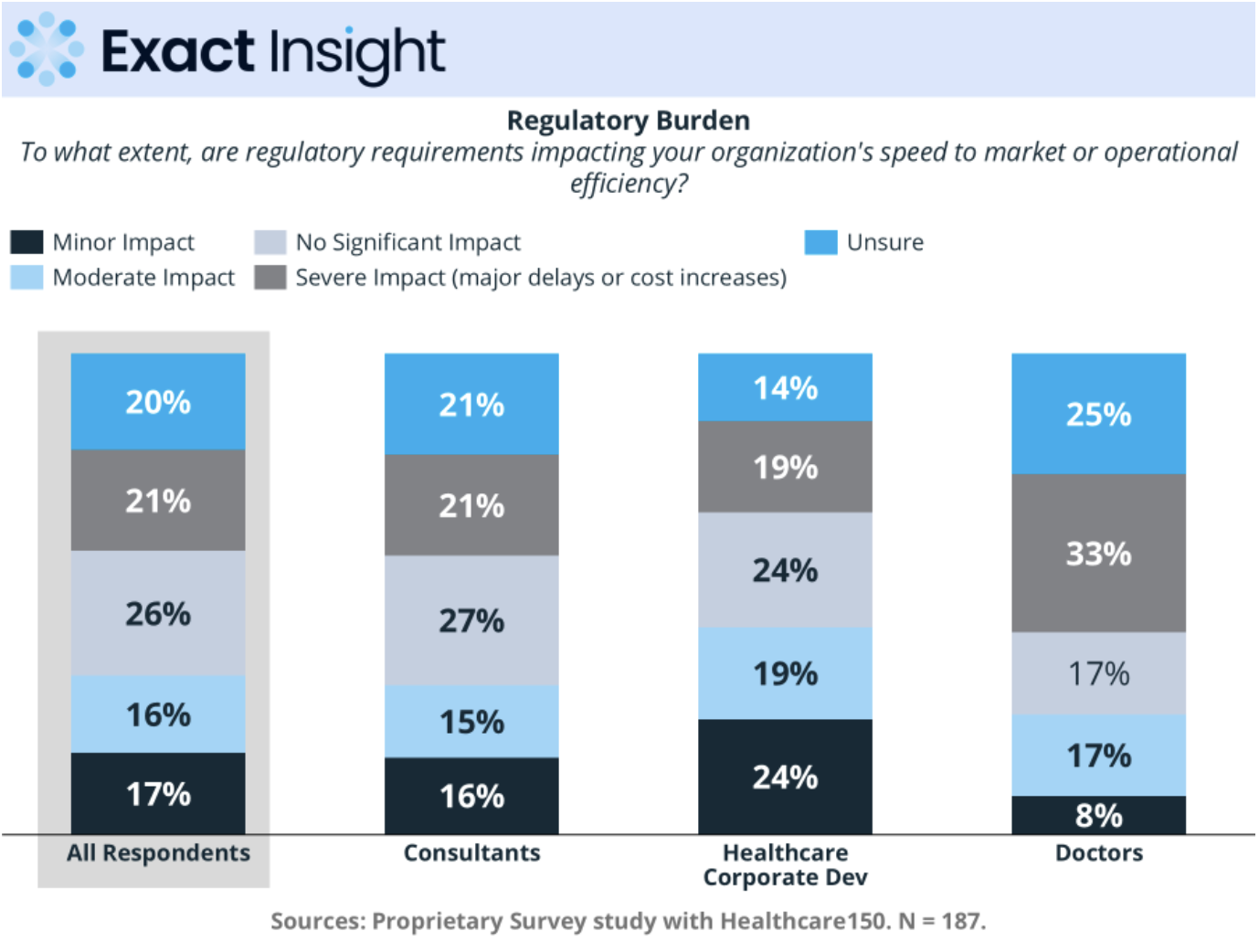
Physicians reported the highest levels of severe impact by a wide margin, reinforcing broader concerns around administrative overload, reimbursement complexity, and workflow disruption. Documentation requirements, licensure protocols, and compliance-related tasks continue to consume increasing portions of clinical time, creating additional pressure on productivity and patient care delivery. By comparison, healthcare corporate development leaders expressed a more measured view, suggesting regulation is increasingly being integrated into strategic planning, diligence, and transaction processes rather than viewed solely as a barrier to growth.
-
33% of all respondents reported moderate to severe operational disruption from regulation
-
Physicians were the most impacted stakeholder group, with the highest share citing severe burden
-
Corporate development leaders showed the lowest uncertainty, reflecting greater familiarity with regulatory diligence and integration processes
The broader takeaway: much of the operational drag may stem not only from regulation itself, but from the fragmented systems, duplicated controls, and legacy governance structures surrounding it. As healthcare organizations continue investing in automation and interoperability, reducing compliance friction may become a key driver of both workforce sustainability and operational performance.
Read the Full Article →
|
|
|
Reader Survey
IT Leaders & AI: 2026 State of Practice
We're surveying IT leaders on how AI is actually being adopted inside organizations in 2026 — what's working, what's stalled, and where teams are investing next. Take our 3-minute reader survey and help shape the upcoming IT Leaders & AI: 2026 State of Practice report.
Take the Survey →
|
|
|
Deal Autopsy: Lessons from the Field
AOL Time Warner: When the Future Arrives Too Early
The January 2000 merger between America Online and Time Warner was announced with extraordinary ambition — a $361 billion combined entity that would fuse the internet's dominant access provider with the world's most valuable media and entertainment brands. At the time, it was the largest merger in U.S. history.
AOL brought 20 million subscribers, a P/E ratio of 245, and a stock price that had compounded at 106% annually for four years. Time Warner brought HBO, CNN, Warner Bros., a broadband cable infrastructure, and $27.3B in annual revenue. The strategic thesis was genuinely compelling: pair AOL's distribution with Time Warner's content to dominate the converging worlds of internet and media.
The deal closed January 11, 2001. The share price hit $47.23 that day. Eighteen months later, it had fallen to $9.64 — a 90% decline from peak. Time Warner eventually spun AOL off in 2009. Multiple publications called it the worst deal in history.
The structural warning signs were visible from day one. Markets never fully priced the merger at its stated terms — the TWX:AOL price ratio persistently traded at 1.42:1 rather than the agreed 1.5:1, signaling that arbitrageurs and institutional investors assigned a meaningful probability that the deal would not close or would not deliver its projected value. AOL shareholders, meanwhile, saw their price fall roughly 15% below pre-announcement levels even before closing, reflecting skepticism about what AOL was actually worth as the dot-com cycle peaked.
Post-close, execution collapsed almost immediately. The two companies had profoundly incompatible cultures — AOL was fast-moving and internet-native; Time Warner was established, hierarchical, and deeply skeptical of its acquirer. Most executives from both firms had been excluded from merger negotiations, creating resentment and resistance throughout the integration. The original strategic rationale — Time Warner content distributed through AOL — was never realized. In a bitter irony, AOL's platform became the one place Time Warner content could not be found. AOL executives were later found to have fraudulently inflated advertising revenues ahead of the deal; $2.4B in shareholder settlements followed.
Key Diligence Gaps
- Overreliance on inflated dot-com valuations to finance an acquisition at a moment of peak market euphoria
- Failure to assess cultural and organizational compatibility between an internet startup culture and a legacy media institution
- Inadequate disclosure and transparency around AOL's deteriorating advertising revenue trajectory
- No credible integration plan for the core strategic thesis — content plus distribution — before the deal closed
Strategic vision is not a substitute for operational readiness. The underlying logic of the AOL–Time Warner combination — content plus broadband delivery — was arguably correct, and was eventually validated by the strategies of Apple, Netflix, and Amazon over the following two decades. What failed was not the idea but everything surrounding it: the valuation, the timing, the cultural integration, and the execution. As Steve Case acknowledged on the day of the spinoff: "Vision without execution is hallucination."
Read More →
|
|
|
Pre-Deal Intelligence
Dry Powder Has an Expiration Date
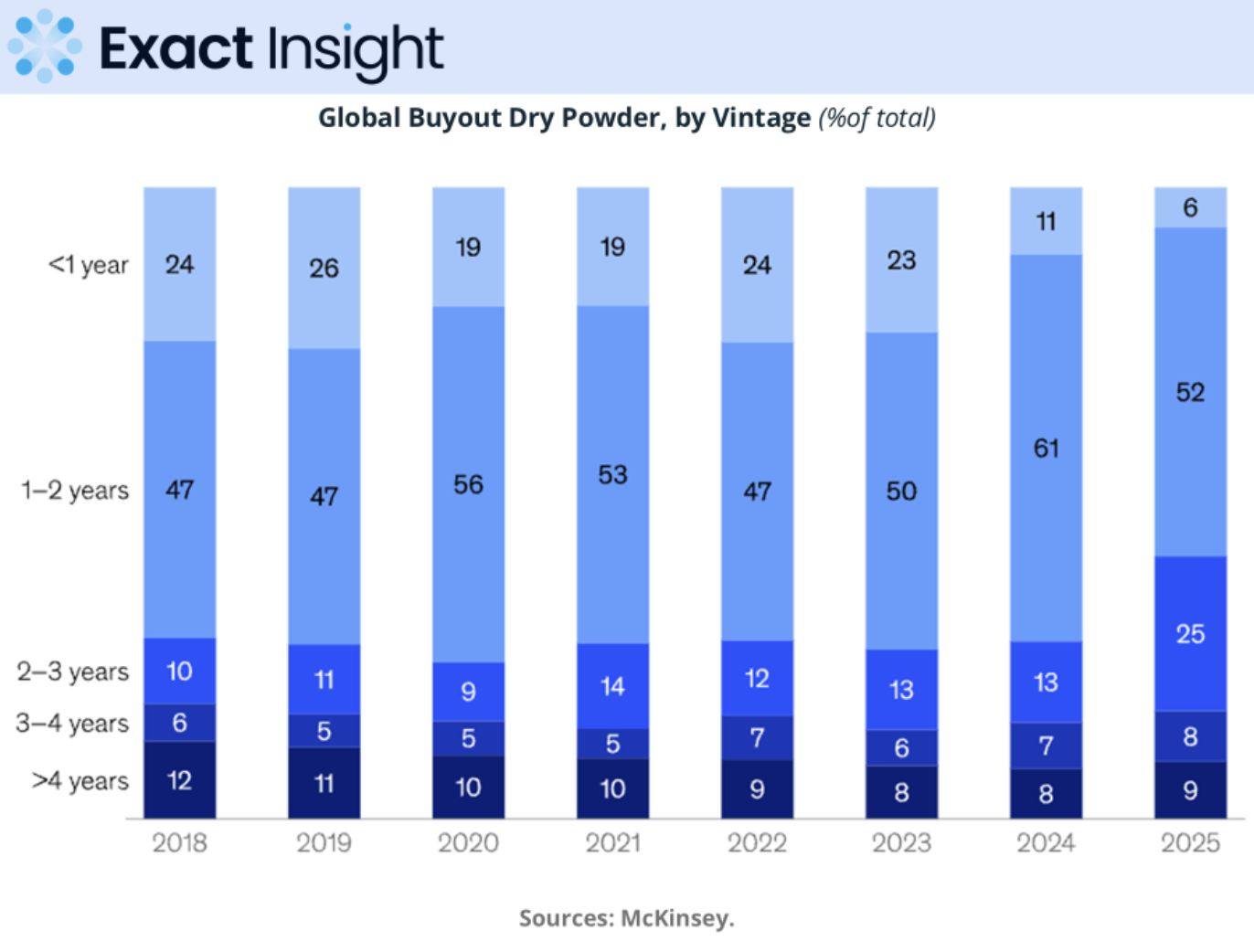
Private equity firms are sitting on a record amount of undeployed capital — but increasingly, that capital is aging. According to McKinsey, only 6% of global buyout dry powder in 2025 is less than one year old, down significantly from 24% in 2018. Meanwhile, capital aged two to three years has climbed to 25%, the highest level in the dataset.
This is more than a fundraising statistic. It signals a meaningful shift in market dynamics.
Dry powder is often discussed as a measure of industry strength, but the age of that capital matters just as much as the size of it. Younger funds can afford patience. They have flexibility to wait for pricing to normalize, for financing markets to improve, or for better-quality assets to emerge. Older funds operate differently. As deployment timelines compress, the pressure to put capital to work intensifies, and that pressure inevitably shapes decision-making.
The closer a fund gets to its investment deadline, the harder it becomes to maintain underwriting discipline. Competitive processes become harder to walk away from. Growth assumptions become more optimistic. Synergy cases become more ambitious. Small diligence concerns that might have derailed a deal two years earlier are more likely to be framed as manageable execution risks.
In practical terms, aging dry powder changes the psychology of the market. Capital that once represented optionality starts becoming a liability if it remains undeployed for too long. General partners still need to demonstrate momentum to LPs, preserve fundraising narratives, and avoid the appearance of sitting idle in a difficult market environment.
That dynamic has important implications for diligence providers and deal advisors. Sponsors under deployment pressure often move faster, compress timelines, and place greater emphasis on confirming the investment thesis rather than challenging it. At the same time, tolerance for uncertainty narrows because higher entry multiples and more aggressive structures leave less room for operational underperformance.
As a result, diligence quality becomes more valuable precisely when the pressure to shortcut it increases. The firms that can surface commercial risks early, pressure-test assumptions rigorously, and separate durable growth from cyclical noise become disproportionately important in a market where capital urgency is rising.
Importantly, this does not necessarily mean private equity activity will slow. In many ways, the opposite may happen. A large stockpile of aging capital can sustain transaction volume even in less favorable macro conditions because firms still need to deploy. But it may also contribute to a market environment characterized by tighter pricing discipline gaps, faster processes, and more aggressive underwriting behavior.
Key Insight
The next phase of private equity may not be defined by a lack of capital. It may be defined by how much of that capital is running out of time — and how that urgency reshapes behavior across the deal ecosystem.
Read More →
|
|
|
Interesting Articles
Worth a Read This Week
|
|
Want to weigh in on the next survey?
Exact Insight is built from operator signal — and the next cut is already in motion. If you're a C-suite leader, director, or senior practitioner and want to contribute (and get early access to the findings), join our next survey.
Sign Up to Participate →
|
|
|