|
Before the Investment Committee
Why Smart Acquirers Are Prioritizing Strategy Over Financials
This week's insights reinforce a common principle in diligence: long-term value is created through strategic positioning, not just strong historical performance. Whether evaluating acquisition targets, entering new markets, or assessing individual business locations, investors must understand the structural factors that drive competitive advantage before capital is deployed.
|
|
Our latest survey with Healthcare150 shows that healthcare dealmakers now prioritize strategic fit over financial performance when evaluating acquisition targets, highlighting the growing importance of capabilities, market positioning, and long-term value creation. The collapse of Tesco's Fresh & Easy expansion offers a complementary lesson, demonstrating that even extensive market research cannot substitute for a deep understanding of local customer behavior. Meanwhile, our examination of spatial diligence illustrates how geography itself can become a source of competitive advantage, with trade areas, competitive density, purchasing power, and customer travel patterns often determining pricing power and unit economics.
Across all three topics, the message is clear: successful investing requires looking beyond financial statements and headline market metrics. The strongest investments are often distinguished by structural advantages that traditional diligence overlooks—from strategic alignment and customer behavior to the local market dynamics that ultimately determine durable enterprise value.
Exact Insight surfaces these patterns early—directly from operator conversations—before they show up in CIMs or IC memos.
Access the Full Briefing
|
|
|
Insights From the Network
Strategy Is Driving Healthcare M&A
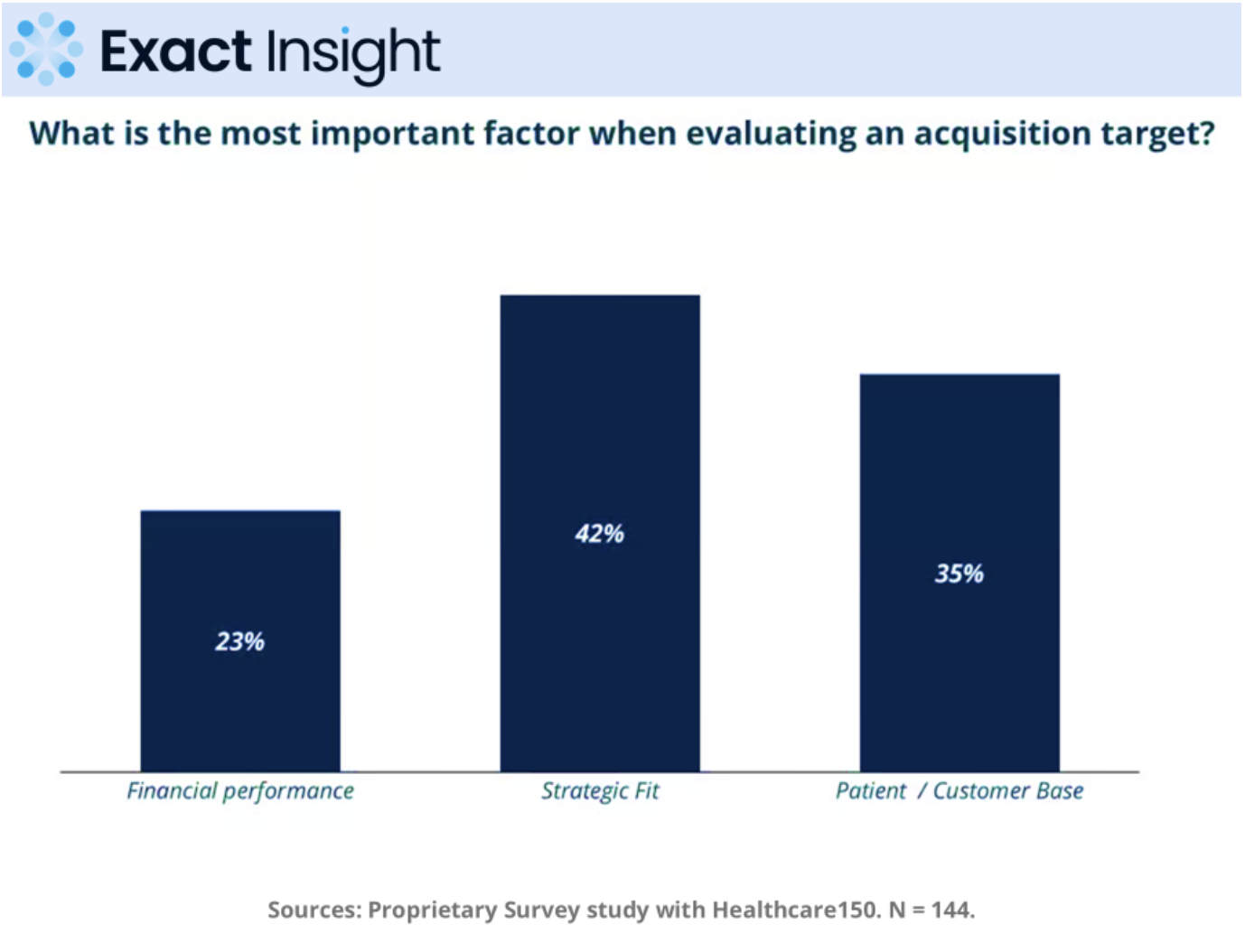
What separates the most attractive healthcare acquisition targets in today's market? According to our latest microsurvey conducted with Healthcare150, the answer is increasingly strategic fit. Among respondents, 42% identified strategic fit as the single most important factor when evaluating an acquisition target, ahead of patient/customer base (35%) and financial performance (23%).
The findings reflect how healthcare M&A priorities are evolving. While financial discipline remains essential, buyers are placing greater emphasis on acquisitions that strengthen long-term competitive positioning rather than simply improve near-term earnings. As the industry continues to navigate AI adoption, value-based care, workforce challenges, and reimbursement pressure, transactions are increasingly being evaluated on their ability to expand capabilities, accelerate growth strategies, and create sustainable competitive advantages.
The strong showing for patient and customer base reinforces this trend. Established relationships with providers, payers, employers, and patients have become increasingly difficult to build organically, making access and market presence valuable strategic assets in their own right. Whether through deeper customer penetration, stronger referral networks, or embedded technology platforms, buyers continue to place significant value on assets that can enhance market position.
Perhaps the most notable takeaway is that financial performance ranked last. This should not be interpreted as reduced financial discipline, but rather as recognition that historical financials explain where a company has been, while strategic alignment often determines where it can go. In today's healthcare market, buyers appear increasingly willing to pay for assets that solve strategic problems, create operational synergies, and position organizations for the next phase of industry transformation.
Read More
|
|
|
Deal Autopsy: Lessons from the Field
Tesco–Fresh & Easy: When Market Research Isn't Market Understanding
In 2007, Tesco invested more than $1.5 billion to launch Fresh & Easy, a chain of neighborhood grocery stores across the western United States. Rather than acquiring an existing operator, Tesco built the business from scratch, convinced that its sophisticated consumer research and operational expertise could replicate its UK success.
The strategy appeared well supported. Extensive market research suggested American consumers wanted smaller stores, prepared meals, and faster shopping experiences. Tesco believed its data-driven approach would allow it to disrupt the U.S. grocery market.
The problem was local market reality.
Fresh & Easy struggled to attract repeat customers, failed to differentiate itself from established competitors, and misunderstood fundamental shopping behaviors. Consumers found the stores unfamiliar, the private-label assortment unappealing, and the shopping experience misaligned with local preferences. After six years of losses, Tesco exited the U.S. market in 2013, recording losses estimated at more than $2 billion.
Key diligence gaps
- Overreliance on quantitative consumer research.
- Insufficient validation of local customer behavior.
- Underestimating competitive intensity and regional preferences.
- Assuming operational excellence could substitute for product-market fit.
Key lesson learned: Commercial diligence should validate how customers actually behave, not simply what research suggests they prefer. Even world-class operators can destroy value when they mistake market data for genuine market understanding.
|
|
|
Pre-Deal Intelligence
Spatial Diligence: Measuring Local Monopoly Power
For consumer-facing businesses, location is far more than a real estate decision—it is often the primary determinant of enterprise value. Hair salons, dental clinics, med spas, laser hair removal providers, veterinary practices, and boutique fitness operators compete within highly localized markets where customer willingness to travel declines rapidly with distance. As a result, a business's true market is rarely defined by a city or county, but by the small trade area surrounding each location.
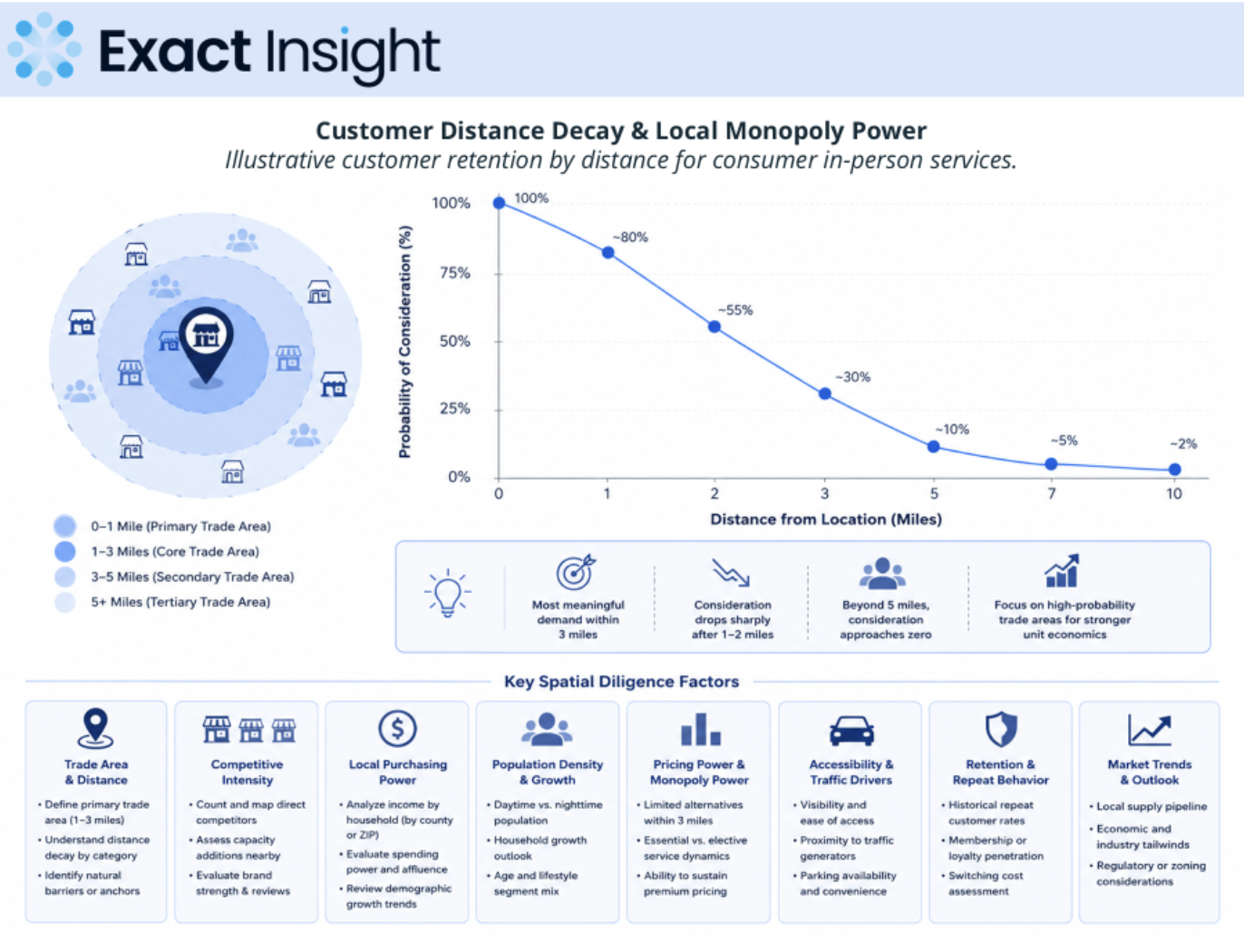
Traditional commercial diligence often focuses on historical revenue and demographics while overlooking the spatial dynamics that determine future performance. Investors should instead evaluate competitor density, local household purchasing power, traffic patterns, anchor retailers, natural barriers, and customer travel behavior. These variables shape a location's effective monopoly power and its ability to sustain pricing over time.
The implications for valuation can be significant. Two locations generating identical EBITDA today may possess very different long-term economics. A site surrounded by affluent neighborhoods, limited nearby competition, and high customer retention within a one-to-three-mile radius is likely to exhibit stronger pricing power and greater resilience than an equally profitable location operating in a saturated trade area.
For sponsors evaluating multi-site businesses, spatial diligence transforms geography into a measurable competitive advantage—revealing where durable value already exists and where expansion opportunities remain.
|
|
|
Interesting Articles
Worth Your Time
|
|
|