|
Before the Investment Committee
Why Resilience Is Replacing Growth as the New Investment Premium
This week's insights highlight a common challenge in investing: distinguishing between what appears resilient and what is genuinely durable. Whether assessing macro conditions, evaluating transformative mergers, or underwriting customer relationships, successful investing requires understanding the structural forces that determine long-term value creation.
|
|
Our latest survey conducted in partnership with PE150 suggests that investors are increasingly accepting a higher-for-longer inflation environment, forcing a reassessment of pricing power, leverage assumptions, and valuation frameworks. The failed Daimler–Chrysler merger offers a complementary lesson, demonstrating that even compelling strategic logic and projected synergies cannot overcome a weak customer and market fit. Meanwhile, our examination of customer concentration reveals how headline growth metrics can obscure significant underlying risks, with a small number of relationships often accounting for a disproportionate share of enterprise value.
Across all three topics, the message is clear: durable value is created by understanding the foundations of resilience. Inflation regimes, strategic fit, and revenue diversification are not secondary considerations—they are structural drivers that determine whether businesses can withstand change and compound value over time.
The strongest investments are often distinguished not by what is immediately visible, but by the hidden dynamics that shape their ability to endure.
Exact Insight surfaces these patterns early—directly from operator conversations—before they show up in CIMs or IC memos.
Access the Full Briefing
|
|
|
Insights From the Network
Pulse: Inflation Isn't Dead. Investors Are Adapting.
Private equity spent the last three years waiting for inflation to normalize. Our latest proprietary survey conducted in partnership with PE150 suggests the industry is increasingly accepting a different reality: inflation may moderate, but it is unlikely to return to pre-pandemic levels.
Only 17% of respondents expect U.S. inflation to stabilize below 2% over the next 12 months, while 61% expect inflation above 2.5%, including 25% who foresee inflation exceeding 4%.
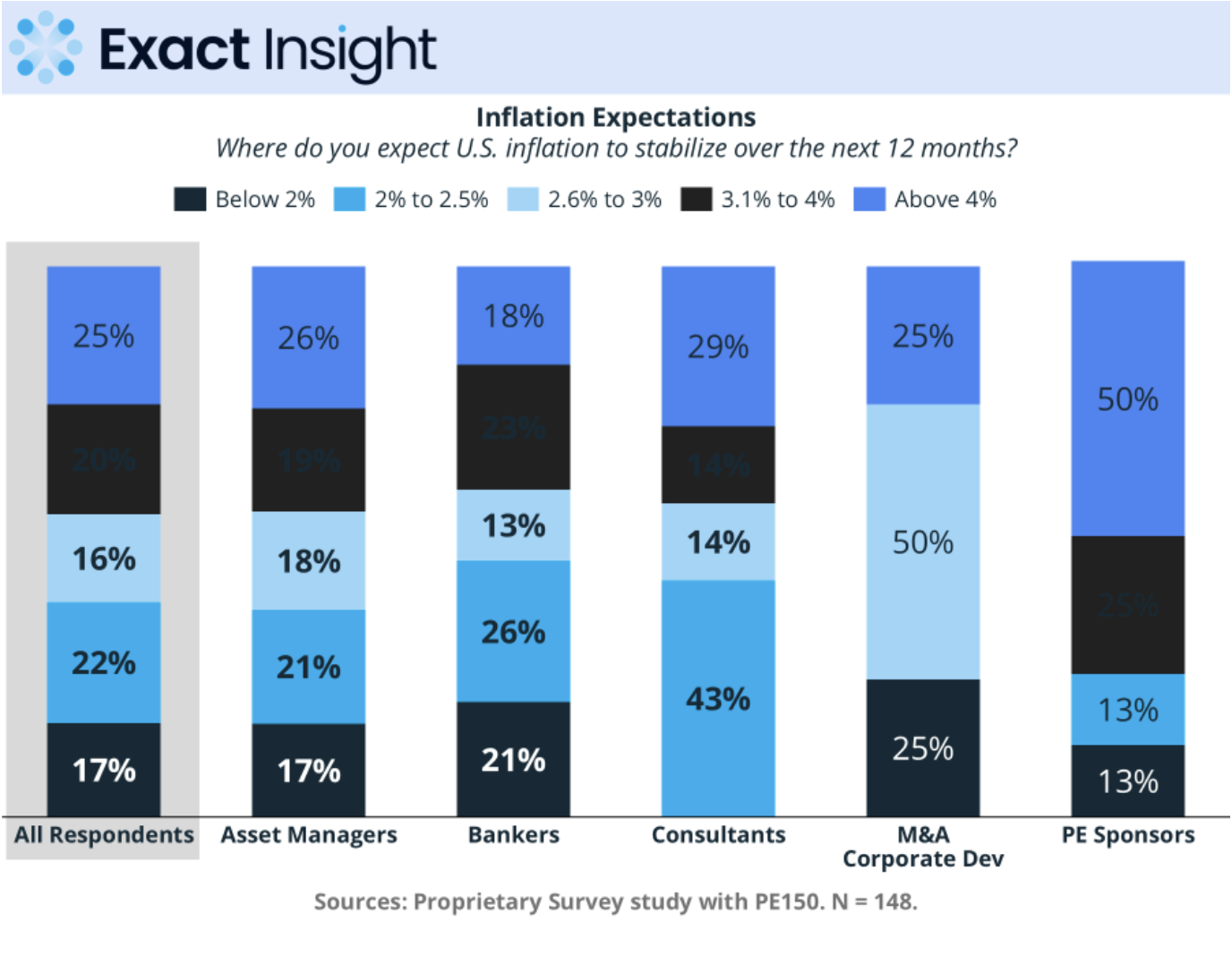
The differences across investor groups are particularly revealing. Corporate development executives were among the most inflation-conscious respondents, reflecting their proximity to real economy pressures such as labor, procurement, and pricing dynamics. Meanwhile, PE sponsors delivered the most polarized outlook, with half expecting inflation above 4%.
The implications for private markets are significant. A persistently higher inflation environment favors businesses with pricing power, resilient margins, and strong cash generation while forcing investors to rethink leverage, valuation assumptions, and exit timing.
The network's message is clear: private equity is no longer debating whether inflation is temporary. It is adapting to a world where higher inflation may simply be the new normal.
Read the Full Article
|
|
|
Deal Autopsy: Lessons from the Field
Daimler–Chrysler: When Strategic Logic Ignores Customer Reality
In 1998, Daimler-Benz acquired Chrysler in a $36 billion merger, marketed as a "merger of equals" that would create a global automotive powerhouse. The thesis was compelling: combine Daimler's engineering excellence and premium brand with Chrysler's mass-market scale and North American presence.
On paper, the synergies looked enormous. The companies expected billions in savings through shared platforms, joint procurement, and global manufacturing efficiencies.
The problem was that the businesses served fundamentally different customers.
Mercedes buyers valued luxury, engineering, and prestige. Chrysler competed on affordability, practicality, and distinctly American consumer preferences. The anticipated product synergies never materialized because the brands, cultures, and customer bases had little overlap.
Integration quickly deteriorated. Cultural tensions emerged, management turnover accelerated, and promised cost savings failed to offset weakening performance. By 2007, Daimler sold an 80% stake in Chrysler for just $7.4 billion, destroying tens of billions of dollars in shareholder value.
Key diligence gaps
- Overestimating the transferability of capabilities across customer segments.
- Assuming cost synergies could overcome weak strategic fit.
- Failing to validate whether customers would perceive value from integration.
- Underestimating cultural and operational incompatibility.
Key lesson learned: Commercial diligence should test whether two businesses create value for customers, not simply whether they create efficiencies on a spreadsheet. Strategic logic often looks compelling in the boardroom, but if the combined company cannot strengthen its competitive position with customers, the expected synergies may never materialize. The best mergers create customer value first and cost synergies second.
|
|
|
Pre-Deal Intelligence
The Hidden Customer Behind Every Investment
A company may report thousands of customers, but many businesses are far less diversified than they appear. In commercial diligence, one of the fastest ways to identify hidden risk is to understand who actually drives revenue.
Customer concentration often develops gradually. A handful of large accounts, referral partners, or distribution relationships generate an increasing share of sales, creating an attractive growth story while simultaneously introducing a significant dependency. The risk is not merely losing a customer—it is discovering that a substantial portion of enterprise value is tied to relationships that may not be durable.
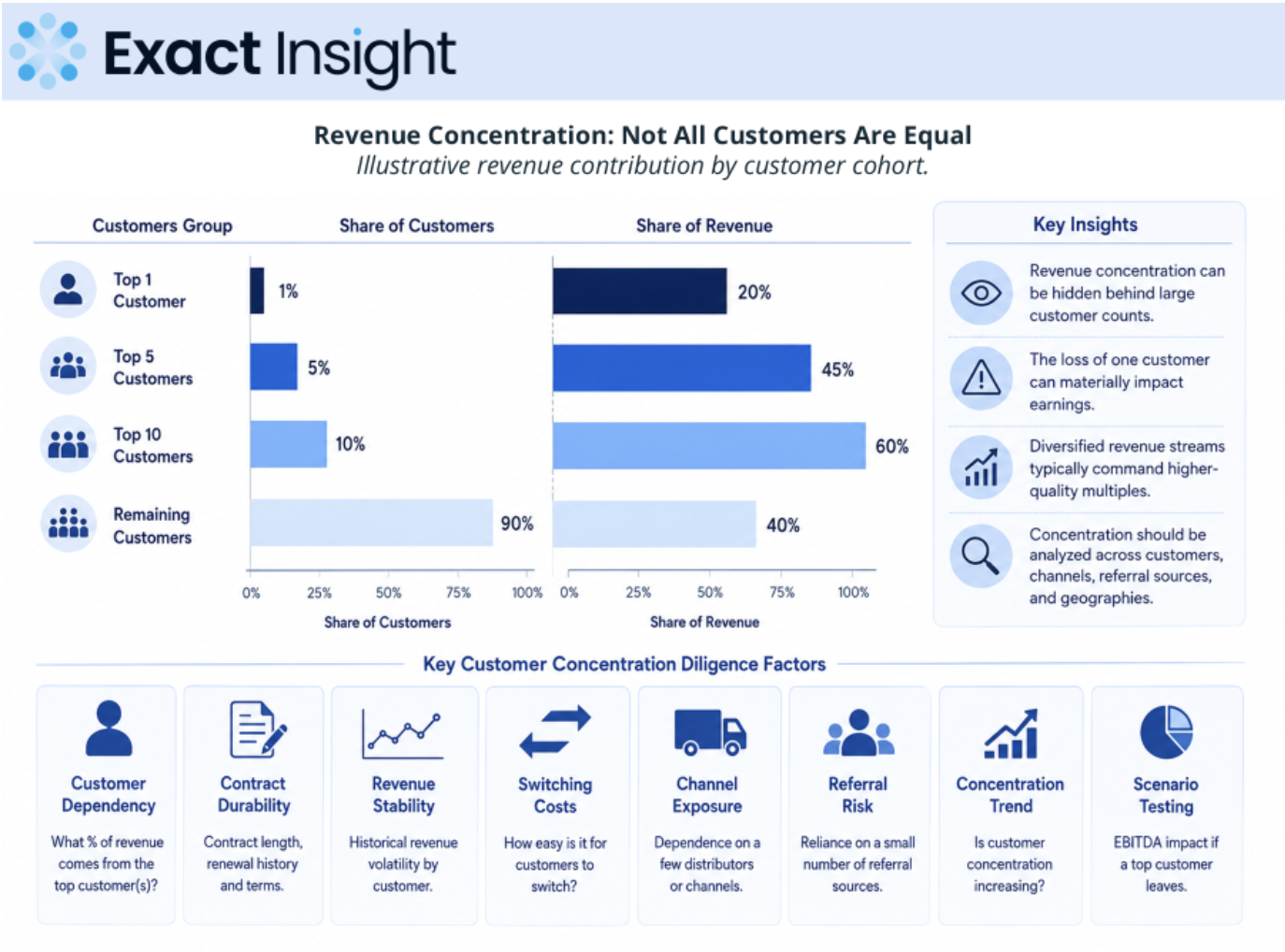
This issue becomes particularly important in B2B services, healthcare, industrials, and specialty distribution businesses, where the loss of a single customer can materially alter growth trajectories and profitability. Yet concentration risk is frequently understated because headline metrics such as customer count, retention, and historical growth obscure the underlying revenue mix.
Commercial diligence should therefore move beyond aggregate customer metrics and examine concentration through multiple lenses: individual customers, channels, geographies, referral sources, and end markets. Investors should ask a simple question: How much of the business truly depends on a small number of relationships?
The implications for valuation can be substantial. Two companies generating identical EBITDA today may possess very different risk profiles. A business with diversified revenue streams and low dependency on any single customer typically deserves a higher quality multiple than one where a few relationships drive a disproportionate share of earnings.
For investors, customer concentration analysis transforms revenue from a historical number into a measure of resilience—revealing whether growth is broadly distributed or resting on a surprisingly narrow foundation.
|
|
|
Interesting Articles
Worth Your Time
|
|
|