|
OPERATOR SIGNAL
|
|
BEFORE THE INVESTMENT COMMITTEE
|
Can This Business Survive a Price Increase?
This week's insights explore a fundamental principle of successful diligence: testing assumptions before they become investment risks. Whether evaluating the macroeconomic outlook, assessing a company's pricing power, or learning from past strategic mistakes, investors generate better outcomes by validating the drivers of value rather than accepting them at face value.
|
|
Hi there,
Our latest proprietary survey conducted in partnership with PE150 shows that while optimism is increasing across the private equity ecosystem, consensus remains fragmented. Sponsors and investment bankers expect stronger economic growth, while corporate development teams continue to adopt a more cautious stance, illustrating how market perspectives influence underwriting assumptions. We complement these findings with a practical framework for evaluating pricing power, highlighting the factors investors should validate before underwriting margin expansion through price increases. Finally, our review of Netflix's 2011 pricing misstep demonstrates how even market-leading businesses can overestimate customer willingness to pay, leading to significant value destruction.
Across all three topics, the message is consistent: the best investment decisions are built on assumptions that have been rigorously tested, not simply accepted.
The strongest investments are rarely defined by the size of the opportunity alone, but by the discipline with which investors validate whether that opportunity can actually be realized.
Exact Insight surfaces these patterns early.directly from operator conversations.before they show up in CIMs or IC memos.
Access the full briefing or request expert calls in this sector to go deeper.
|
|
|
|
INSIGHTS FROM THE NETWORK
Optimism Is Rising, But Conviction Remains Divided
How the private equity ecosystem views the U.S. economy depends heavily on where participants sit in the deal process. In a proprietary survey conducted in partnership with PE150 (N = 184), we found that while overall sentiment has become more constructive, there is still no clear consensus on the economic outlook over the next 12 months.
Across all respondents, 44% expect economic expansion, including 21% forecasting strong GDP growth above 3% and 23% expecting moderate expansion. However, caution remains prevalent, with 38% anticipating a recession and another 20% expecting only slow growth. Rather than converging around a single macro narrative, investors appear to be preparing for multiple potential outcomes.
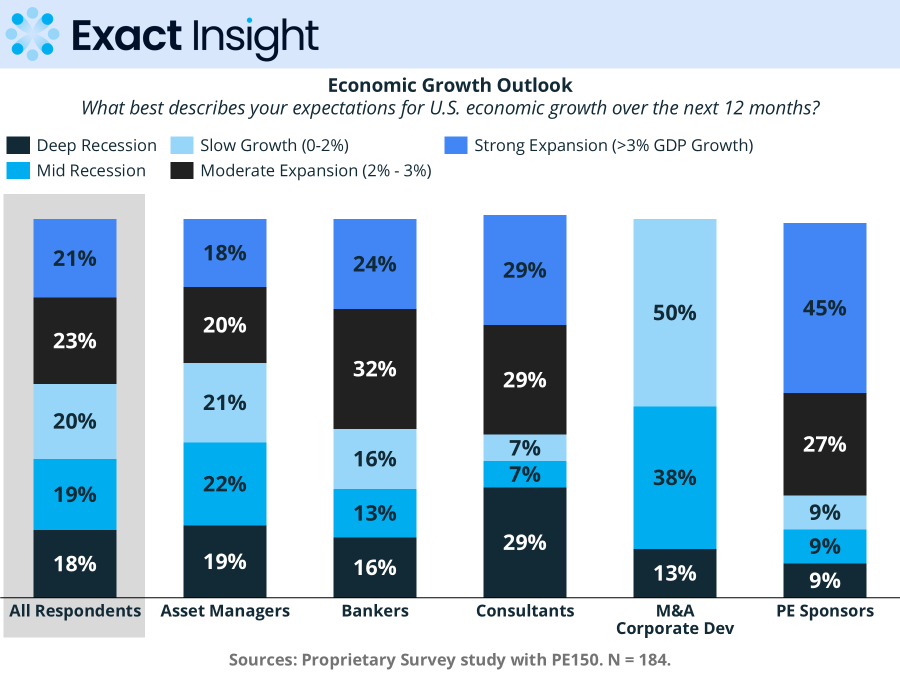
The most notable insight is the sharp divergence between market participants. Private equity sponsors are by far the most optimistic group, with 72% expecting economic expansion, including 45% forecasting strong growth. Investment bankers also lean positive, reflecting improving confidence in financing markets and transaction activity. In contrast, corporate development teams remain significantly more cautious, with 51% expecting recessionary conditions and 50% forecasting only slow growth, suggesting strategic acquirers continue to prioritize capital preservation over aggressive expansion.
For diligence professionals, this fragmentation matters. Understanding how different participants interpret the macro environment provides valuable context when evaluating management assumptions, stress-testing forecasts, and assessing valuation expectations. When buyers, advisors, and sponsors hold materially different economic views, those differences often translate into pricing gaps, underwriting assumptions, and ultimately, transaction outcomes.
|
|
|
|
PRE-DEAL INTELLIGENCE
Can This Business Survive a Price Increase?
One of the most common assumptions in commercial diligence is that a business possesses pricing power simply because it has raised prices successfully in the past. In reality, sustainable pricing power is one of the most misunderstood competitive advantages in investing. Before underwriting margin expansion or revenue growth driven by price increases, investors must determine whether customers will continue buying when prices rise or quietly migrate to alternatives.
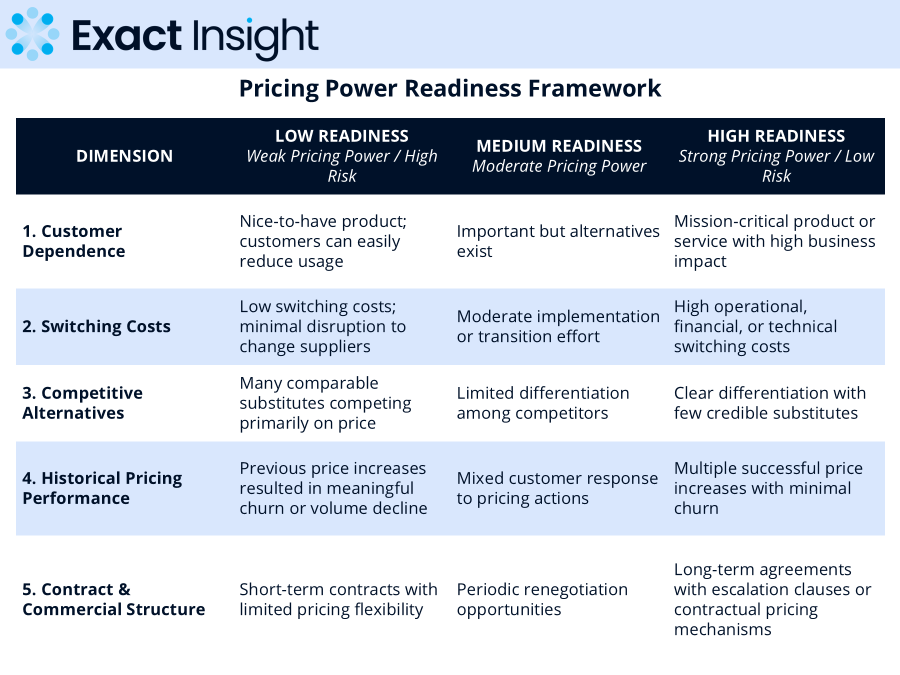
A rigorous diligence process should evaluate five dimensions. First, customer dependence: How mission-critical is the product or service? Second, switching costs: How difficult and costly is it for customers to change suppliers? Third, competitive intensity: Are there credible substitutes capable of absorbing dissatisfied customers? Fourth, pricing history: How have customers responded to previous price increases in terms of churn, volume, and contract renewals? Finally, contract structure: Are price increases contractually supported through escalators or periodic renegotiation clauses?
Many businesses appear to have pricing power during inflationary periods when the entire industry raises prices simultaneously. True pricing power only becomes evident when a company can increase prices independently without materially affecting customer retention or demand. For private equity investors, validating pricing power through customer interviews, win-loss analysis, historical pricing data, and competitive benchmarking can materially alter EBITDA forecasts, valuation assumptions, and ultimately the investment thesis.
|
|
|
|
LESSONS FROM THE FIELD
Netflix's 2011 Pricing Misstep
Netflix's 2011 pricing overhaul remains one of the clearest examples of why pricing power should never be assumed during diligence. At the time, the company dominated the U.S. streaming market and had built an exceptionally loyal subscriber base. Confident in its competitive position, in July of 2011, management separated its DVD-by-mail and streaming services, increasing the effective monthly cost for customers subscribing to both plans from $9.99 to $15.98, a price increase of roughly 60%.
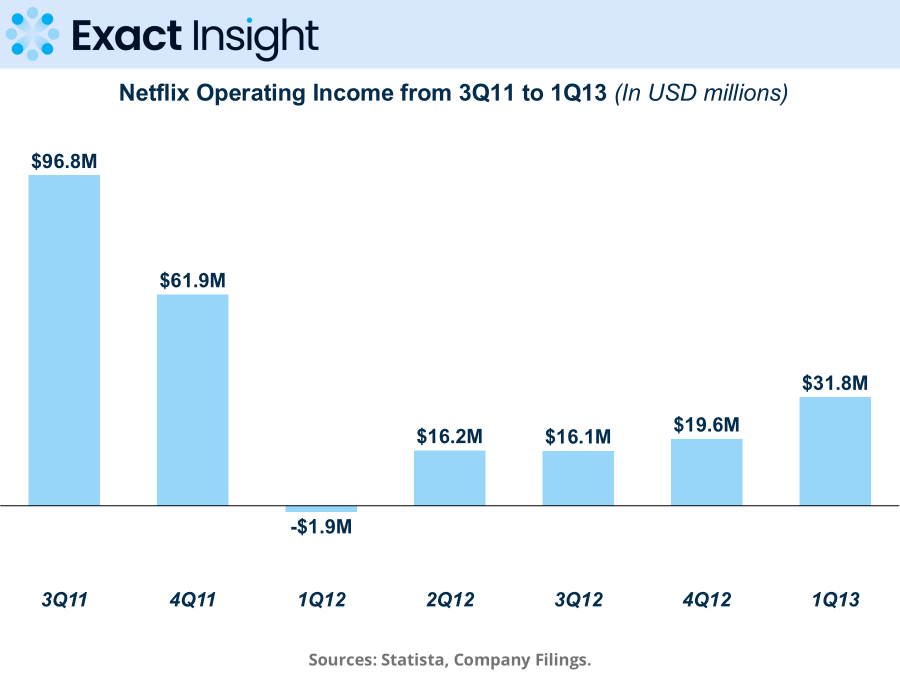
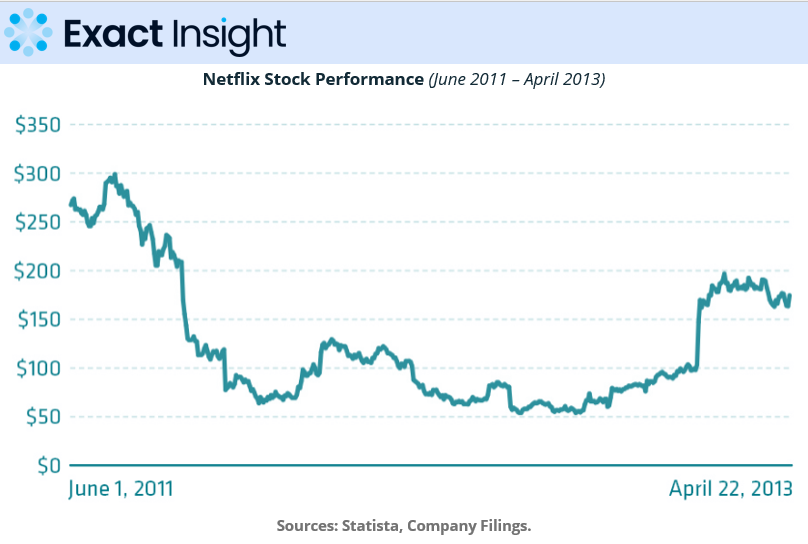
The market response was immediate. Rather than absorbing the increase, customers canceled subscriptions in large numbers. Netflix lost approximately 800,000 subscribers within a single quarter, significantly exceeding management's expectations. Investor confidence deteriorated rapidly, with the company's share price falling by more than 70% over the following months. The failed rollout forced management to abandon its proposed "Qwikster" spin-off and reassess both its pricing strategy and customer communication.
| |
For investors, the lesson extends well beyond Netflix. Strong brands, recurring revenue, and high customer satisfaction do not automatically translate into pricing power. The critical diligence question is not whether customers value the product, but whether they will continue purchasing when prices increase. Customer interviews, historical pricing analyses, churn data, contract structures, and competitive benchmarking should all be used to validate pricing assumptions before underwriting EBITDA expansion driven by higher prices.
|
Read More
IMD. Netflix (B): The 2011 fiasco
Statista. Netflix's successful transition
|
|
|
|
INTERESTING ARTICLES
Worth Your Time
Private Equity Due Diligence: Assessing the Technical Upside of a Potential Acquisition. Rohini Kasturi
PE Due Diligence: Questions for C-Level Teams. Plausity
The New Due Diligence. Dentons
|
|
Operator Signal . by Exact Insight
Exact Insight . 170 Mason Street . Greenwich, Connecticut 06830 . United States
You're receiving this because you subscribed to Operator Signal.
|
|