|
Before the Investment Committee
The Next Healthcare Consolidation Wave Is Taking Shape
This week's insights highlight a common principle in due diligence: strong investment decisions depend on understanding what sits beneath headline market opportunities, management assumptions, and reported growth. Whether identifying consolidation opportunities, pressure-testing an investment thesis, or evaluating revenue quality, investors need to determine whether the underlying fundamentals can support sustainable value creation.
|
|
Our latest survey conducted in partnership with Healthcare150 identifies behavioral health as the healthcare services segment most likely to experience increased consolidation, reflecting the intersection of fragmentation, structural demand, and opportunities to create operational scale. Our examination of expert calls offers a complementary diligence perspective, showing how firsthand insights from industry participants can help investors challenge assumptions, uncover risks, and build conviction before committing capital. Meanwhile, our analysis of revenue quality demonstrates why headline growth alone can be misleading, with price, volume, mix, and acquisitions producing fundamentally different implications for the durability of future performance.
Across all three topics, the message is clear: effective diligence requires looking beyond surface-level indicators. Consolidation potential, market intelligence, and revenue growth only create value when their underlying drivers are understood, tested, and proven sustainable.
The strongest investments are often distinguished not by what is immediately visible, but by the hidden dynamics that shape their ability to endure.
Exact Insight surfaces these patterns early—directly from operator conversations—before they show up in CIMs or IC memos.
Access the Full Briefing
|
|
|
Insights From the Network
Behavioral Health Moves to the Front of the Consolidation Pipeline
Healthcare services M&A is becoming more selective, but investors still see significant consolidation opportunities in sectors where fragmentation, structural demand, and operational scalability converge.
In partnership with Healthcare150, we surveyed 120 healthcare industry experts to identify which healthcare services segments are most likely to experience increased consolidation over the next 24 months. The results point decisively toward behavioral health: 50% of respondents selected the sector, compared with 33% for physician practice management and 17% for home-based care.
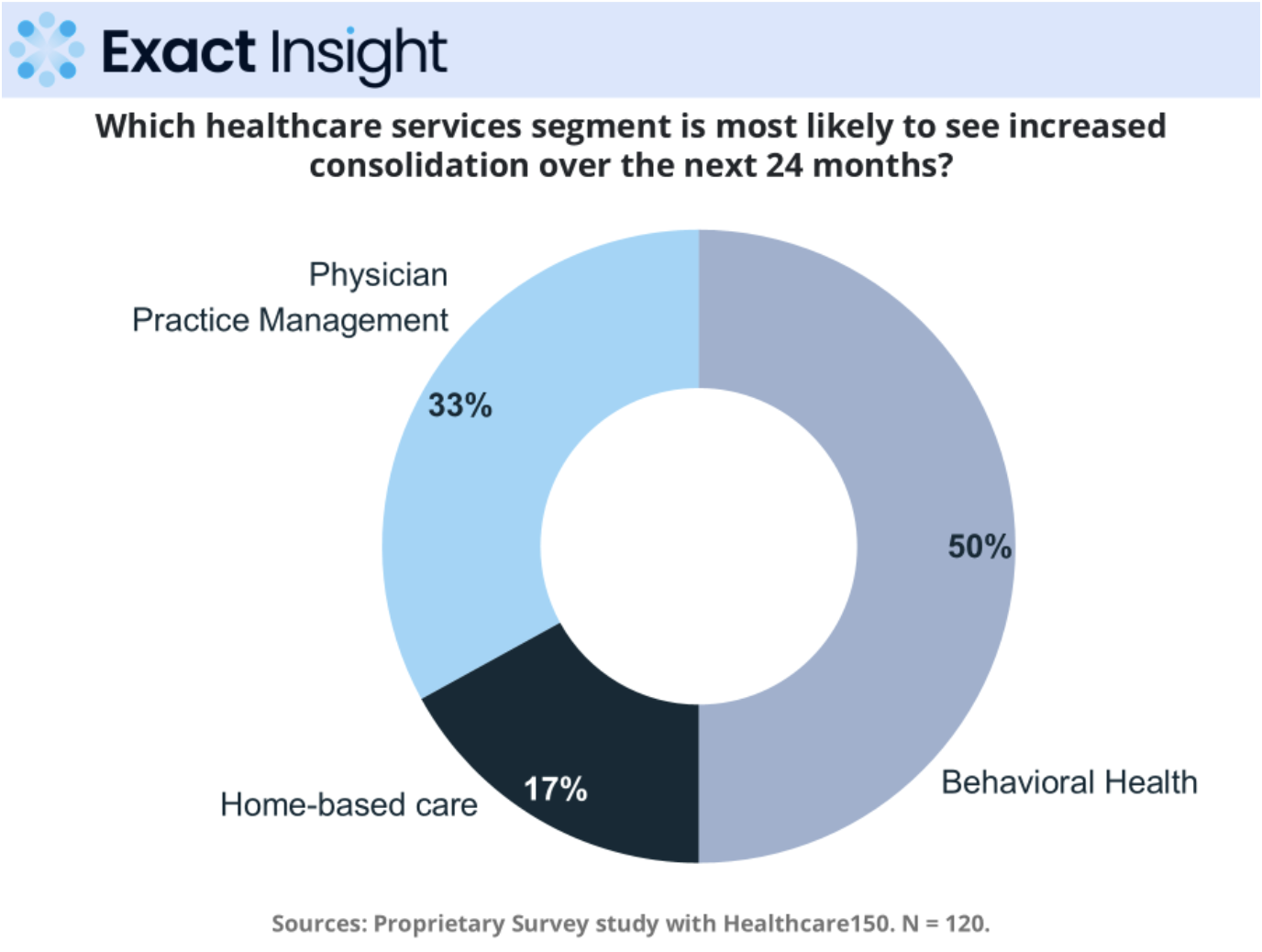
The findings highlight a compelling diligence thesis. Behavioral health combines persistent demand-supply imbalances with a highly fragmented provider landscape, creating opportunities for buyers to build scale, improve administrative efficiency, strengthen payer negotiations, expand referral networks, and invest in technology.
Physician practice management remains firmly on the consolidation radar, although rising labor costs, reimbursement uncertainty, and regulatory scrutiny are making specialty and platform selection increasingly important. Home-based care, meanwhile, appears to be shifting toward a more disciplined phase focused on sustainable margins and workforce stability.
The diligence takeaway: consolidation potential alone is not enough. The strongest opportunities will be platforms where scale translates into measurable operational advantages, better care coordination, and stronger economics. Right now, our network sees behavioral health as the clearest intersection of those characteristics.
Read More
|
|
|
Our Know-how
Expert Calls: The Human Edge in Due Diligence
Private equity diligence is increasingly data-rich, but some of the most valuable insights still cannot be found in a data room. As deal timelines compress and competition for attractive assets intensifies, expert calls are becoming a critical component of pre-deal intelligence.
By speaking directly with former executives, customers, competitors, suppliers, and industry specialists, investment teams can pressure-test the assumptions behind an investment thesis before committing capital. These conversations can reveal nuances that financial models and market reports often miss, from actual pricing power and customer switching behavior to competitive threats, operational bottlenecks, and emerging regulatory risks.
The value is particularly powerful early in diligence. A handful of carefully selected conversations can help determine whether a market is as attractive as it appears, whether management's growth assumptions are realistic, and which risks deserve deeper investigation. Expert insight should not replace quantitative analysis, but it can identify where the numbers need to be challenged.
For deal teams, this creates a simple advantage: faster learning, sharper questions, and stronger conviction before the investment committee.
Need firsthand intelligence for your next deal? Tap into Exact Insight's expert network to connect with highly relevant industry professionals and bring real-world insight directly into your diligence process.
|
|
|
Pre-Deal Intelligence
Revenue Quality: Not All Growth Is Created Equal
A company growing 20% annually may look like a compelling investment. But in commercial diligence, the headline growth rate tells only part of the story. The more important question is: What is actually driving that growth?
Revenue expansion typically comes from four sources: price, volume, mix, and acquisitions. Two companies can report identical growth while having fundamentally different underlying economics. One may be gaining customers and increasing volumes organically, while another relies on aggressive pricing or repeated acquisitions to offset declining demand.
This distinction matters because not every growth driver is equally sustainable. Price-led growth can weaken if customers become more sensitive or competitors respond. Acquisition-driven growth may conceal weak organic performance. Favorable mix shifts can reverse. By contrast, consistent volume growth supported by customer acquisition, retention, and market share gains often signals stronger underlying demand.
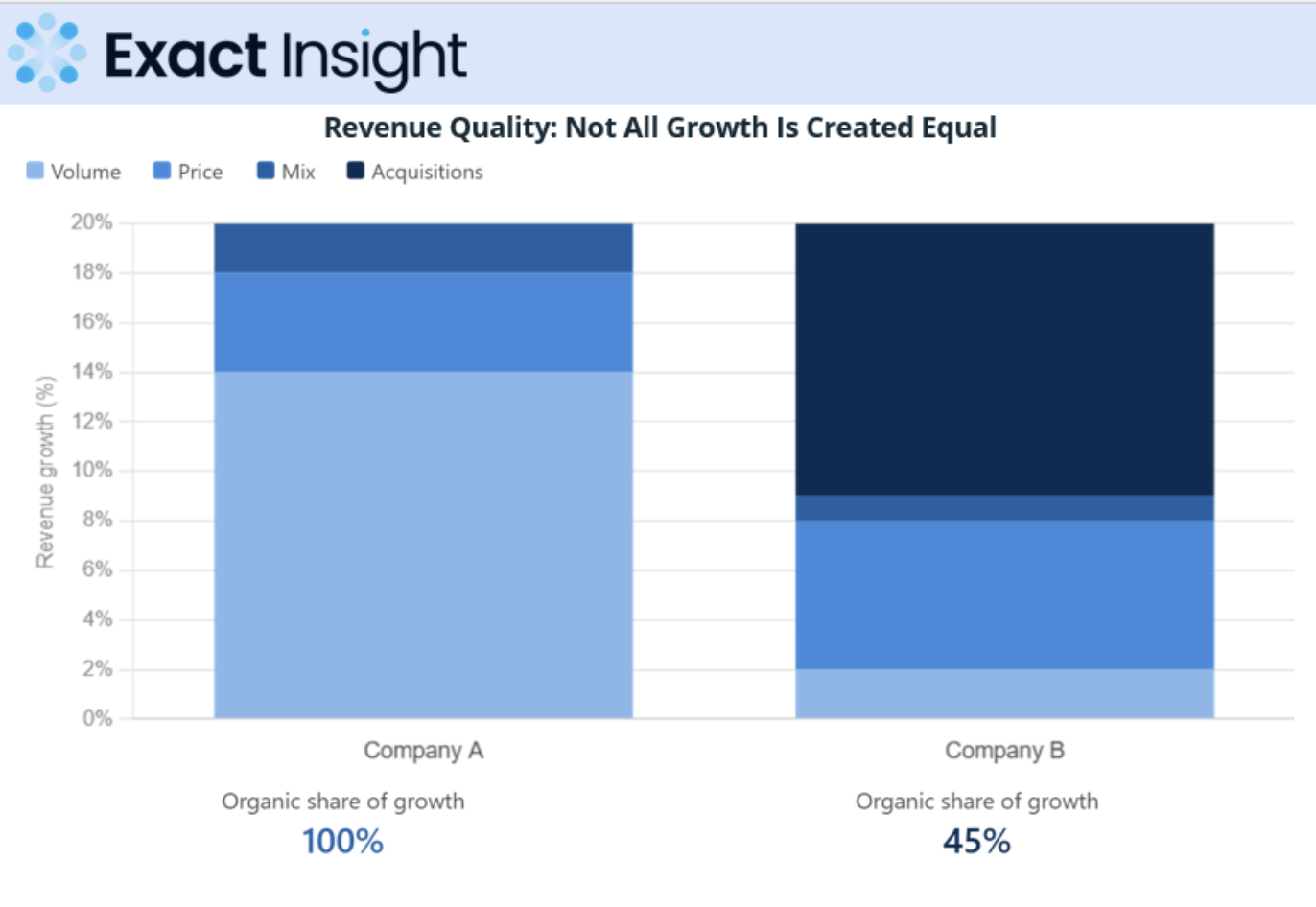
Commercial diligence should therefore decompose historical growth rather than treating revenue CAGR as a single metric. Investors should test organic versus inorganic growth, price realization, unit volumes, customer growth, market expansion, and mix effects.
The implication for valuation is straightforward: two businesses with identical historical growth rates may deserve very different multiples.
For investors, revenue quality analysis answers the question that matters most: Is the growth engine repeatable after the deal closes?
|
|
|
Interesting Articles
Worth Your Time
|
|
|