|
OPERATOR SIGNAL
|
|
BEFORE THE INVESTMENT COMMITTEE
|
Pilots Prove. Systems Decide. Scale Separates.
This week, Operator Signal looks at why digital health companies still struggle to turn promising pilots into enterprise platforms, how investors should diligence hospital adoption risk before underwriting software-led healthcare growth, and Babylon Health as a reminder that consumer demand and technology visibility do not automatically create a durable operating model.
|
|
Hi there,
Across all three topics, the message is consistent: healthcare technology only becomes valuable when it can survive the complexity of real delivery systems.
Exact Insight surfaces these patterns early.directly from operator conversations.before they show up in CIMs or IC memos.
Access the full briefing or request expert calls in this sector to go deeper.
|
|
|
INSIGHTS FROM THE NETWORK
Digital Health's Scale Problem Is Operational, Not Technical
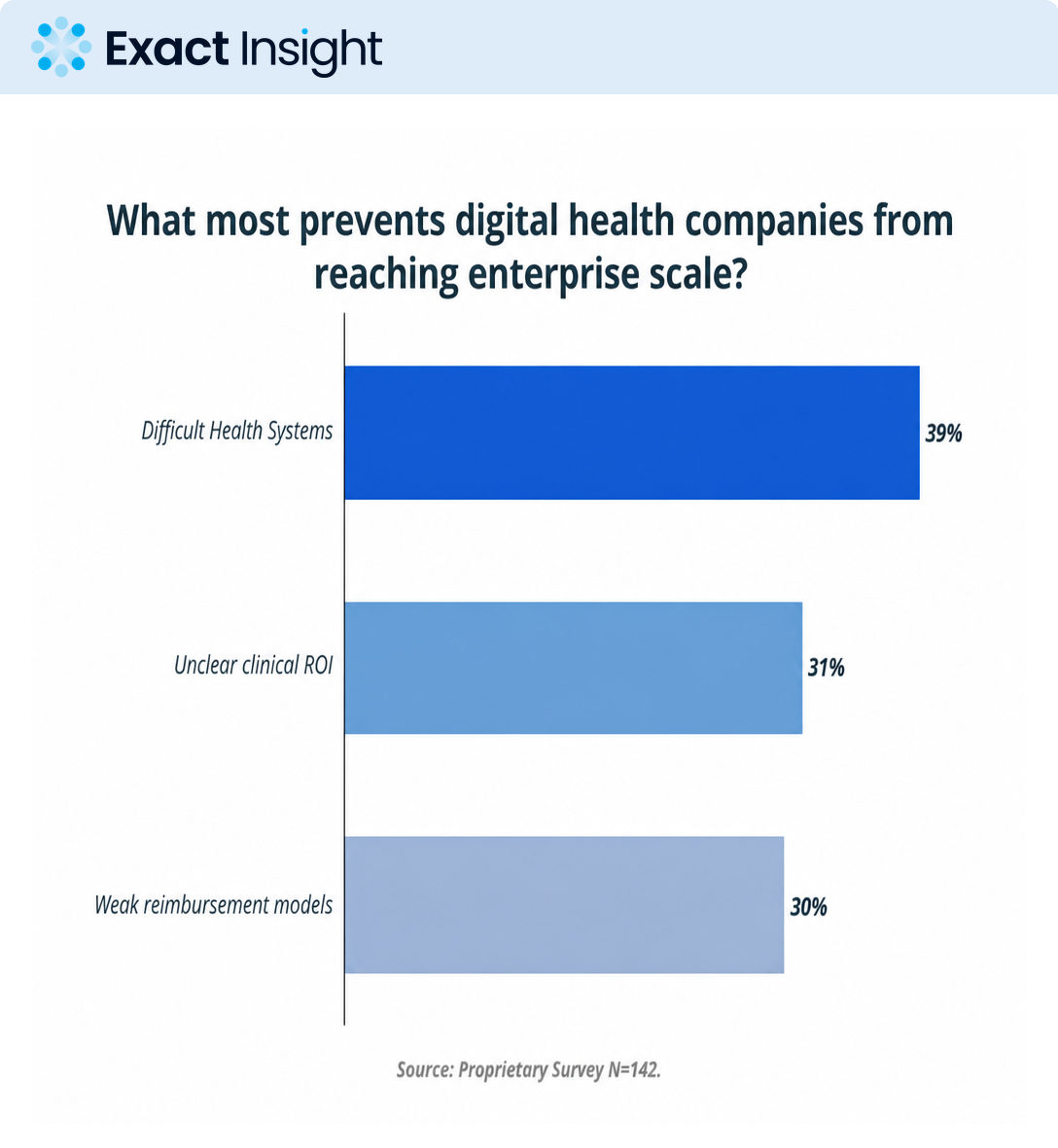
In the survey we conducted in partnership with Healthcare150, 142 healthcare professionals pointed to a clear constraint on digital health scale. The largest share of respondents, 39%, identified navigating health systems as the biggest obstacle preventing digital health companies from reaching enterprise scale. That ranked ahead of unclear clinical ROI at 31% and weak reimbursement models at 30%.
That hierarchy matters because it reframes what investors should treat as the real bottleneck. The problem is not simply whether a product works in a pilot. It is whether the buyer organization can adopt it across clinicians, procurement, IT, finance, compliance, legal, and operational stakeholders without adding friction to workflows that are already under pressure.
The survey also suggests that clinical validation is no longer enough on its own. Health systems increasingly expect digital health vendors to connect adoption to measurable enterprise value, including lower administrative cost, shorter wait times, better revenue capture, improved clinician productivity, or reduced operational leakage.
For investors, the implication is straightforward: execution has become part of the product. The best digital health companies may not be the ones with the most advanced feature set. They will be the ones that can integrate cleanly, prove financial value, and make implementation feel manageable inside complex health systems.
|
|
|
PRE-DEAL INTELLIGENCE
Can This Product Survive the Hospital Buying System?
Digital health diligence should not stop at product efficacy or pilot outcomes. The harder question is whether the company can repeatedly move from departmental enthusiasm to enterprise adoption.
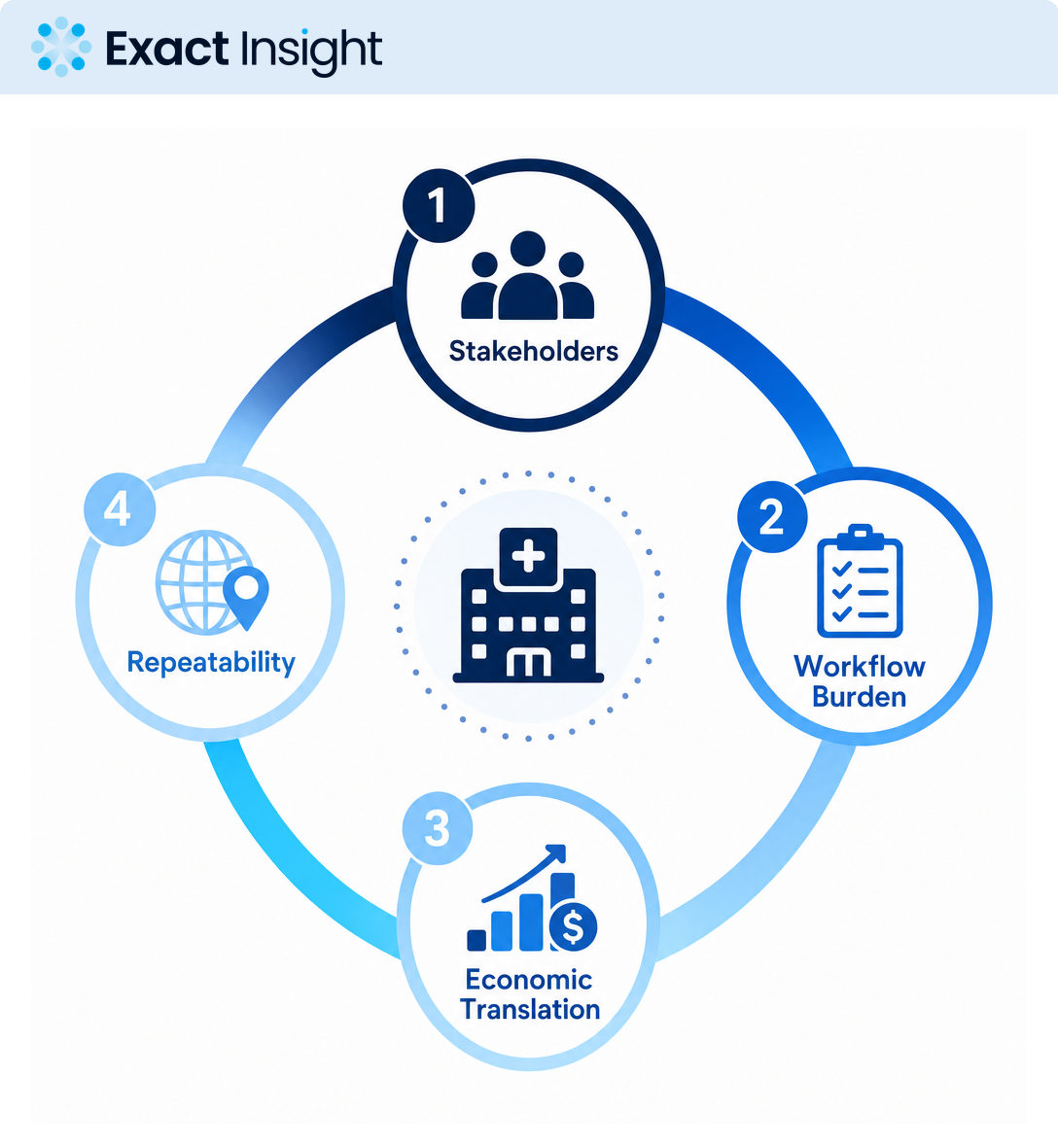
A useful diligence screen starts with four tests.
First, stakeholder complexity. Who must say yes before expansion happens, and what does each group measure? A product that excites clinicians may still stall if IT sees integration risk, finance cannot verify ROI, or compliance sees unresolved exposure.
Second, workflow burden. Does implementation remove work from the system, or does it create another process clinicians and administrators must manage? In hospitals, even good technology can fail if the adoption cost lands on already constrained teams.
Third, proof of economic translation. Can management show that usage converts into recognized savings, revenue improvement, throughput, or capacity release? Pilot metrics matter less if the CFO cannot see the benefit in operating results.
Fourth, repeatability across sites. Has the company proven that implementation works across different EHR environments, leadership structures, specialties, and payer mixes? A product that scales only with founder-led handholding may not support venture or sponsor-style growth assumptions.
In this market, the question is not just whether the product solves a healthcare problem. It is whether the organization buying it can actually absorb the solution.
|
|
|
LESSONS FROM THE FIELD
Babylon Health Shows How Digital Health Scale Can Break Without Operating Proof
Babylon Health offered one of the clearest cautionary cases in digital health. The company went public through a SPAC transaction in 2021 at a reported $4.2 billion valuation, positioning itself as a scaled digital-first healthcare platform.
Less than two years later, the model had unraveled. Babylon filed for Chapter 7 bankruptcy protection for U.S. subsidiaries in August 2023, and the company later announced that substantially all of its remaining U.K. business assets had been acquired by eMed. The SEC filing stated that the sale would not provide payment to Babylon's Class A ordinary shareholders or other equity instrument holders.
The lesson is not that digital health lacks demand. It is that demand, brand awareness, and public-market access cannot substitute for durable unit economics, reimbursement clarity, implementation discipline, and credible operating scale.
For deal teams, Babylon is a reminder to underwrite adoption quality before growth narrative. If a healthcare technology company cannot prove that customers can buy, deploy, expand, and economically sustain the product, reported scale may be more fragile than it looks.

Read More
Babylon Holdings Limited Form 8-K
Babylon sells UK business to US firm as it winds down operations
|
|
|
INTERESTING ARTICLES
Worth Your Time
Why Digital Health Still Struggles to Reach Enterprise Scale
Babylon Holdings Limited Form 8-K
Babylon closes US business, lays employees
|
|
Operator Signal · by Exact Insight
Exact Insight · 170 Mason Street, Greenwich, Connecticut 06830, United States
You're receiving this because you subscribed to Operator Signal.
|
|