|
EXACT INSIGHT WEEKLY
|
OPERATOR SIGNAL · BEFORE THE IC MEMO
|
|
|
|
Operator Signal · Before the IC Memo
|
Diligence Alert: Modeling
Revenue Volatility vs. AI Defensibility
As deal noise and technical hype intensify, the gap between perceived value and structural defensibility is widening—success now requires isolating the specific assets that can withstand an aggressive competitive cycle.
|
|
Operator Signal. Before the Investment Committee.
This week's signal highlights a market where "participation" no longer guarantees "protection." As deal noise and technical hype intensify, the gap between perceived value and structural defensibility is widening. Success now requires moving past broad growth labels to isolate the specific assets—proprietary code, stable revenue streams, or niche clinical platforms—that can actually withstand an aggressive competitive cycle.
Insights from our network and recent deal flow reveal three distinct focal points: a flight to precision in Healthcare M&A, where conviction is shifting toward specialty care and tech-enabled platforms with high visibility; a critical diligence gap in how customer concentration is modeled, often overlooking how top-line dependency triggers outsized earnings volatility; and the urgent need to distinguish defensible AI from superficial wrappers that lack the "secret sauce" needed to deter entrants.
The takeaway: prioritize precision over breadth by backing healthcare assets with proven unit economics; treat customer concentration as a primary driver of earnings-at-risk rather than a footnote; and look beyond "AI-enabled" labels to validate a true technical moat. In a market where everyone claims an edge, the only credible defense is structural, not narrative.
Exact Insight surfaces these patterns early—directly from operator conversations—before they show up in CIMs or IC memos.
|
|
|
Insights From the Network
Where Healthcare M&A Looks Most Resilient
|
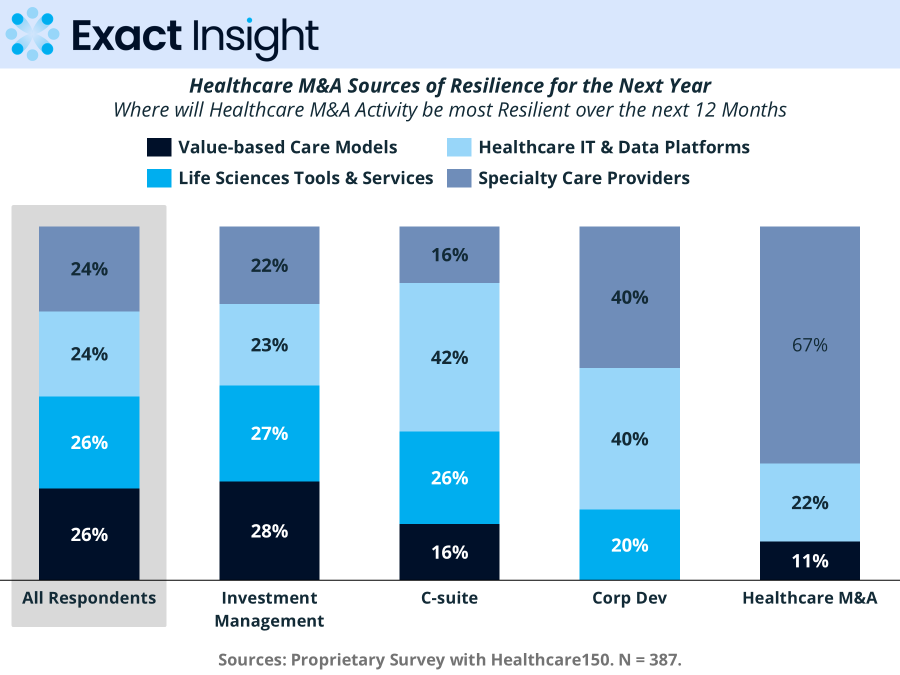
In partnership with Healthcare150, we ran a microsurvey to understand where healthcare M&A activity is most likely to hold up over the next 12 months. The signal from our network is clear: dealmaking is still happening, but buyers are concentrating on assets with stronger visibility, defensibility, and scalable economics.
At the market level, sentiment was broadly balanced. Value-based care models and life sciences tools & services each captured 26% of responses, while healthcare IT & data platforms and specialty care providers followed closely at 24% each. Rather than one dominant theme, respondents see multiple pockets of resilience.
The strongest conviction came from operators and transaction professionals. 67% of healthcare M&A respondents selected specialty care providers as the most resilient segment, pointing to continued appetite for outpatient, procedure-driven platforms with predictable demand and consolidation potential.
Meanwhile, executives leaned toward technology-enabled assets. 42% of C-suite leaders chose healthcare IT & data platforms, with corporate development teams split between IT and specialty care (40% each). The appeal is straightforward: recurring revenue, workflow efficiency, and infrastructure critical to cost containment.
For investors, value-based care remains relevant—but underwriting standards have tightened. Proven outcomes, payer alignment, and durable unit economics matter more than narrative growth.
Our view: 2026 healthcare M&A will reward precision over breadth, with capital flowing to assets that combine real demand, clear margins, and credible paths to scale.
|
|
|
Diligence Blind Spot
Customer Concentration Is Often Underwritten Too Lightly
|
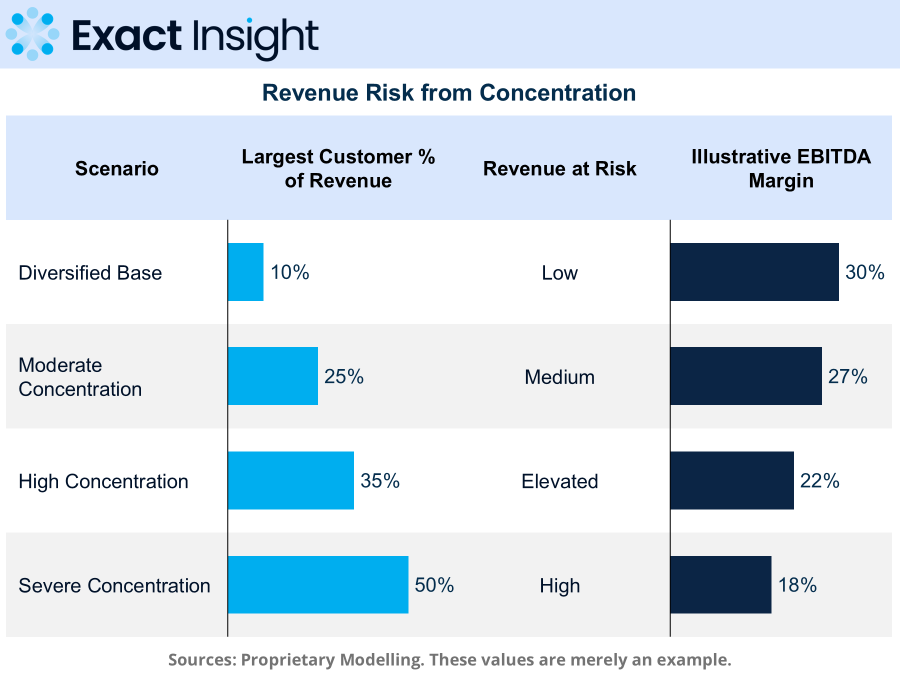
A recurring issue in diligence is treating customer concentration as a disclosure item rather than a valuation driver. Sponsors and buyers may note that a business has one or two customers representing 20–40% of revenue, but fail to fully underwrite renewal risk, pricing leverage, and the operational dependence tied to those relationships.
The problem becomes more acute when concentrated customers are sophisticated buyers with procurement power or multiple vendor alternatives. Revenue may appear stable historically, yet a single rebid, insourcing decision, or pricing reset can materially impair EBITDA in a short period.
For example, a company generating 30% EBITDA margins with its largest customer representing 35% of revenue may see margins compress to 22% if that account reprices by 10% and fixed costs remain largely intact. What looks like modest commercial downside can create outsized earnings impact.
|
The key principle: customer concentration should be modeled as an earnings volatility issue—not just a commercial footnote. Proper diligence should test contract durability, switching costs, wallet share trends, and downside cases tied to top-account attrition.
|
|
|
|
Pre-Deal Intelligence
Defensible AI as an Entry Barrier
|
The Emerging Signal
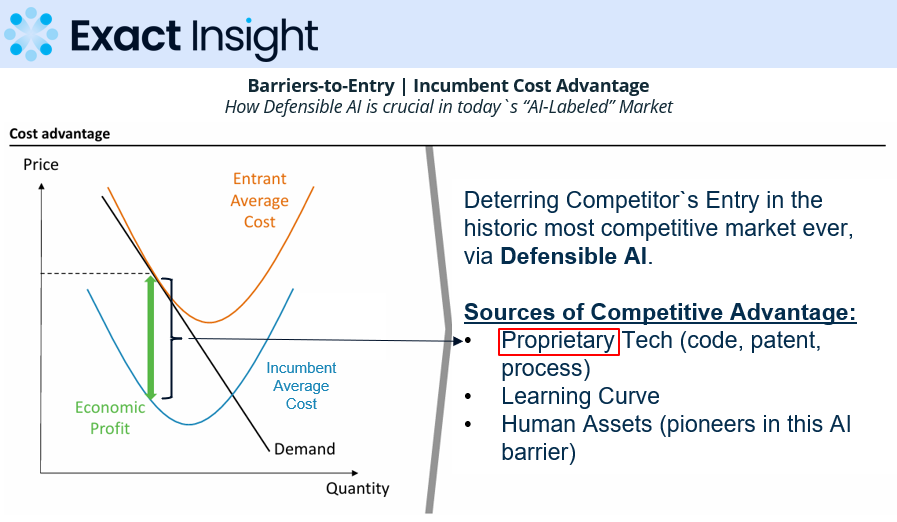
In today's "AI-labeled" market, the distinction between an AI-wrapped service and a truly AI-driven company is a primary driver of enterprise value. As shown in the chart, a structural Incumbent Cost Advantage is the only way to generate sustained economic profit.
While many startups claim AI capabilities, most are merely "renting" intelligence via API calls to models like Claude or GPT-4. Without a proprietary "secret sauce," these firms lack a learning curve and face an entrant average cost curve nearly identical to their own, leading to rapid margin erosion.
|
What to Pressure-Test
1. Technical Moat (Proprietary Tech)
|
Does the target own the underlying code, patents, or unique data-processing workflows? |
|
Assess if the AI is a core architectural component or a peripheral feature that a competitor could replicate in a weekend |
2. The Learning Curve & Human Assets
|
Is there a data flywheel effect where more usage leads to a structural cost advantage? |
|
Evaluate the "AI Pioneers" on the team—is the talent high-level enough to maintain a barrier against fast-followers? |
|
Why It Matters Now
Competition is moving faster than ever. When every company is "AI-enabled" by default, the label provides zero protection. Diligence must move beyond functional testing to structural defensibility.
|
If the cost curve doesn't shift downward through proprietary assets, the company isn't an AI leader—it's a commodity service provider in an overcrowded market.
|
|
|
|
|
|
Want to weigh in on the next survey?
Exact Insight is built from operator signal — and the next cut is already in motion. If you're a C-suite leader, director, or senior practitioner and want to contribute (and get early access to the findings), join our next survey here:
|
|
You're receiving this because you subscribed to Exact Insight Weekly.
exactinsight.ai
·
exactinsightweekly.com
|
|