|
OPERATOR SIGNAL
|
|
BEFORE THE INVESTMENT COMMITTEE
|
More Capital. Better Intelligence. Measurable AI.
This week's insights examine a central challenge in today's deal environment: more activity and more technology do not automatically translate into better investments. As capital deployment expectations shift and AI becomes increasingly embedded in value creation plans, investors need stronger evidence to distinguish attractive narratives from capabilities that can genuinely improve business performance.
|
|
Hi there,
Our latest proprietary survey conducted in partnership with PE150 shows a market moving at different speeds. While 42% of respondents expect investment activity to increase over the next 12 months, PE sponsors remain considerably more cautious, with 55% anticipating a decline. We complement these findings with a look at expert panel surveys, conducted in partnership with 150 Diligence, and how targeted primary research can quantify customer behavior, competitive positioning, pricing power, and other assumptions before they become embedded in an investment case. Finally, our Pre-Deal Intelligence section examines AI maturity and productivity, highlighting why investors should look beyond tool adoption and determine whether AI is producing measurable improvements in the underlying economics of a target.
Across all three topics, the message is consistent: conviction should come from evidence, not momentum.
Whether deploying capital, validating an investment thesis, or underwriting AI-driven value creation, stronger diligence begins by asking what can actually be measured, validated, and defended before the deal is done.
Exact Insight surfaces these patterns early—directly from operator conversations—before they show up in CIMs or IC memos.
Access the full briefing or request expert calls in this sector to go deeper.
|
|
|
|
INSIGHTS FROM THE NETWORK
More Capital May Be Moving—But Not From Everyone
Private markets may be preparing for a busier deployment environment, but expectations vary sharply across the deal ecosystem.
Our latest proprietary microsurvey conducted in partnership with PE150 found that 42% of respondents expect their organizations to increase investment activity over the next 12 months, including 19% anticipating a significant increase. Another 26% expect activity to remain unchanged, while 33% anticipate some degree of decline.
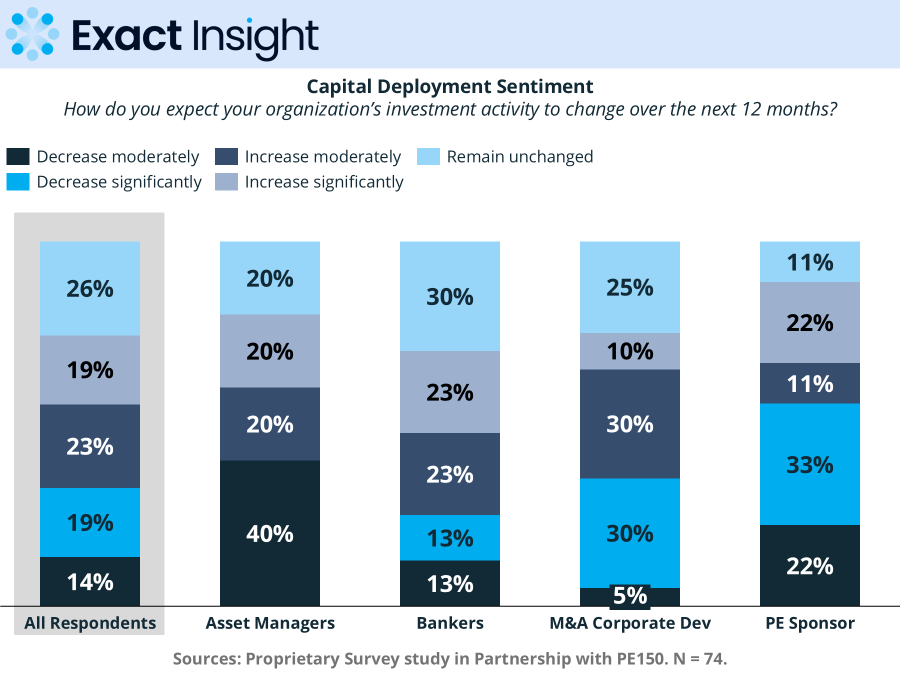
The divergence by respondent type is particularly revealing. Bankers are the most constructive, with 46% expecting increased activity, while 40% of both asset managers and corporate development professionals expect deployment to rise. PE sponsors stand apart: 55% expect investment activity to decline, compared with only 33% anticipating an increase.
For dealmakers, this creates an unusual setup. Transaction activity can recover even while sponsors remain cautious. If bankers, strategics, and other pools of capital become more active while PE firms maintain tighter underwriting standards, competition could become increasingly concentrated around a limited universe of high-quality assets.
The implication for diligence is important: more deal flow does not necessarily mean more attractive deals. As capital returns, disciplined selection—and knowing when not to deploy—may become even more valuable.
|
|
|
|
PRE-DEAL INTELLIGENCE
Is AI Productivity Real—or Just an Adoption Story?
AI is increasingly appearing in value creation plans, but pre-deal diligence should distinguish between AI adoption and measurable operating improvement. Giving employees access to AI tools is relatively easy; embedding those tools into workflows in a way that changes business economics is considerably harder.
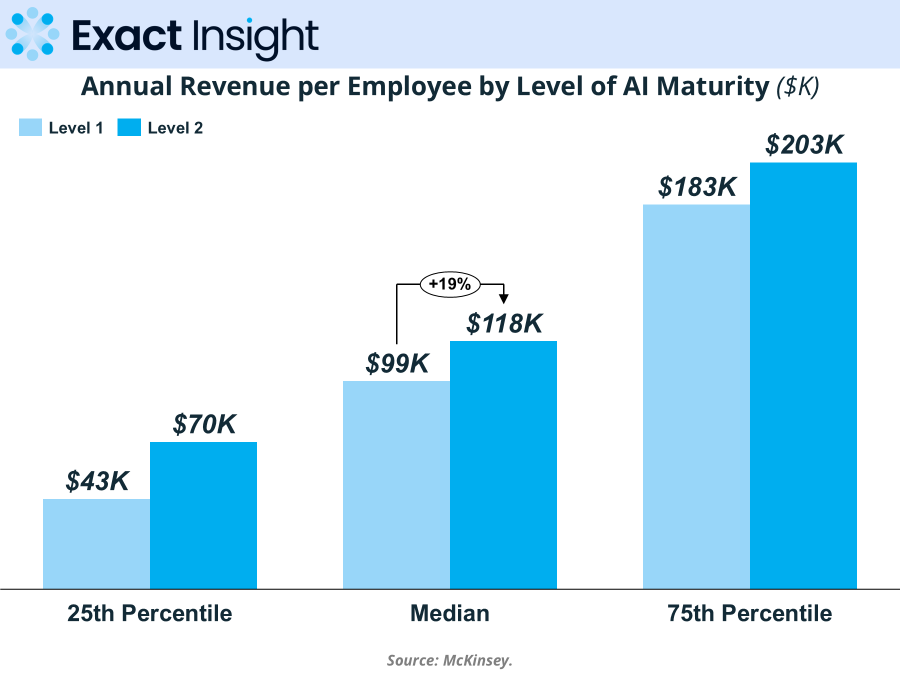
McKinsey's analysis of PE-backed companies illustrates the distinction. At the median, Level 2 businesses—those integrating AI into operating workflows—generated $118,000 in annual revenue per employee, versus $99,000 for Level 1 companies characterized by more opportunistic adoption, a 19% difference. Similar gaps appear across the productivity distribution.
These figures do not establish that AI caused the productivity advantage. More productive businesses may also possess better technology infrastructure, cleaner data, stronger management, or other characteristics that make systematic AI adoption easier.
That is precisely what diligence should investigate. Investors should test where AI is deployed, which workflows have actually changed, what implementation costs are required, and whether improvements can be demonstrated through operating KPIs such as revenue per employee, cost per transaction, sales capacity, or margins.
The underwriting question is not "Does this company use AI" It is "Can we demonstrate that AI is changing the economics of the business"
|
|
|
|
OUR KNOW-HOW
Expert Panel Surveys: Turning Market Experience Into Decision-Ready Data
Expert calls can reveal the why behind a market. Expert panel surveys help investors determine how widely those views actually hold.
In partnership with 150 Diligence, we design and execute targeted surveys among industry professionals, customers, operators, and other relevant market participants to test the assumptions behind an investment thesis at scale. Rather than relying on a handful of conversations, deal teams can quantify market sentiment across a broader expert sample and identify where consensus—and disagreement—actually exists.
The applications span the diligence process. Expert panels can test customer purchasing criteria, pricing sensitivity, competitive positioning, brand perception, switching behavior, market growth expectations, technology adoption, and emerging risks. Results can also be segmented by respondent profile, company size, geography, or other relevant characteristics to uncover differences hidden within headline averages.
Most importantly, expert panel surveys transform qualitative hypotheses into measurable evidence. A deal team may believe a target has strong pricing power or superior customer loyalty; a properly designed survey can directly test those assumptions before they become embedded in the underwriting case.
For investors, the advantage is straightforward: broader market validation, quantified conviction, and clearer evidence for the investment committee.
Need to pressure-test the market behind your next deal? Through our partnership with 150 Diligence, Exact Insight can design, field, and analyze targeted expert panel surveys built around the key questions driving your investment thesis.
|
|
|
|
INTERESTING ARTICLES
Worth Your Time
Industrializing AI Across the Portfolio
10 IT Due Diligence Questions PE Firms Should Ask Before an Acquisition
Private Equity Pricing Topology: Power Diligence
|
|
Operator Signal . by Exact Insight
Exact Insight . 170 Mason Street, Greenwich, Connecticut 06830, United States
You're receiving this because you subscribed to Operator Signal.
|
|