|
Operator Signal · Before the IC Memo
Structural Fragmentation Across Capital Markets
A market increasingly defined by fragmentation, competitive pressure, and the growing importance of discipline beneath strong headline growth.
|
|
Opening Words
Operator Signal. Before the Investment Committee.
This week's signals point to a market increasingly defined by fragmentation, competitive pressure, and the growing importance of discipline beneath strong headline growth. Across financing markets, private credit, and strategic execution, the common challenge is no longer simply accessing capital or identifying opportunity — it is determining which business models and underwriting assumptions remain durable as liquidity conditions evolve.
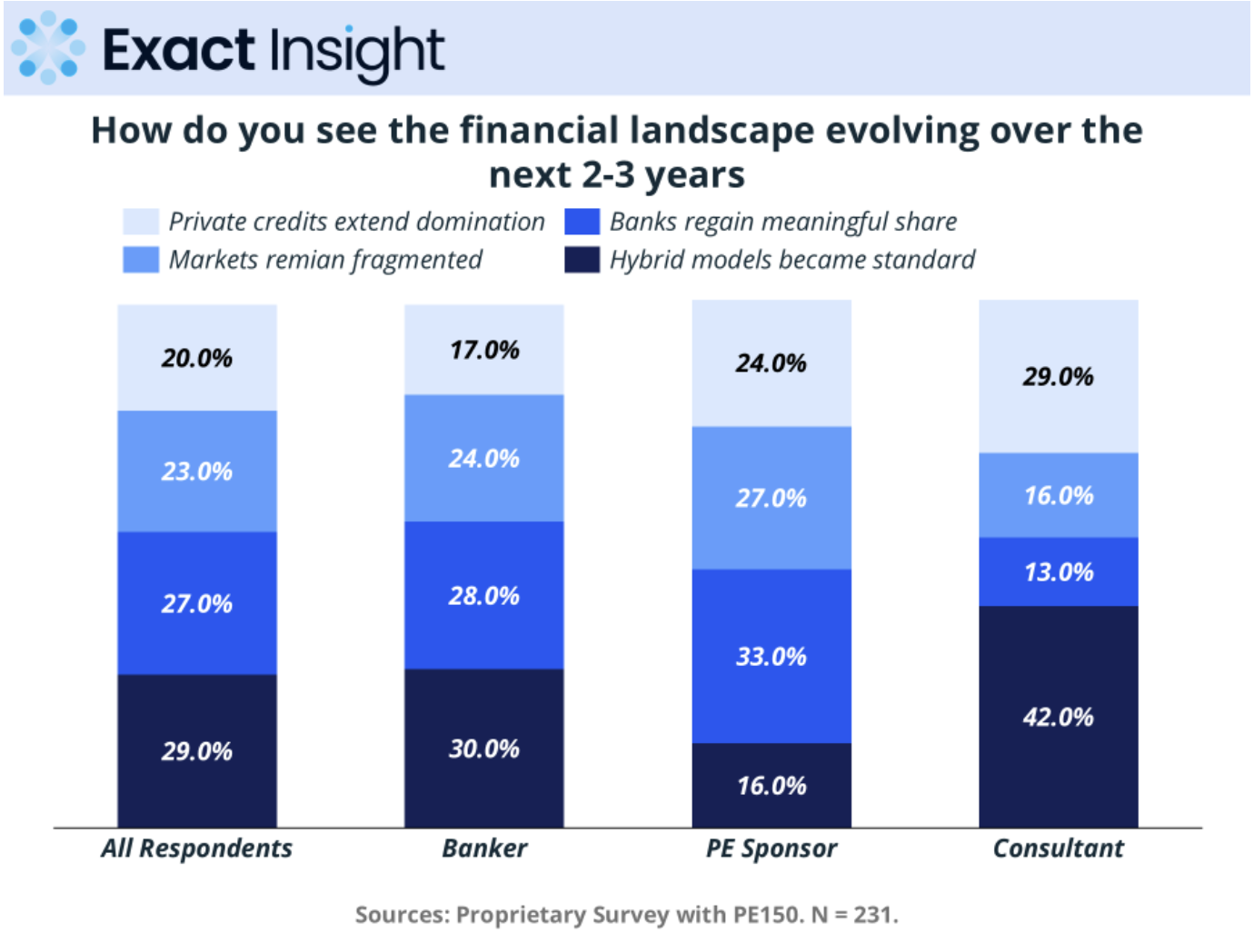
As private markets continue adapting to higher rates, extended holding periods, and shifting refinancing dynamics, investors are becoming less focused on consensus narratives and more focused on structural resilience. Our latest survey with PE150 suggests many market participants expect the future financial landscape to become increasingly fragmented, with banks, private lenders, and hybrid financing structures competing simultaneously across different parts of the market. At the same time, concerns are rising that excess capital and competitive deployment pressure may gradually weaken underwriting discipline within private credit.
Insights from our network and recent analysis highlight three recurring themes: the growing importance of flexibility in a fragmented financing environment; the risk that abundant liquidity can compress selectivity and normalize weaker underwriting standards; and a continued reminder from the DaimlerChrysler merger that even compelling strategic logic can fail when execution complexity and organizational realities are underestimated.
The takeaway: evaluate financing markets through the lens of adaptability rather than permanence; pressure-test underwriting assumptions most aggressively when competition is strongest; and treat operational alignment as a core diligence issue, not a secondary integration consideration. In a market increasingly shaped by evolving liquidity structures and narrowing margins for error, the advantage may belong less to firms with the most capital — and more to those with the discipline to deploy it selectively.
Exact Insight surfaces these patterns early — directly from operator conversations — before they show up in CIMs or IC memos.
Access the Full Briefing →
|
|
|
Insights From the Network
Financial Markets: Is Fragmentation Becoming the New Normal?
Private credit has expanded rapidly over the last several years, supported by constrained bank lending, abundant alternative capital, and increasing demand for flexible financing solutions. But as financing markets continue evolving, investors are beginning to question whether the future landscape will be defined by private credit dominance alone — or by a more fragmented ecosystem where banks, private lenders, and hybrid financing structures coexist.
According to our survey conducted with our partners at PE150, hybrid financing models were identified as the most likely long-term outcome by 29% of respondents overall, with consultants expressing the strongest conviction at 42%. At the same time, PE sponsors showed materially higher expectations that banks could regain meaningful market share, with 33% selecting that outcome, suggesting growing divergence between market participants on how competitive dynamics may evolve over the next several years.
The key question is becoming: Are current financing markets moving toward consolidation around private capital — or toward a structurally fragmented system with multiple competing liquidity providers?
Areas that investors should pressure-test include:
- Dependence on private credit availability under stressed refinancing conditions
- Competitive pressure between banks and private lenders on pricing and structure
- Sustainability of returns as more capital enters alternative lending markets
- Reliance on hybrid capital solutions to support transaction activity
- Liquidity flexibility across different financing environments
- Sensitivity of capital structures to changes in interest rates and credit conditions
The strongest platforms are likely to be differentiated not simply by access to capital, but by flexibility across financing environments, underwriting discipline, and the ability to navigate increasingly complex liquidity ecosystems.
Key Insight
The future of financial markets may not be defined by a single dominant source of capital — but by increasing fragmentation between banks, private lenders, and hybrid financing models competing across different parts of the market.
Read the Full Article →
|
|
|
Reader Survey
IT Leaders & AI: 2026 State of Practice
We're surveying IT leaders on how AI is actually being adopted inside organizations in 2026 — what's working, what's stalled, and where teams are investing next. Take our 3-minute reader survey and help shape the upcoming report.
Take the Survey →
|
|
|
Deal Autopsy: Lessons from the Field
DaimlerChrysler: When Strategic Logic Ignores Cultural Reality
The 1998 merger between Daimler-Benz and Chrysler was initially presented as a "merger of equals" that would create a global automotive powerhouse capable of combining German engineering strength with American manufacturing scale and market reach. Instead, it became one of the most cited examples of cultural and operational integration failure in modern M&A history.
Daimler-Benz acquired Chrysler in a deal valued at approximately $36B during a period of strong automotive demand and increasing globalization across the industry. Management projected significant synergies through shared procurement, manufacturing efficiencies, platform integration, and expanded international distribution.
In practice, the integration quickly became strained by deep cultural and managerial differences. Daimler operated with a highly hierarchical, engineering-driven corporate structure, while Chrysler maintained a faster-moving, cost-focused, and more entrepreneurial operating culture. Decision-making processes, compensation philosophies, and management expectations differed materially between the two organizations.
The operational complexity of integrating product development, manufacturing systems, and corporate functions proved substantially greater than anticipated.
Rather than producing the expected synergies, the merger generated internal friction, talent attrition, and strategic misalignment. Daimler ultimately sold a majority stake in Chrysler to Cerberus Capital Management in 2007 for approximately $7.4bn — a fraction of the original transaction value.
Key Diligence Gaps
- Underestimating cultural and managerial integration risk
- Overestimating achievable operational synergies across fundamentally different organizations
- Failure to align incentives and management structures early in the integration process
- Assuming scale alone would create competitive advantage in a cyclical industry
Strategic logic and financial synergies cannot compensate for incompatible operating cultures. In complex integrations, cultural alignment is not a soft consideration — it is often a primary determinant of execution success or failure.
Read More →
|
|
|
Pre-Deal Intelligence
Secondary Liquidity Is Starting to Influence Valuations
As exit timelines continue to extend across private markets, secondary liquidity solutions are becoming increasingly embedded in valuation dynamics. Continuation vehicles, GP-led secondaries, structured liquidity transactions, and minority stake sales were initially viewed as temporary tools to manage delayed exits. Increasingly, they are becoming part of the market's core liquidity infrastructure.
The shift matters because secondary transactions can influence not only liquidity timing, but also valuation expectations, portfolio marks, and sponsor incentives. In some cases, transactions that provide liquidity may simultaneously reduce true price discovery, particularly when buyer pools are limited or when sponsors retain significant influence over valuation processes.
The key question is becoming: Are valuations still being validated by broad market demand, or increasingly supported by engineered liquidity solutions?
Areas that investors should pressure-test include:
- Reliance on continuation vehicles to delay exits
- Alignment of incentives between LPs, GPs, and secondary buyers
- Whether portfolio marks are supported by competitive third-party pricing
- Sensitivity of valuations to lower financing availability
- Dependence on structured liquidity to sustain reported performance
- Concentration of demand among a small group of secondary market participants
The strongest firms are likely to be differentiated not by their ability to manufacture liquidity, but by whether underlying portfolio companies can attract genuine buyer demand under normalized market conditions.
Key Insight
Secondary liquidity can stabilize portfolios during periods of weak exits, but it can also blur valuation discipline when liquidity solutions begin substituting for true market clearing prices.
Read More →
|
|
|
Interesting Articles
Worth a Read This Week
|
|
Want to weigh in on the next survey?
Exact Insight is built from operator signal — and the next cut is already in motion. If you're a C-suite leader, director, or senior practitioner and want to contribute (and get early access to the findings), join our next survey.
Sign Up to Participate →
|
|
|