|
Operator Signal · Before the IC Memo
Why Validation Matters More Than Narrative
Conviction is no longer built on access to information alone — it is built on the ability to validate assumptions under pressure.
|
|
Opening Words
Operator Signal. Before the Investment Committee.
This week's signal points to a market where conviction is no longer built on access to information alone — it is built on the ability to validate assumptions under pressure. As underwriting environments tighten and holding periods extend, the distinction between narrative and evidence is becoming increasingly consequential. In this environment, consensus can create false confidence, while resilience depends on understanding what truly holds up when conditions change.
Insights from our network and recent analysis highlight three focal points: the growing importance of combining expert perspectives with real-time market validation in diligence processes; a reminder from the Toys "R" Us collapse that leverage without adaptability can turn operational strength into strategic fragility; and a critical operational lens on efficiency, where strong margins may conceal underlying scalability and productivity risks.
The takeaway: treat expert consensus as a starting point, not confirmation; evaluate leverage through the lens of adaptability, not just return amplification; and view operational efficiency as a measure of resilience under stress, not simply current profitability. In a market increasingly defined by structural disruption and tighter execution windows, the edge belongs to firms that pressure-test assumptions faster than others accept them.
Exact Insight surfaces these patterns early — directly from operator conversations — before they show up in CIMs or IC memos.
Access the Full Briefing →
|
|
|
Insights From the Network
Beyond the Expert Call
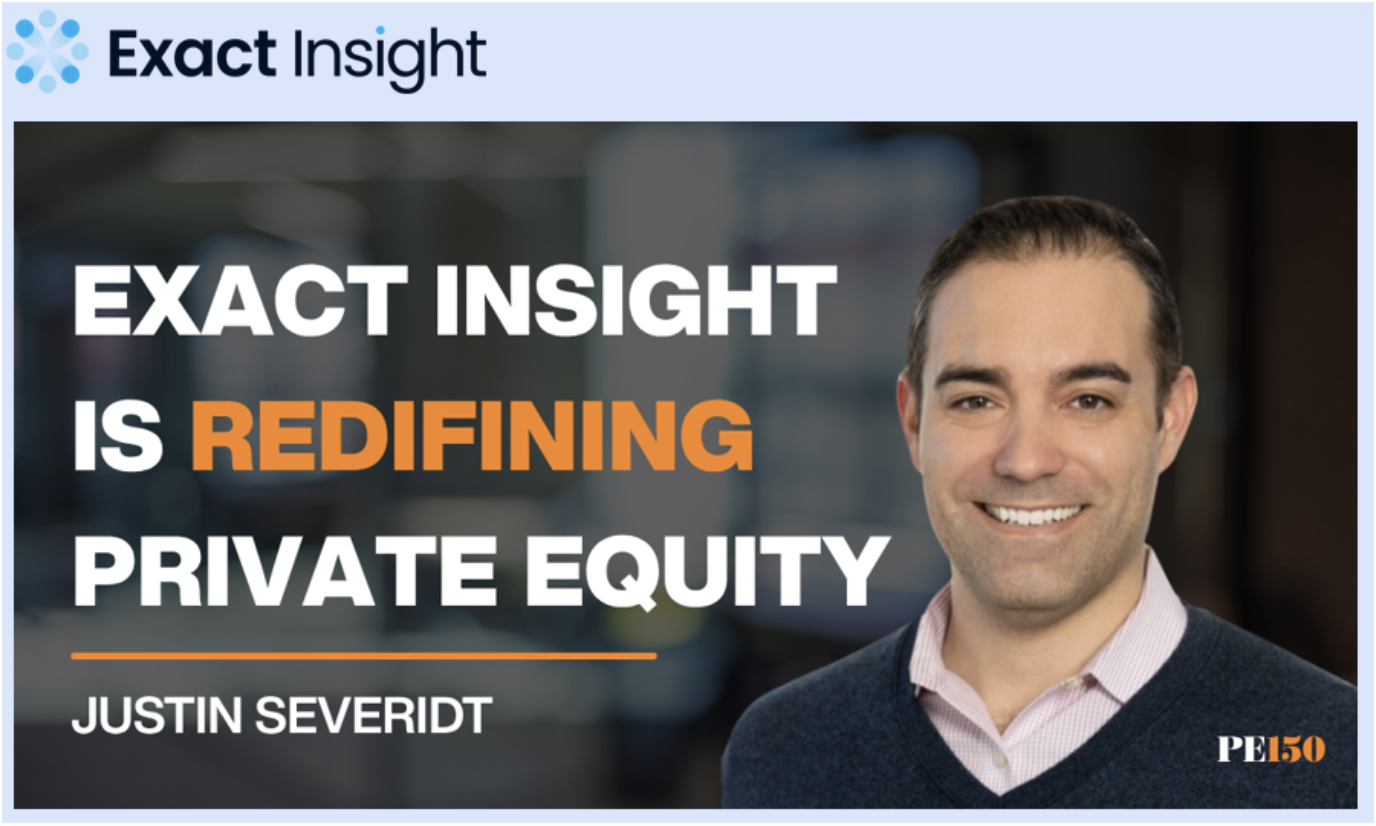
Our partners at PE150 & 150Diligence recently interviewed Justin Severidt, our Partner at Exact Insight, as part of our ongoing private equity diligence partnership focused on helping sponsors make faster, more defensible investment decisions.
One theme from the conversation stood out immediately: expert calls are still valuable, but modern diligence cannot stop there.
Justin discussed how many deal teams fall into the trap of hearing the same bullish narrative repeated across industry experts and mistaking consensus for validation. In competitive processes, that can become dangerous quickly.
At Exact Insight, the focus is on pairing expert perspectives with rapid quantitative validation through verified end user research. Expert interviews surface the narrative. Market data tests whether that narrative actually holds up at scale.
The distinction becomes especially important in healthcare, consumer, and other sectors where management teams and operators can unintentionally overestimate customer loyalty, pricing power, or retention durability.
As PE firms face longer hold periods and tighter underwriting conditions, diligence is increasingly shifting from information gathering toward assumption testing. The firms that validate fastest often gain the clearest edge.
Read the Full Article →
|
|
|
Reader Survey
IT Leaders & AI: 2026 State of Practice
We're surveying IT leaders on how AI is actually being adopted inside organizations in 2026 — what's working, what's stalled, and where teams are investing next. Take our 3-minute reader survey and help shape the upcoming report.
Take the Survey →
|
|
|
Deal Autopsy: Lessons from the Field
Toys "R" Us: When Leverage Prevents Adaptation
The 2005 leveraged buyout of Toys "R" Us by KKR, Bain Capital, and Vornado Realty Trust is a clear example of how excessive leverage can leave companies unable to adapt to structural industry change. The ~$6.6bn acquisition loaded the retailer with more than $5bn of debt, creating substantial interest obligations and reducing financial flexibility at a time when e-commerce competition was accelerating rapidly.
While the company remained operationally profitable for years, its debt burden became increasingly unsustainable as Amazon and other online retailers reshaped consumer behavior. According to MIT Sloan, the company's leadership failed to adequately prepare for the competitive threat posed by e-commerce and lacked the flexibility to reinvest sufficiently in pricing, logistics, stores, and digital capabilities.
The complexity of the company's capital structure further compounded the problem. After the 2008 financial crisis, debt renegotiations required alignment across multiple creditor groups with different seniority levels and incentives, making restructuring efforts difficult and slow. Ultimately, declining profitability combined with high leverage pushed the company into bankruptcy in 2017.
Key Diligence Gaps
- Underestimating the pace and impact of e-commerce disruption
- Excessive leverage relative to operational flexibility
- Insufficient focus on reinvestment requirements in a changing retail environment
- Complex debt structure that reduced restructuring optionality
Leverage can amplify returns, but it can also eliminate a company's ability to adapt. Businesses operating in industries exposed to technological or structural disruption require financial flexibility, not just operational strength.
Read More →
|
|
|
Pre-Deal Intelligence
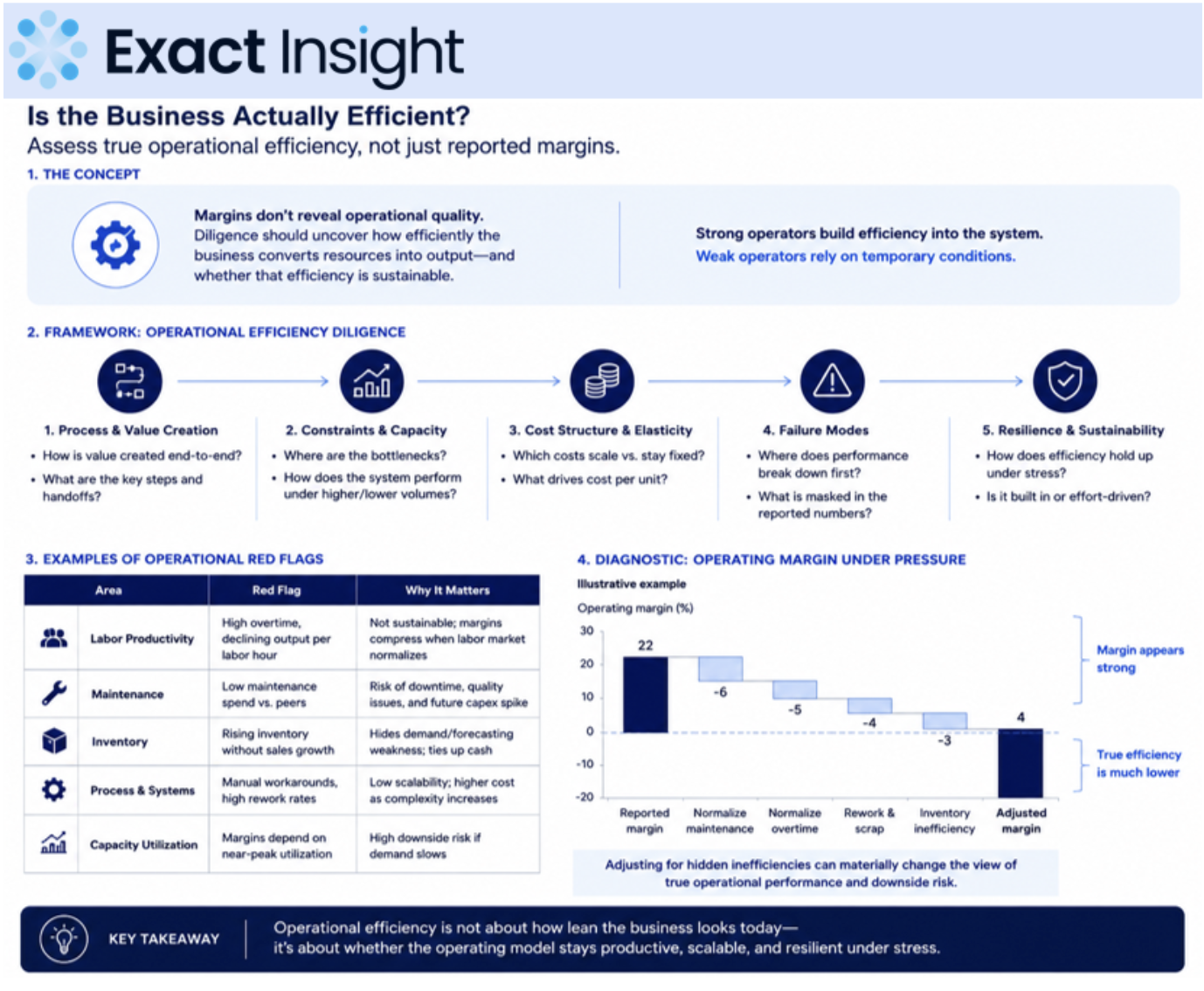
Is the Business Actually Efficient?
Strong margins do not always mean strong operations. Many companies appear profitable because of high utilization, temporary volume leverage, or deferred operational issues — not because the operating model is truly efficient.
Operational efficiency diligence focuses on how effectively the business converts labor, assets, and working capital into output — and whether that performance holds under stress.
The key question is simple: Is efficiency structural, or just temporary?
Areas that typically reveal hidden weakness include:
- Declining productivity masked by growth
- Excess inventory and poor forecasting
- Manual processes limiting scalability
- High fixed-cost absorption
- Margin sensitivity to lower utilization
The most resilient businesses maintain productivity and margins even when volumes slow or complexity increases.
Key Insight
Operational efficiency is not about looking lean today — it is about whether the operating model remains scalable, productive, and resilient across cycles.
|
|
|
Interesting Articles
Worth a Read This Week
|
|
Want to weigh in on the next survey?
Exact Insight is built from operator signal — and the next cut is already in motion. If you're a C-suite leader, director, or senior practitioner and want to contribute (and get early access to the findings), join our next survey.
Sign Up to Participate →
|
|
|