|
Operator Signal · Before the IC Memo
Why Some Margins Are Expanding While Others Collapse
Performance is no longer cyclical — it is structural. This week's signal: where dispersion is widening, and what separates the resilient from the exposed.
|
|
Opening Words
Operator Signal. Before the Investment Committee.
This week's signal points to a market where performance is no longer cyclical — it is structural. The familiar narrative of broad-based pressure is giving way to a more nuanced reality: outcomes are increasingly determined by business model design, not just market conditions. In this environment, surface-level stability can obscure meaningful divergence underneath.
Insights from our network and recent analysis highlight three focal points: a growing margin divide in healthcare, where proximity to care delivery dictates resilience; a reminder from past deal failures that unchecked macro assumptions can undermine even the most ambitious capital structures; and a critical diligence lens on pricing formation, where understanding who truly sets the price can redefine an entire investment thesis.
The takeaway: treat margins as model-driven, not market-driven; anchor underwriting in downside resilience, not base-case optimism; and view pricing power as a function of control, not assumption. In a market where dispersion is increasing and hidden dependencies matter more, clarity — not consensus — drives conviction.
Exact Insight surfaces these patterns early — directly from operator conversations — before they show up in CIMs or IC memos.
Access the Full Briefing →
|
|
Insights From the Network
Margin Divergence Is Defining the Market
In partnership with Healthcare150, our latest survey highlights a critical shift: margin pressure in healthcare is no longer a sector-wide story — it is increasingly determined by business model.
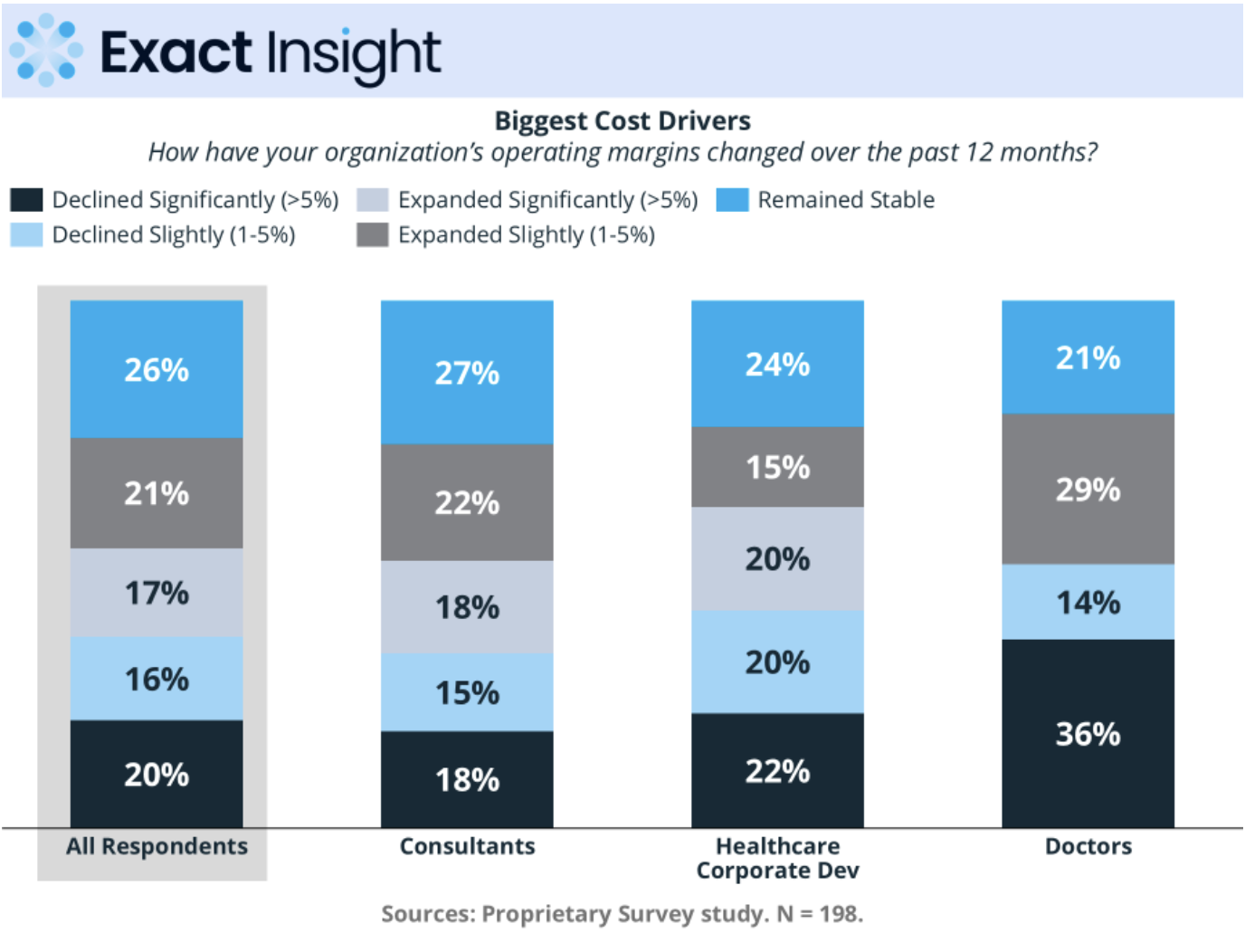
At a headline level, the market appears balanced. 38% of respondents report margin expansion, while 36% report contraction and 26% remain stable. But this surface-level symmetry masks a much sharper divide beneath.
The real differentiation emerges by role. Physicians are under the most strain, with half reporting margin decline and over a third experiencing significant deterioration. This reflects structural pressures — labor inflation, staffing shortages, and reimbursement lag — that are hardest to offset at the point of care. For investors, this raises a key implication: revenue growth in provider-heavy models does not necessarily translate into earnings strength.
At the other end, consultants show the strongest resilience, with 40% reporting margin expansion. Their advantage lies in pricing flexibility and lower fixed-cost exposure, enabling faster adaptation to inflationary pressures. Corporate development leaders sit in between, balancing scale benefits with ongoing exposure to cost and reimbursement dynamics.
The takeaway is clear: margin performance is diverging based on proximity to care delivery. Organizations that can flex pricing, optimize cost structures, and adapt operating models quickly are pulling ahead — while labor-intensive models face sustained pressure.
Read the Full Article →
|
|
Deal Autopsy: Lessons from the Field
Energy Future Holdings (TXU): A Due Diligence Failure in Commodity Risk
The 2007 leveraged buyout of Energy Future Holdings by KKR and TPG illustrates a classic diligence breakdown. The ~$45bn deal was based on the assumption that natural gas prices would remain high, supporting electricity prices and stable cash flows. However, diligence failed to adequately stress-test downside scenarios or anticipate the U.S. shale gas boom, which drove gas and power prices sharply lower.
With more than $40bn of debt, the company's capital structure left minimal room for error. As revenues declined, it became unable to service its obligations and filed for bankruptcy in 2014.
Key diligence gaps: overreliance on a single macro variable (natural gas prices); insufficient downside scenario analysis; excessive leverage relative to earnings volatility.
Key lesson learned: investment theses must be resilient to adverse scenarios; leverage amplifies not just returns, but errors in diligence.
Read More →
|
|
Pre-Deal Intelligence
Who Really Sets the Price?
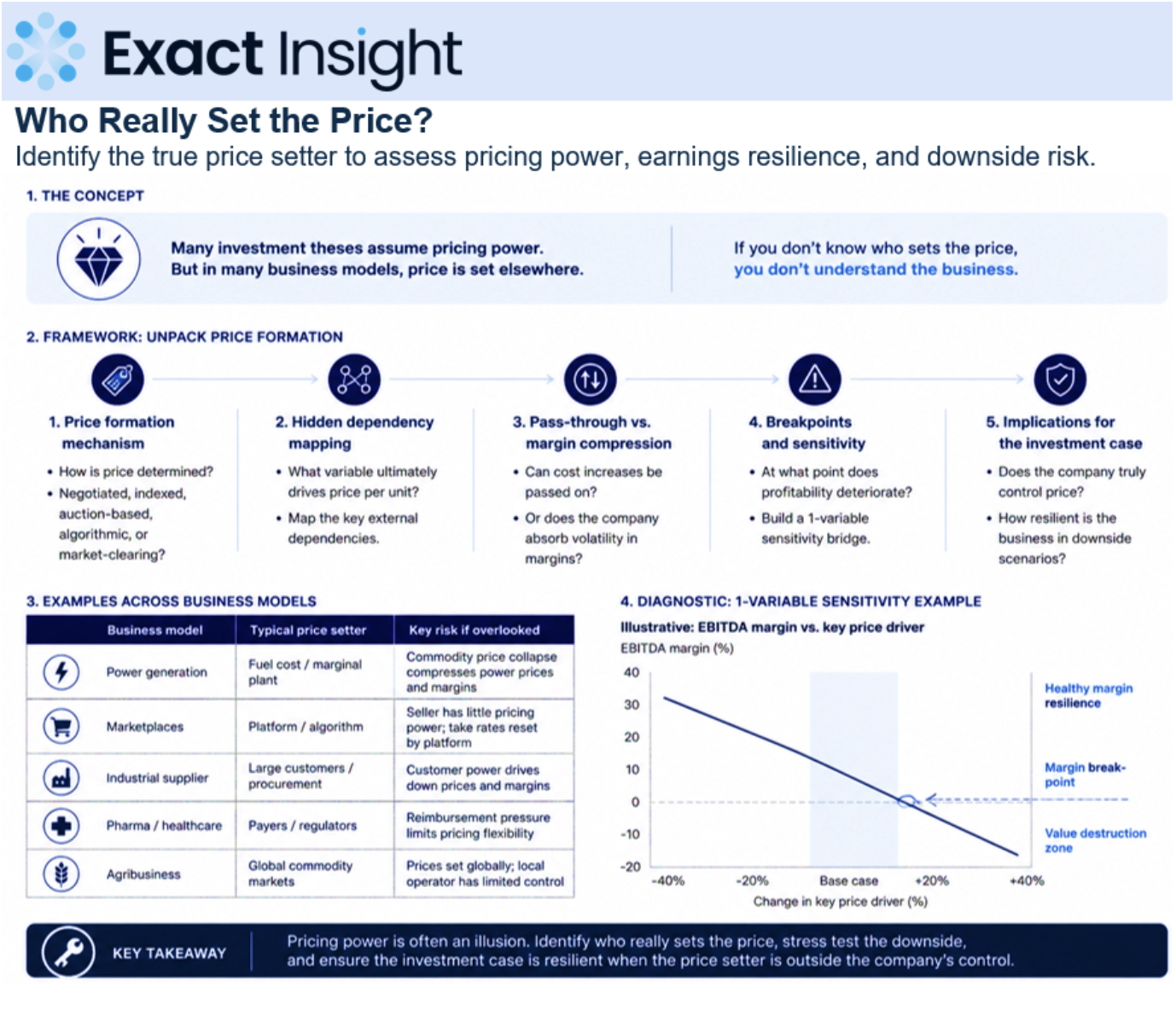
A frequently overlooked but highly revealing diligence angle is identifying who actually sets the price in a given business model. Many investment theses implicitly assume that the target company has some degree of pricing power, yet in reality, pricing is often determined externally — by input costs, dominant customers, platforms, or market-clearing dynamics. Missing this point can fundamentally distort revenue and margin expectations.
In rigorous diligence, the focus should shift from nominal pricing to price formation mechanisms. Is pricing negotiated bilaterally, indexed to a commodity, driven by auctions, or controlled by an algorithm? For example, in several infrastructure and energy markets, prices are not set by producers but by the marginal cost of the last unit supplied, often linked to a single volatile input. Similarly, in platform businesses, pricing may be effectively dictated by the platform's rules rather than the supplier.
Another critical layer is mapping hidden dependencies. The key question is not just "what drives revenue," but "what variable ultimately determines price per unit?" This helps distinguish between businesses with true pricing power and those exposed to margin compression when conditions shift.
A structured way to operationalize this is through sensitivity analysis — linking EBITDA to the primary price driver and identifying breakpoints where profitability deteriorates.
For a deeper discussion of pricing power and its strategic implications, see Competitive Strategy.
Key insight: if pricing is set externally, the investment case hinges less on execution and more on factors outside the company's control.
|
|
Interesting Articles
Worth a Read This Week
|
Want to weigh in on the next survey?
Exact Insight is built from operator signal — and the next cut is already in motion. If you're a C-suite leader, director, or senior practitioner and want to contribute (and get early access to the findings), join our next survey.
Sign Up to Participate →
|
|
|