|
OPERATOR SIGNAL
|
|
BEFORE THE INVESTMENT COMMITTEE
|
Buy. Build. Protect.
This week, Operator Signal examines a PE150 survey on the friction behind add-on acquisitions, a diligence test for a platform's integration capacity, and TreeHouse Foods' reminder that integration activity can distract from selling.
|
|
Hi there,
Across all three topics, the message is consistent: closing another acquisition does not prove the platform can absorb it. The investment case needs evidence that processes, systems, and customer coverage can withstand the next integration wave.
Underwrite the capacity to integrate, not just the appetite to acquire.
Exact Insight helps investors test the commercial facts before the deal closes. Learn more: https://www.exactinsight.ai/
Exact Insight surfaces these patterns early, directly from operator conversations, before they show up in CIMs or IC memos.
Access the full briefing or request expert calls in this sector to go deeper.
|
|
|
|
INSIGHTS FROM THE NETWORK
The Integration Bottleneck Is in the Operating Model
In the survey we conducted in partner with PE150, 82 respondents identified the biggest integration challenge in add-on acquisitions. Operational process integration led at 39%, followed by systems and technology integration at 34% and management bandwidth at 27%.
The responses put workflows and technology ahead of executive capacity. That does not make management bandwidth unimportant. It suggests that adding people is not a substitute for deciding how the combined business will take orders, serve customers, and produce reliable operating information.
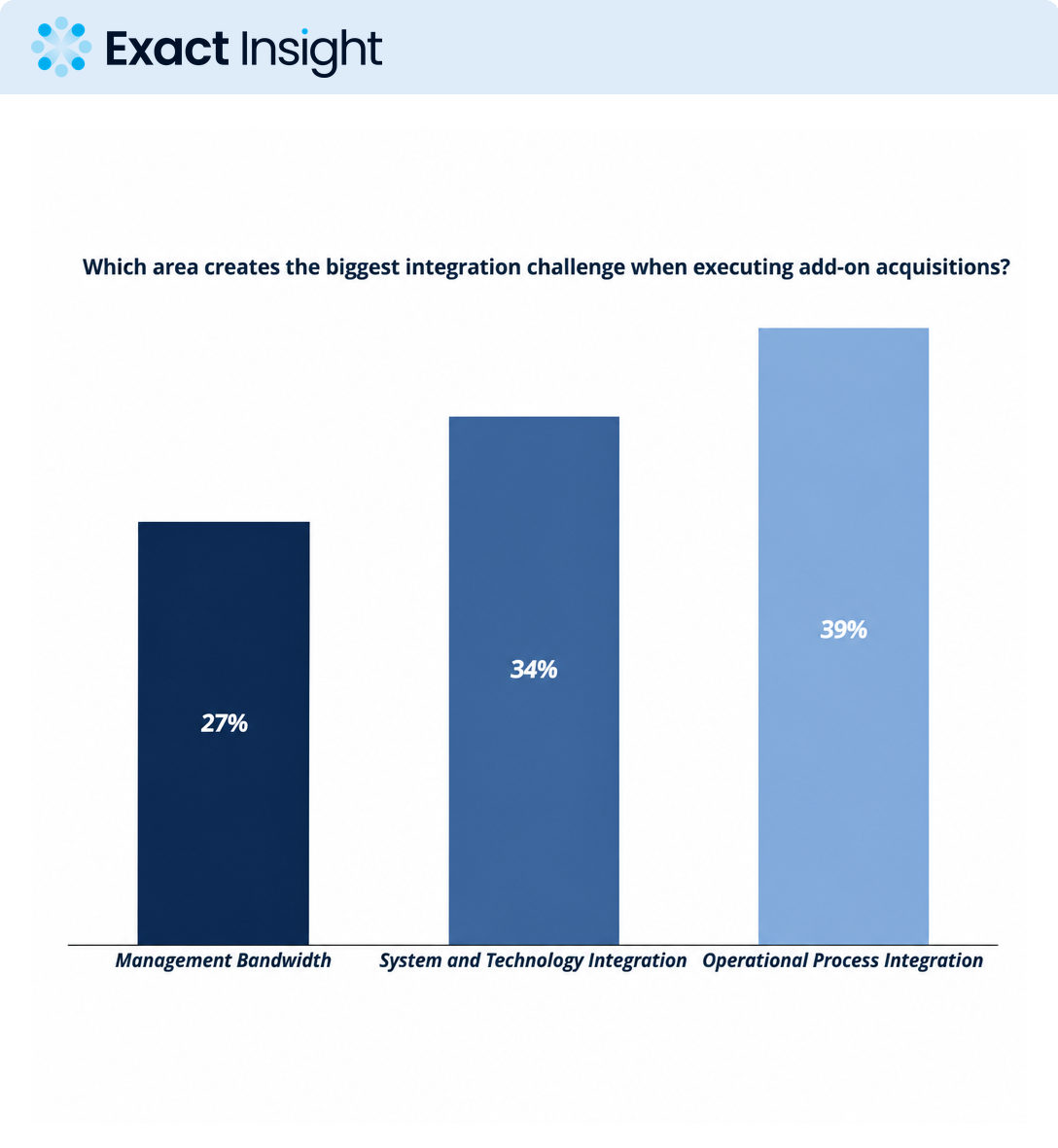
For buyers, the useful follow-up is specific: which process failed to standardize in the last acquisition, what workaround remains, and what happens if another business is added before it is resolved? A platform that cannot answer those questions may be accumulating complexity faster than capability.
|
|
|
|
PRE-DEAL INTELLIGENCE
What Has to Be True Before the Next Add-On Can Close?
Treat integration capacity as a release condition, not a promise in the synergy model. Before underwriting the next acquisition, test four operating dependencies. Process proof: trace one customer order through fulfillment, billing, and collections across the last acquired business; identify every manual handoff still required. System proof: reconcile one operating metric between local systems and the platform dashboard, then establish which decision depends on the reconciliation. People proof: name the owner and protected capacity for each critical integration workstream without borrowing the same hours already committed to running the business. Commercial proof: assign someone outside the integration workstream to monitor customer coverage, order conversion, and service performance through each cutover.
These are gates, not four equally weighted checklist items. A clean dashboard cannot compensate for an unreliable order process. Extra project staff cannot replace an unassigned customer relationship. Ask management to sequence the dependencies and identify the point at which the next acquisition would compete for the same constrained resources.
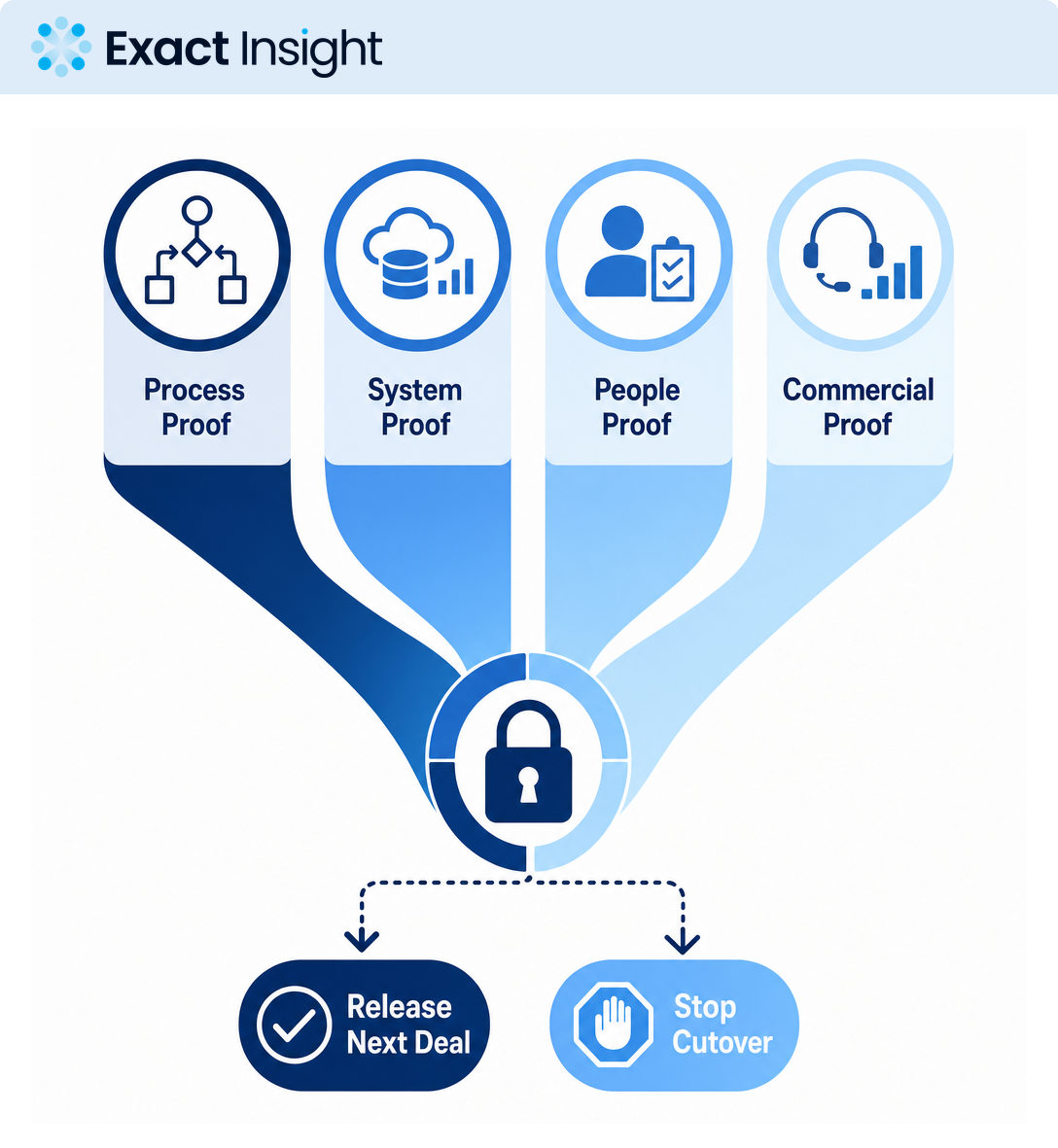
Translate the answers into the investment case: specify which unresolved dependency could delay the next acquisition, which synergy must remain outside the base case until demonstrated, and who can stop a cutover if customer service deteriorates. The acquisition timetable should follow proven absorption capacity, rather than assume integration will catch up after closing.
|
|
|
|
LESSONS FROM THE FIELD
TreeHouse: Integration Progress Is Not Commercial Continuity
TreeHouse Foods acquired ConAgra's private brands business in February 2016 for $2.7 billion in cash plus transaction expenses. Later that year, it reported third-quarter adjusted diluted earnings per share of $0.70, compared with $0.86 a year earlier. Management linked Private Brands' weaker-than-expected sales to attention devoted to plant consolidation, workforce stabilization, and reducing reliance on transition services, and announced a new go-to-market sales structure. This was a transformative acquisition, not a small bolt-on, but the operating tension is relevant to acquisition-led platforms.
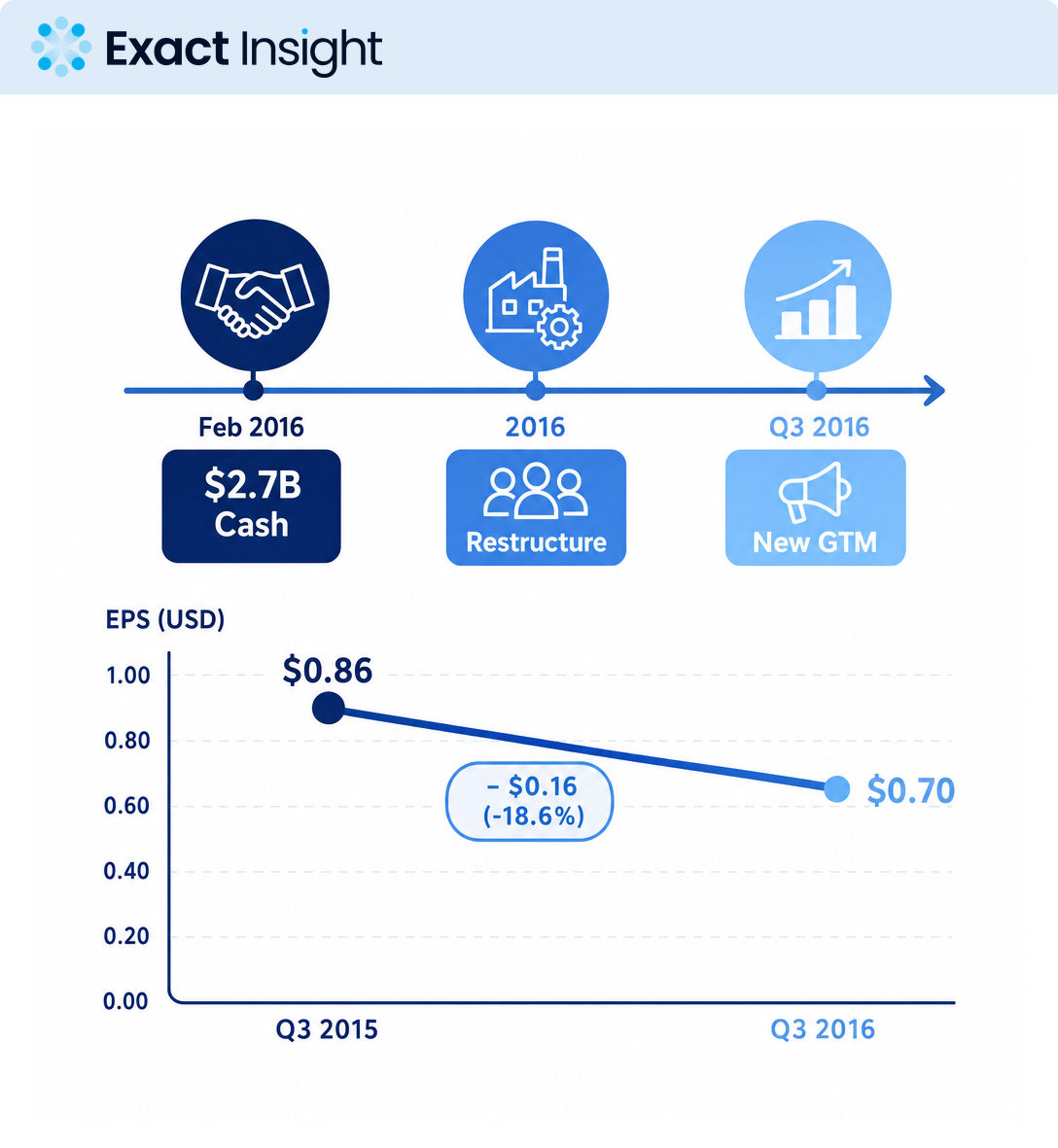
The diligence lesson is direct: separate responsibility for integration delivery from responsibility for protecting the commercial engine. Before close, identify who owns customer coverage and sales execution while operational teams manage the transition. Completing a plant conversion or exiting a transition service is not sufficient evidence of success if the business loses focus on winning and fulfilling orders. Integration was management's explanation for the sales weakness, not proof that it alone caused the earnings decline.
|
|
|
|
INTERESTING ARTICLES
Worth Your Time
PwC: 2026 M&A Integration Survey
L.E.K.: Rapid Integration Deployment: Realizing M&A Potential
Grant Thornton: Accelerating M&A value through outsourcing and AI
|
|
Operator Signal · by Exact Insight
Exact Insight · 170 Mason Street, Greenwich, Connecticut 06830, United States
You're receiving this because you subscribed to Operator Signal.
|
|